

30 Best Hotel Revenue Management Software for 2026

10 Best Hotel Revenue Management Software Shortlist


Hotel revenue management software solves the problem of setting optimal room rates and maximizing occupancy across seasons, which frees up your team to focus on enhancing guest experiences and boosting long-term loyalty. Managing fluctuating demand and market shifts can be challenging, but the proper inventory tools improve forecast accuracy and increase profitability.
In this article, I compare and review the best hotel revenue management tools to support your buying decision.
Table of Contents
- Best Hotel Revenue Management Software Shortlist
- What is Hotel Revenue Management Software?
- Best Hotel Revenue Management Software Summary
- Best Hotel Revenue Management Software Reviews
- When to Use Hotel Revenue Management Software
- Other Hotel Revenue Management Software
- Related Reviews
- What are the Benefits of Using Hotel Revenue Management Software?
- How Much Does Hotel Revenue Management Software Cost?
- What Are the Key Features to Look for When Buying Revenue Management Software?
Best Hotel Revenue Management Software Summary
| Tool | Best For | Trial Info | Price | ||
|---|---|---|---|---|---|
| 1 | Best for automatic rate optimization | Free demo available | Pricing upon request | Website | |
| 2 | Best for PMS-connected revenue decisions | Free demo available | Pricing upon request | Website | |
| 3 | Best for extensive integrations | Free demo available | From $10/room/month (min. of $100/month) | Website | |
| 4 | Best for independent hotel operations | Free demo available | Pricing upon request | Website | |
| 5 | Best for property management functionality | Not available | Pricing upon request | Website | |
| 6 | Best for dynamic pricing optimization | Free demo available | Pricing upon request | Website | |
| 7 | Best for small hotel management | 30-day free trial | From $179/month | Website | |
| 8 | Best for intuitive user interface | Not available | From $30/user/month (billed annually) | Website | |
| 9 | Best for flexible pricing configurations | Not available | From $599/month, plus 0.9% of revenue on overages | Website | |
| 10 | Best for advanced analytics | Not available | Pricing upon request | Website |
-

roommaster
Visit WebsiteThis is an aggregated rating for this tool including ratings from Crozdesk users and ratings from other sites.4.3 -
Little Hotelier
Visit WebsiteThis is an aggregated rating for this tool including ratings from Crozdesk users and ratings from other sites.4 -
Roomstay Hotel Booking Engine
Visit Website


Best Hotel Revenue Management Software Reviews


roommaster is a comprehensive property management system designed specifically for hotels. It provides a range of tools to help you manage day-to-day hotel operations, from front desk tasks to guest services. Whether you're running a small boutique hotel or a large property, roommaster is built to support your team with managing reservations, guest check-ins, and billing.
Why I Picked roommaster: It offers built-in revenue optimization tools that automatically adjust room rates based on demand, helping you maximize occupancy and income.
With its rate management tools, you can quickly implement yield management strategies by setting up rules that control room pricing depending on factors like occupancy rates or seasonal changes. The system also provides detailed reporting that helps you track financial performance.
Standout features & integrations:
Features include its direct booking engine lets you accept reservations through your website, reducing reliance on third-party channels. The built-in housekeeping management feature makes it easy to assign tasks to staff, track room status, and ensure timely room turnovers. The mobile app allows your team to manage guest check-ins, check-outs, and housekeeping duties on the go.
Integrations include AdriaScan, Amadeus, H&L, Sage, Triptease, Windcave, Airbnb, Booking.com, Expedia, QuickBooks, Alpharooms, Bookeasy, and Hotwire.
Pros and Cons
Pros:
- Prevents overbooking through channel management
- Easy integration with OTAs and direct website booking
- Includes tools for revenue optimization and dynamic pricing
Cons:
- Limited customization options for some features
- Initial setup can be time-consuming
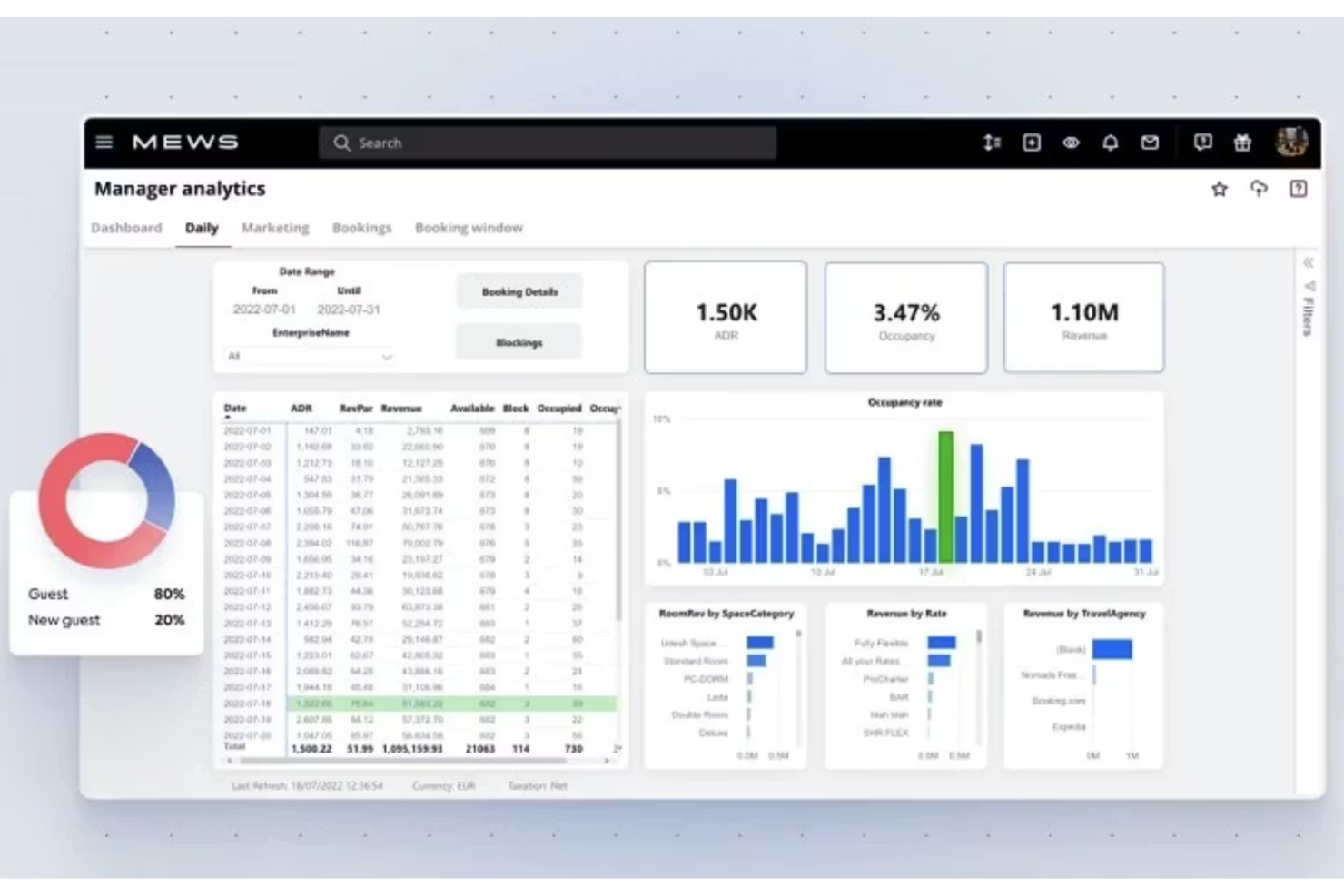
Running your hotel on Mews gives you a connected environment where pricing, forecasting, and guest activity feed into one system that helps you make smarter revenue decisions. It’s built for properties that want real-time visibility into demand signals while reducing the manual work that normally slows down revenue teams.
Why I Picked Mews
I picked Mews because its platform brings revenue management closer to where your reservations, operations, and payments already live, so your team can react to market shifts without juggling disconnected systems. You get AI-powered forecasting and automated price recommendations through Atomize, Mews’ integrated RMS, which adjusts rates in real time based on demand and competitor movements. I also like that you can apply pricing rules, restrictions, and group-rate logic directly inside the system to maintain strategy control.
Mews Key Features
In addition to its pricing automation and forecasting tools, Mews offers:
- Bookable services by the hour: Let you price meeting rooms, parking, co-working spaces, and other services to diversify revenue.
- Multi-property rate controls: Allow you to push bulk rate changes and compare performance across your entire portfolio.
- Integrated upselling engine: Surfaces relevant add-ons during booking and check-in to increase ancillary revenue.
- Analytics and Reporting: Mews offers comprehensive analytics and reporting tools to help you gain insights into your property's performance and make data-driven decisions.
Mews Integrations
Integrations include Booking.com, Expedia, SiteMinder, Amadeus iHotelier, SALTO KS, 24SevenOffice, Adyen, Lightspeed, Mailchimp, and Stripe, and an open API is available for custom integrations.
Pros and Cons
Pros:
- Hourly and monthly booking options expand revenue streams.
- Forecasting tools highlight future demand shifts early.
- AI price automation adjusts rates throughout the day.
Cons:
- Historical data imports from old PMS systems may require support.
- Advanced forecasting may overwhelm smaller properties.


WebRezPro is a cloud-based property management system that enables hoteliers to manage their operations online, including reservations, accounting, and front- and back-office procedures. Its capability for extensive integrations sets it apart, making it ideal for those who value interconnected systems for improved workflow.
Why I Picked WebRezPro: I chose WebRezPro for its comprehensive suite of features and its impressive ability to integrate with a vast range of third-party systems.
Its capability for extensive integrations effectively creates a centralized hub for hotel operations, making it ideal for those who appreciate an integrated approach to hotel management.
Standout features & integrations:
Features include an integrated web reservation engine, a commission-free booking engine, and guest relationship management.
Integrations include over 100 systems, including OTAs, POS systems, payment gateways, and electronic locks.
Pros and Cons
Pros:
- Has a commission-free booking engine
- Offers extensive integration capabilities
- Provides a comprehensive suite of features
Cons:
- Pricing is on the higher end for smaller establishments
- May require time to understand all features
- Interface can seem outdated


innRoad is a cloud-based hotel management software specifically designed to fulfill the needs of independent hotels. By providing a fully integrated, end-to-end solution, it empowers hoteliers to reduce operational burdens and focus more on providing exceptional guest experiences.
Why I Picked innRoad: I selected innRoad for its commitment to simplifying operations for independent hoteliers. It's a complete, all-in-one solution, providing everything from reservation management to revenue management, making it stand out as an excellent choice for independent hotels.
Its ability to streamline various operations justifies it being the best choice for independent hotel operations.
Standout features & integrations:
Features include a robust set of features including an intuitive reservation management system, guest communication tools, and detailed reporting for revenue optimization.
Integrations include a wide range of distribution channels, payment processors, and third-party booking platforms, facilitating broader reach and streamlined workflows.
Pros and Cons
Pros:
- Broad range of integration options
- Designed specifically for independent hotel operations
- Offers a comprehensive, all-in-one solution
Cons:
- Requires minimum five seats, making it less suitable for very small operations
- Higher pricing, particularly for smaller establishments
- The interface could be more modern


Guesty is a comprehensive property management platform designed to handle the complex operations of property management companies. By incorporating an extensive set of tools for managing, marketing, and analyzing rental properties, it's particularly useful for those seeking powerful property management functionality.
Why I Picked Guesty: I chose Guesty due to its broad range of property management features, which cater to the complexities of managing multiple properties. Its comprehensive solution makes it distinct in the market, providing capabilities from task automation to guest communication.
These aspects are why I find it best for companies seeking top-notch property management functionality.
Standout features & integrations:
Features include a unified inbox for guest communication, multi-calendar to manage multiple properties, and robust automation tools.
Integrations include leading online travel agencies, payment processing services, and operation tools, making it a versatile platform for managing rental properties.
Pros and Cons
Pros:
- Provides integrations with leading travel agencies and operation tools
- Includes a unified inbox for improved communication
- Offers extensive property management functionality
Cons:
- Limited customization options in certain areas
- May have a steeper learning curve due to its wide range of features
- Pricing can be high for smaller businesses


Intelligence Node is a sophisticated eCommerce analytics platform that excels in providing pricing and market insights. It is designed to enhance brand visibility and competitiveness in the digital marketplace, making it a valuable tool for various industries.
Why I Picked Intelligence Node: I chose Intelligence Node as a good fit for hotel revenue management because of its dynamic pricing optimization feature. This feature allows you to adjust room rates in real-time based on market demand, which is crucial for maximizing revenue in the hospitality industry. Additionally, Intelligence Node's competitor price monitoring can give you an edge by keeping you informed about pricing trends, helping you make data-driven decisions.
Another reason for my choice is the platform's digital shelf analytics. This feature provides insights into how your hotel is positioned in the market, allowing you to optimize your offerings and improve your market share. These insights can be critical in tailoring your services to meet customer expectations and enhance your hotel's profitability.
Standout Features & Integrations
Features include share of search analysis, which helps you understand your hotel's online visibility compared to competitors. The platform also offers assortment management, ensuring that your room offerings are aligned with market demand. Lastly, its content optimization feature allows you to enhance your hotel's online listings, making them more appealing to potential guests.
No integrations are listed on the official website.
Pros and Cons
Pros:
- Tracks competitor pricing to ensure competitive pricing strategies.
- Utilizes advanced AI analytics for digital shelf insights, pricing optimization, and MAP monitoring.
- Ensures a consistent product content experience across listings by auditing and implementing content corrections.
Cons:
- May be expensive for small businesses.
- Learning curve for advanced features.


Little Hotelier is a property management system specifically designed for small hotels, bed and breakfasts, inns, hostels, vacation rentals, and other small lodging establishments. It offers a suite of tools specifically tailored to the needs and resources of smaller operations, which is why it earns the title of best for small hotel management.
Why I Picked Little Hotelier: I picked Little Hotelier because its features and pricing structure are uniquely fitted to small-scale establishments. It's a powerful tool that helps small hotels compete in the market without requiring resources akin to larger chains. Therefore, I found it to be the best fit for small hotel management.
Standout features & integrations:
Features include front desk management, reservations management, and a robust online booking system.
Integrations include leading OTAs and GDSs, helping small hotels maximize their reach without heavy investment in separate marketing tools.
Pros and Cons
Pros:
- Includes a robust online booking system
- Provides integration with leading OTAs and GDSs
- Tailored to the needs and resources of small hotels
Cons:
- Annual billing cycle may not be suitable for all businesses
- Lacks some advanced features available in systems designed for larger hotels
- Pricing may be high for very small establishments


Preno is a hotel management software that aims to simplify the process of running accommodation businesses. Its intuitive user interface makes it easy for operators to manage bookings, room availability, rates, and reporting, aligning with its qualification as the best for an intuitive user interface.
Why I Picked Preno: I chose Preno due to its clear, user-friendly design that eases the typically complex task of hotel management. This element sets it apart from many other tools in the industry, reinforcing my belief that it's the best choice for those seeking an intuitive user interface.
Standout features & integrations:
Features include a host of useful features, including real-time availability and occupancy rate updates, customer relationship management (CRM), and reporting tools.
Integrations include major platforms such as Xero for accounting and Mailchimp for marketing, contributing to its overall utility.
Pros and Cons
Pros:
- Integrates well with major platforms such as Xero and Mailchimp
- Real-time updates for availability and rates
- User-friendly interface, easy for staff to understand and use
Cons:
- The annual billing might not be suitable for all businesses
- Limited customization options
- Higher cost compared to some competitors


Chargify, now known as Maxio, is a subscription billing and financial operations platform designed for B2B SaaS companies. Its main focus is on optimizing subscription and usage-based billing with features like customizable pricing, automated invoicing, and comprehensive reporting.
Why I Picked Chargify: I picked Chargify as a good fit for hotel revenue management because it offers flexible pricing configurations that can adapt to various market needs. You can manage subscription plans and automate billing processes, which is essential for handling the diverse pricing strategies required in hotel revenue management. With features like automated invoicing and customizable pricing, Chargify helps you focus on maximizing revenue without getting bogged down in manual processes.
Another reason is Chargify's ability to facilitate sales-negotiated contracts and self-service signups. This flexibility allows you to offer pre-payment options and adapt pricing strategies based on customer feedback, which is crucial for hotels looking to expand their market reach. The platform's usage-based pricing models, such as metered and tiered billing, allow you to tailor your services to fit customer demands more precisely.
Standout Features & Integrations
Features include automated dunning capabilities that help recover late payments, improving both revenue collection and customer retention. The platform also supports multiple payment methods, which makes it easier for you to cater to a diverse customer base. Additionally, Chargify provides customizable account statuses, allowing you to manage customer relationships more effectively.
Integrations include Salesforce, QuickBooks, HubSpot, Stripe, NetSuite, Shopify, PayPal, Microsoft Dynamics, SAP, Authorize.Net, Google Sheets, and Amazon S3.
Pros and Cons
Pros:
- Allows businesses to set variable pricing options to tailor customer experiences.
- The automated dunning feature efficiently handles missed payments.
- Platform offers great tools for automating customer messaging and collections.
Cons:
- Some frustration over the lack of comprehensive reporting features.
- Accessing transaction history can be cumbersome.


IDeaS Revenue Management Solutions offers robust, data-driven insights for the hospitality industry. The tool focuses on using advanced analytics to provide strategies for maximizing hotel revenue, which is why it excels in its category.
Why I Picked IDeaS Revenue Management Solutions: I selected IDeaS Revenue Management Solutions for its in-depth analytics capabilities. While many hotel management tools include some form of analytics, IDeaS stands apart with its advanced, proprietary analytics that drive revenue growth.
I determined it to be the best choice for those prioritizing sophisticated data insights in their hotel management process.
Standout features & integrations:
Features include advanced forecasting, pricing decisions, inventory controls, yield management, and automated decision intelligence. These tools work together to drive revenue optimization.
Integrations include several popular hotel property management systems (PMS), customer relationship management (CRM) systems, and business intelligence tools.
Pros and Cons
Pros:
- Robust features for revenue optimization
- Integrates with popular PMS, CRM, and BI tools
- In-depth, advanced analytics
Cons:
- Could be overkill for smaller or less complex operations
- May be overwhelming for those not accustomed to detailed data analysis
- Pricing is not transparent
When to Use Hotel Revenue Management Software
Hotel revenue management software takes the guesswork out of pricing by automatically analyzing demand, competitor rates, and market trends to set the right room rate at the right time. The result: more revenue per available room without piling more work onto your team. If any of the scenarios below sound familiar, it's probably time to add one to your stack:
- You're still setting rates manually every morning: Say you're pulling up OTA dashboards, checking a competitor's site, and updating rates in your PMS by hand each day. An RMS automates that entire process, freeing up hours and reacting to demand shifts faster than any manual workflow can.
- Your RevPAR is flat even when occupancy is strong: High occupancy with weak revenue usually means you're leaving money on the table during peak demand. An RMS applies dynamic pricing in real time, capturing higher rates when demand spikes instead of selling out too cheap.
- Managing pricing across multiple OTAs is becoming a full-time job: If you're juggling Booking.com, Expedia, and direct channels while trying to maintain rate parity, something always slips. An RMS syncs pricing across all channels automatically, keeping you consistent and competitive.
- Your team has no time for forecasting: Smaller properties especially feel this: there's no dedicated revenue manager, so pricing decisions default to gut feel or last year's numbers. An RMS handles demand forecasting automatically, so you're always working from current data.
- A major event is coming and you don't know how to price it: A conference or festival in your market can mean 3x the normal demand, but only if you react fast enough. An RMS detects the demand surge early and adjusts your rates before your competitors get there first.
Other Hotel Revenue Management Software
Below is a list of additional hotel revenue management software that I shortlisted, but did not make it to the top 10. Definitely worth checking them out.
- RoomPriceGenie
For real-time pricing optimization
- Duetto
For real-time pricing capabilities
- Revenue Analytics
For AI-driven pricing automation
- Beonprice
For AI-driven revenue optimization
- Hotellab
For strategic revenue planning
- Roomdex
For automated room upgrades
- RoomKeyPMS
For diverse property types
- Solonis
For data-driven insights
- Right Revenue
For adaptive pricing algorithms
- Kriya RevGEN
For demand forecasting
- Vena
For precise forecasting
- RateBoard
Good for scientifically calculated revenue management
- Cendyn
Good for maximizing guest value and hotel profitability
- Wiser
Good for competitive pricing intelligence
- Duve
Good for enhancing guest experience alongside revenue management
- OTA Insight
Good for optimizing pricing through market intelligence
- RevControl
Good for demand-driven dynamic pricing
- Retalon
Good for advanced predictive analytics in retail pricing
- Infor EzRMS
Good for large hotels and chains with complex revenue needs
- RateWise
Good for cloud-based revenue optimization


What is Hotel Revenue Management Software?
Hotel revenue management software is a tool that helps hotels set the right prices to maximize profit and occupancy. It’s used by hotel managers and revenue teams to tackle pricing, demand forecasting, and inventory control—especially during high and low seasons.
What Are The Benefits Of Using Hotel Revenue Management Software?
So, what are the benefits of using hotel revenue management software?
There are many benefits of using hotel revenue management software, including:
- Increased Revenue: One of the main benefits of using hotel revenue management software is that it can help with increasing revenue. Hotel revenue management software can help improve room rates and occupancy levels, leading to increased profits.
- Better Control of Rates: Hotel revenue management software gives hoteliers better control over rates, which can help to maximize profits.
- Improved Efficiency: Hotel revenue management software can help improve efficiency by automating rate changes and inventory management tasks. This can lead to reduced costs and improved profitability.
- Increased Customer Satisfaction: Hotel revenue management software can help to improve customer satisfaction by optimizing room types availability and rates. This can lead to increased bookings and higher customer satisfaction levels.
There are many other benefits of using hotel revenue management software, including improved marketing efforts, more accurate forecasting, and better decision-making.
How Much Does Hotel Revenue Management Software Cost?
So, how much does this valuable software usually cost? Hotel revenue management software can vary depending on the features included, but it's typically priced between $1,000 and $10,000 per year. However, many vendors offer a free trial or demo, so you can explore the software before purchasing.
When shopping for hotel revenue management software, be sure to ask about the following features:
- The ability to create custom spreadsheet and reports
- Automatic rate updates
- Sales and marketing analysis
- Group booking management
- Commission tracking
What Are The Key Features To Look For When Buying Revenue Management Software?
When purchasing revenue management software, it's important to consider the following key features:
- Integration: The software should connect easily with your hotel's booking and rate management systems.
- Real-time information: You need access to real-time occupancy and room rate data for quick, effective decision-making.
- Forecasting and modeling tools allow you to predict future sales trends and make informed pricing decisions.
- Allocation algorithms: These ensure your rooms are being sold most profitably.
- Group booking management: This feature is crucial if your hotel frequently caters to group bookings, as it helps manage their complex pricing structures.
- Channel management capabilities: This feature helps you manage your presence on multiple booking platforms and maintain price parity.
Choose software that includes all these features, and is also user-friendly and easy to navigate. Your specific needs may prioritize some features over others.
What Next?
Don't forget to browse around the site for more great hotel management tips, templates, and tools. Plus, join The Hotel GM newsletter for expert tidbits sent right to your inbox!