

Cloud-based hotel management software gives you a centralized system to run every part of your hotel—from bookings to billing—through any device with an internet connection. As a hotel manager, you need more than just room calendars and guest records.
You want mobile-friendly tools that help front desk, housekeeping, and revenue teams deliver the best guest experience while keeping an eye on profit. In this guide, I break down top cloud hotel management solutions that fit real-world hospitality operations, so you can pick the right one for 2026 and keep your property competitive, efficient, and guest-focused.
Why Trust Our Software Recommendations
6,700+
Reviews
20
Industry experts
16+
Evaluation factors
14
Years
Our team has been testing and reviewing software since 2012. As hospitality leaders ourselves, we know how difficult—and important—it is to choose the right software.
For this guide, we evaluated tools using hands-on testing and independent research, scoring tools using our selection criteria.
Our reviews reflect our human editorial judgment, not a sales pitch.
Compare the Best Cloud-Based Hotel Management Software
Compare pricing and specs, side by side, for the cloud-based hotel management software that made it onto my shortlist.
| Tool | Best For | Trial Info | Price | ||
|---|---|---|---|---|---|
| 1 | Best for independent hotels on 130+ OTA channels | Free demo available | Pricing upon request | Website | |
| 2 | Best for contactless check-in at any property scale | Free demo available | Pricing upon request | Website | |
| 3 | Best for channel-managed direct booking growth | Free demo available | From $236/month | Website | |
| 4 | Best for independents with 43-year hospitality depth | Free demo available | Pricing upon request | Website | |
| 5 | Best for all-in-one suite with native AI revenue tools | Free demo available | Pricing upon request | Website | |
| 6 | Best for multi-property portfolio management | Free demo available | Pricing upon request | Website | |
| 7 | Best for independent hotels scaling distribution | Free demo available | Pricing upon request | Website | |
| 8 | Best for independent hotels scaling across OTAs | Free demo available | Pricing upon request | Website | |
| 9 | Best for multi-property enterprise PMS scaling | Free demo available | Pricing upon request | Website | |
| 10 | Best for enterprise multi-property chains | Free demo available | Pricing upon request | Website |


Cloud-Based Hotel Management Software Reviews
Below are my detailed summaries of the best cloud-based hotel management software that made it onto my shortlist. My reviews offer a detailed look at the features, best use cases, and integrations of each software to help you find the best one for you.
 Best for independent hotels on 130+ OTA channels
- Free demo available
- Pricing upon request
Visit WebsiteCustomer Rating:4.6/5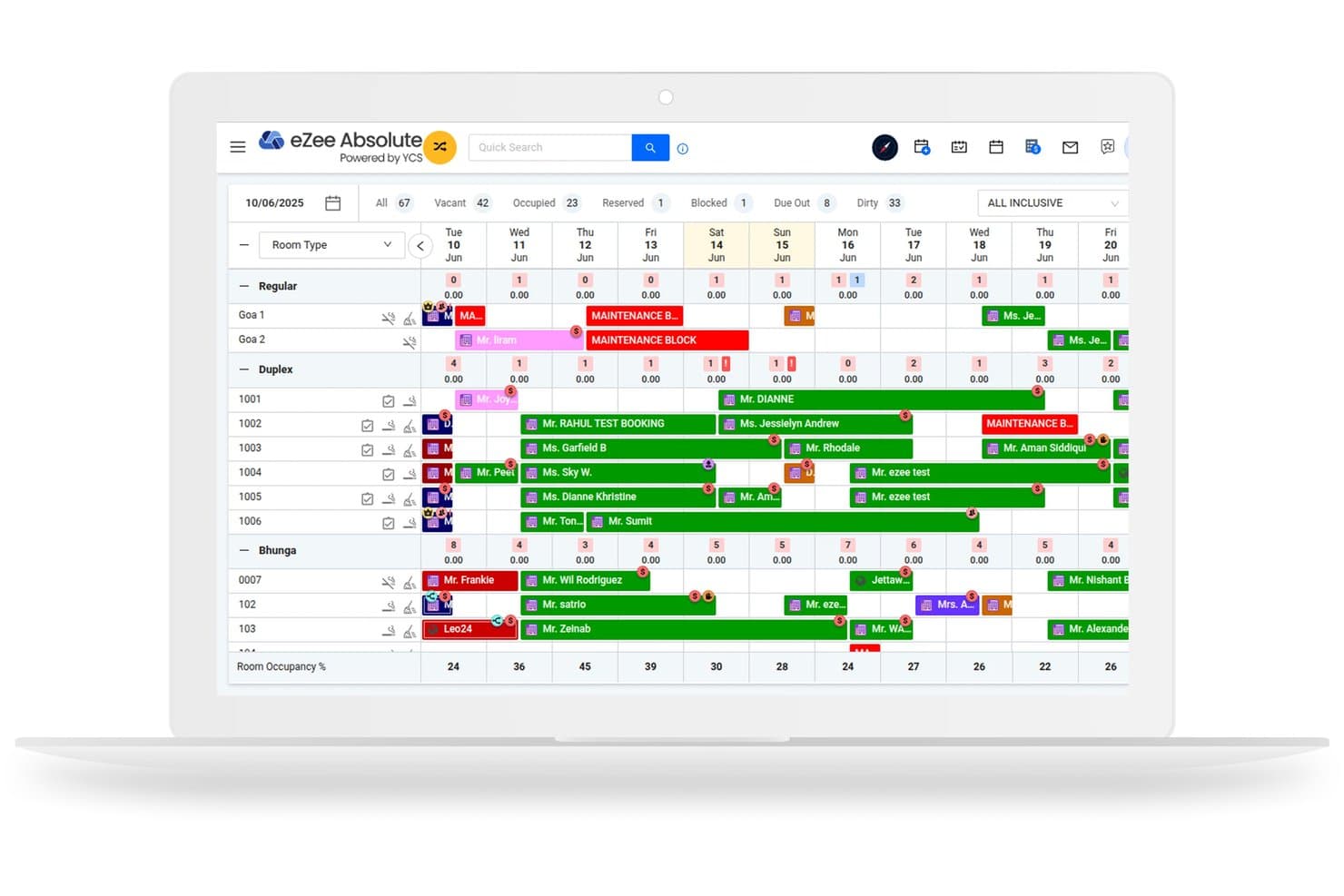
eZee Absolute's timeline view tracks room bookings and occupancy across dates. eZee Absolute is a cloud-based hotel management platform that bundles a PMS, channel manager, direct booking engine, and payment processing into a single subscription.
Who Is eZee Absolute Best For?
eZee Absolute is a strong fit for independent hoteliers who want a single subscription covering their PMS, channel manager, and booking engine without per-booking commissions.
Why I Picked eZee Absolute
I've included eZee Absolute in my top picks because its native channel manager, eZee Centrix, connects to 130+ OTAs, GDS platforms, and metasearch engines with two-way real-time sync, which is genuinely hard to match at this price point. I particularly like that the direct booking engine is bundled in commission-free, so every reservation through your own website costs nothing extra. The centralized OTA inbox pulls guest messages from all channels into one place, which keeps front desk teams from juggling multiple platform logins.
eZee Absolute Key Features
- Automated night audit: Runs daily transaction validation and revenue reconciliation automatically, generating a summary report without manual input.
- Self check-in/out kiosk: Guests can complete their own arrival and departure via tablet, mobile, or dedicated kiosk, reducing front desk queues.
- Drag-and-drop tape chart: Gives front desk staff a visual room allocation view with drag-and-drop controls for moving and adjusting reservations.
- Guest CRM with email segmentation: Stores guest history and preferences in centralized profiles and supports targeted email campaigns across defined guest segments.
eZee Absolute Integrations
eZee Absolute connects with 130+ channels, including Booking.com, Expedia, Airbnb, Agoda, Amadeus, Sabre, and Google Hotels, plus Xero, QuickBooks, ChargeAutomation, and RemoteLock. It also offers a marketplace and open API for custom integrations.
Pros and Cons
Pros:
- Channel manager syncs 130+ OTAs directly
- Supports contactless guest check-in and checkout
- Centralizes front desk, reservations, and housekeeping
Cons:
- Reporting interface can be confusing for teams
- Mobile app lacks full desktop feature set
Learn more about eZee Absolute: Best for contactless check-in at any property scale
- Free demo available
- Pricing upon request
Visit WebsiteCustomer Rating:4.4/5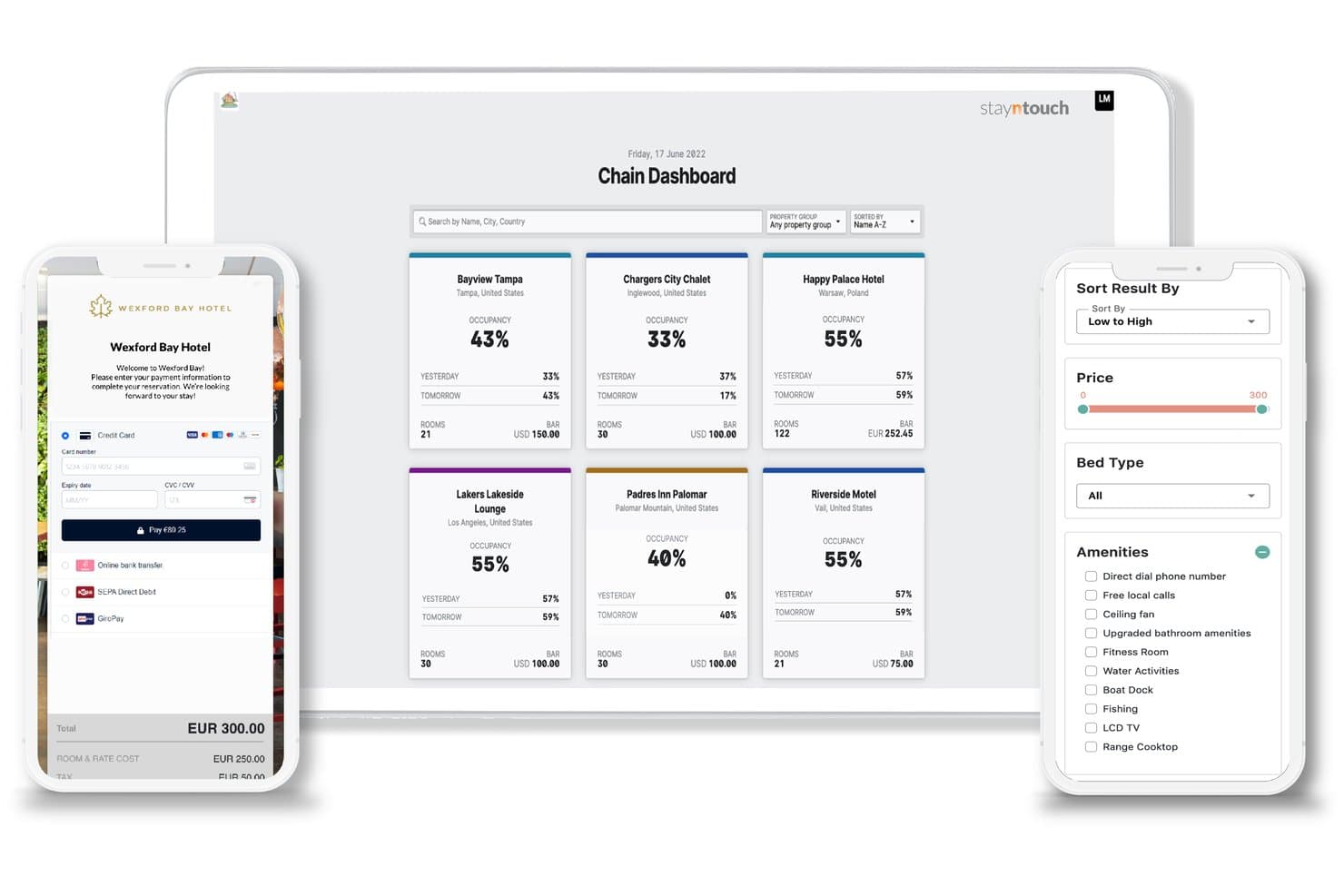
Stayntouch supports reservations, front desk, rates, housekeeping, and contactless check-in. Stayntouch is a cloud-native, mobile-first hotel property management system that covers reservations, front desk operations, rate and inventory management, housekeeping, channel distribution, and contactless guest check-in via kiosk or mobile device.
Who Is StayNTouch Best For?
StayNTouch is a strong fit for hotels and multi-property groups that want to replace legacy front desk hardware with a fully mobile, cloud-native PMS.
Why I Picked StayNTouch
StayNTouch earns its spot on my shortlist because the contactless check-in experience here is genuinely end-to-end, not bolted on. I love that the self-service kiosk handles full check-in in about 30 seconds, including automated room assignment and key pickup, with zero staff involvement. The mobile pre-arrival flow adds digital registration cards and upsell offers before guests even arrive at the property, so the front desk queue effectively disappears.
StayNTouch Key Features
- Native rate strategy module: Set occupancy-based pricing thresholds that automatically adjust room rates in real time without a separate revenue management system.
- Multi-property dashboard: Switch between chain-level, group-level, and individual property views with shared guest profiles and consolidated reporting across your portfolio.
- Stayntouch Pay: Process payments natively through the PMS with card tokenization, automated deposit charges, custom payment links, and integrated card terminals.
- AI-powered guest messaging: Manage SMS, WhatsApp, OTA, and web chat conversations from a centralized inbox, with AI handling routine guest requests and built-in upsell automation.
StayNTouch Integrations
StayNTouch offers 1,400+ integrations, including SiteMinder, IDeaS, Duetto, Toast POS, Breezeway, ASSA ABLOY, Amadeus, Sabre SynXis, and Microsoft Power BI. Its REST API, webhooks, OAuth security, and sandbox support custom integrations at no extra integration cost.
Pros and Cons
Pros:
- Multi-property dashboard for portfolio-wide control
- AI guest messaging covers SMS and WhatsApp
- End-to-end contactless check-in and checkout
Cons:
- Pricing is not published or transparent
- Reporting customization requires third-party BI tools
Learn more about StayNTouch: Best for channel-managed direct booking growth
- Free demo available
- From $236/month
Visit WebsiteCustomer Rating:4.1/5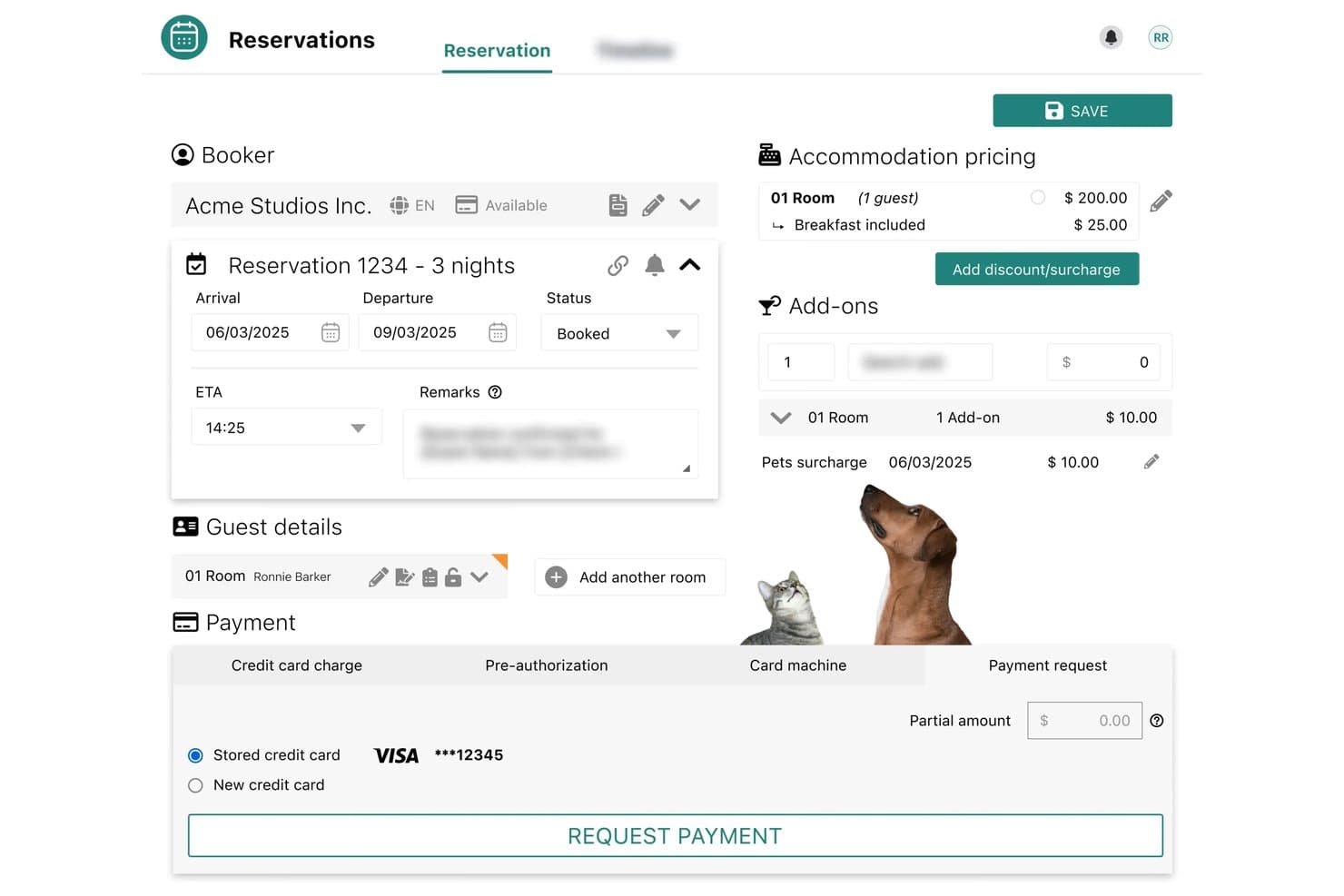
RoomRaccoon lets users manage bookings, pricing, and pet add-ons in one view. RoomRaccoon is a cloud-native hotel management system that brings together a PMS, channel manager, booking engine, payment processing, revenue management, and housekeeping tools in one platform built specifically for independent and boutique hotels.
Who Is RoomRaccoon Best For?
RoomRaccoon is a strong fit for independent and boutique hotel operators who want to grow direct bookings alongside OTA distribution without managing multiple disconnected tools.
Why I Picked RoomRaccoon
RoomRaccoon earns its spot on my shortlist because of how tightly its booking engine and channel manager work together to grow direct revenue without sacrificing OTA reach. I love that the booking engine is commission-free and embedded directly on your hotel website, while the native channel manager syncs rates and availability across 200+ OTAs in about 5 seconds. RaccoonRev Plus layers AI-driven pricing on top, adjusting rates based on competitor data, booking pace, and local events.
RoomRaccoon Key Features
- RaccoonID scanner: Automatically reads guest passports and IDs to populate digital registration cards at check-in, cutting manual data entry at the front desk.
- RaccoonUpsell: Sends automated pre-arrival and in-stay offers for room upgrades, late check-outs, and ancillary add-ons based on reservation triggers.
- Contactless check-in and check-out: Lets guests complete the arrival and departure process via tablet, kiosk, or mobile device without front desk involvement.
- Integrated payment processing: Handles deposit collection, card tokenization, pre-authorizations, VCC automation for OTA bookings, and payment reminders natively within the PMS.
RoomRaccoon Integrations
RoomRaccoon offers 300+ certified partner integrations, including Booking.com, Expedia, Airbnb, Vrbo, Google Hotel Ads, Lightspeed, Stripe, Adyen, QuickBooks, and Mailchimp. Its open REST API supports custom integrations.
Pros and Cons
Pros:
- Contactless workflows streamline guest arrival and departure
- AI-driven pricing analyzes events and weather data
- Five-second OTA sync minimizes overbooking risk
Cons:
- No offline mode for server outages
- Payment and deposit reporting frequently criticized
Learn more about RoomRaccoon: Best for independents with 43-year hospitality depth
- Free demo available
- Pricing upon request
Visit WebsiteCustomer Rating:3.9/5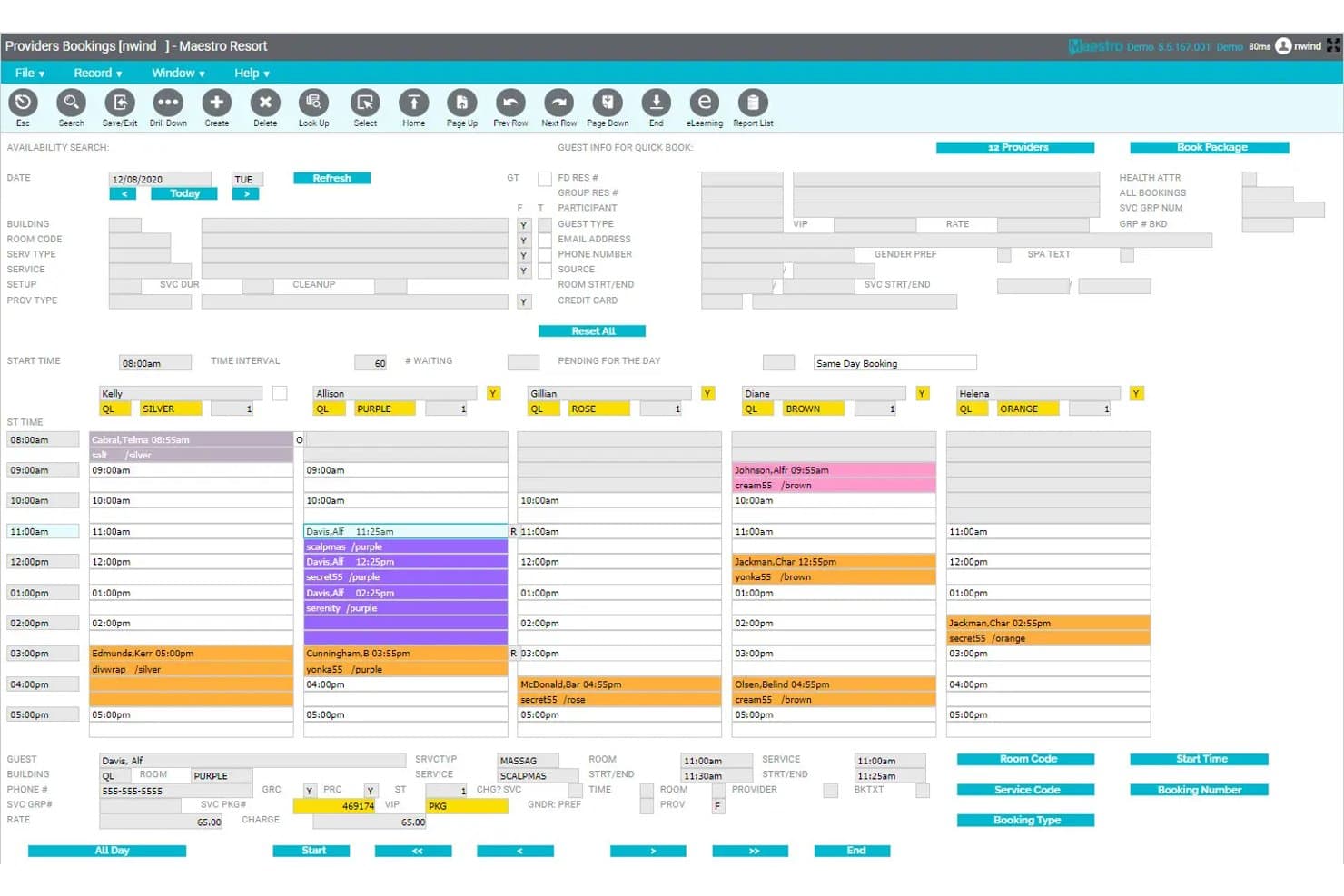
Maestro PMS manages reservations, front desk, housekeeping, rates, and guest communications. Maestro PMS is a cloud-capable hotel management platform built for independent properties and multi-property groups, covering front desk operations, reservations, housekeeping, yield management, channel distribution, and guest communications across 20+ integrated modules.
Who Is Maestro PMS Best For?
Maestro PMS is a strong fit for independent hotels, resorts, and multi-property groups that need a full-featured platform with the depth to handle complex operations across multiple departments.
Why I Picked Maestro PMS
Maestro PMS earns its spot on my shortlist because 43 years of exclusive focus on independent hotels and resorts has produced a depth that newer cloud-native platforms simply haven't had time to build. I especially like the built-in Yield Management module, which automatically pushes rate changes across every connected channel in real time without requiring a separate revenue management system. The single-image database also lets multi-property teams manage consolidated guest profiles and cross-property rates from one place.
Maestro PMS Key Features
- MezzoPay embedded payments: Process credit card transactions directly inside the PMS with EMV-ready terminals, tokenization, and automatic folio reconciliation.
- GuestXMS two-way messaging: Send and receive SMS and digital messages with guests across pre-arrival, in-stay, and post-stay touchpoints from within the platform.
- Contactless check-in and checkout: Support mobile check-in, digital registration cards, mobile key issuance, and QR-based e-folio checkout without front desk interaction.
- 20+ integrated modules on a single database: Manage spa, activities, food and beverage, sales and catering, condo, club membership, and housekeeping from one unified system.
Maestro PMS Integrations
Maestro PMS supports 800+ partner integrations, including SiteMinder, Expedia QuickConnect, Booking.com, SynXis, LodgIQ AI, PurpleCloud Technologies, RoomChecking, Zaplox, and Shift4. It also offers open REST APIs and HTNG/OTA connectivity for custom integrations.
Pros and Cons
Pros:
- Tablet-based front desk for mobile operations
- Automated yield management for real-time rate changes
- Centralized guest profiles across multiple properties
Cons:
- Custom reports require additional module licensing
- Interface feels dated compared to competitors
Learn more about Maestro PMS: Best for all-in-one suite with native AI revenue tools
- Free demo available
- Pricing upon request
Visit WebsiteCustomer Rating:4.5/5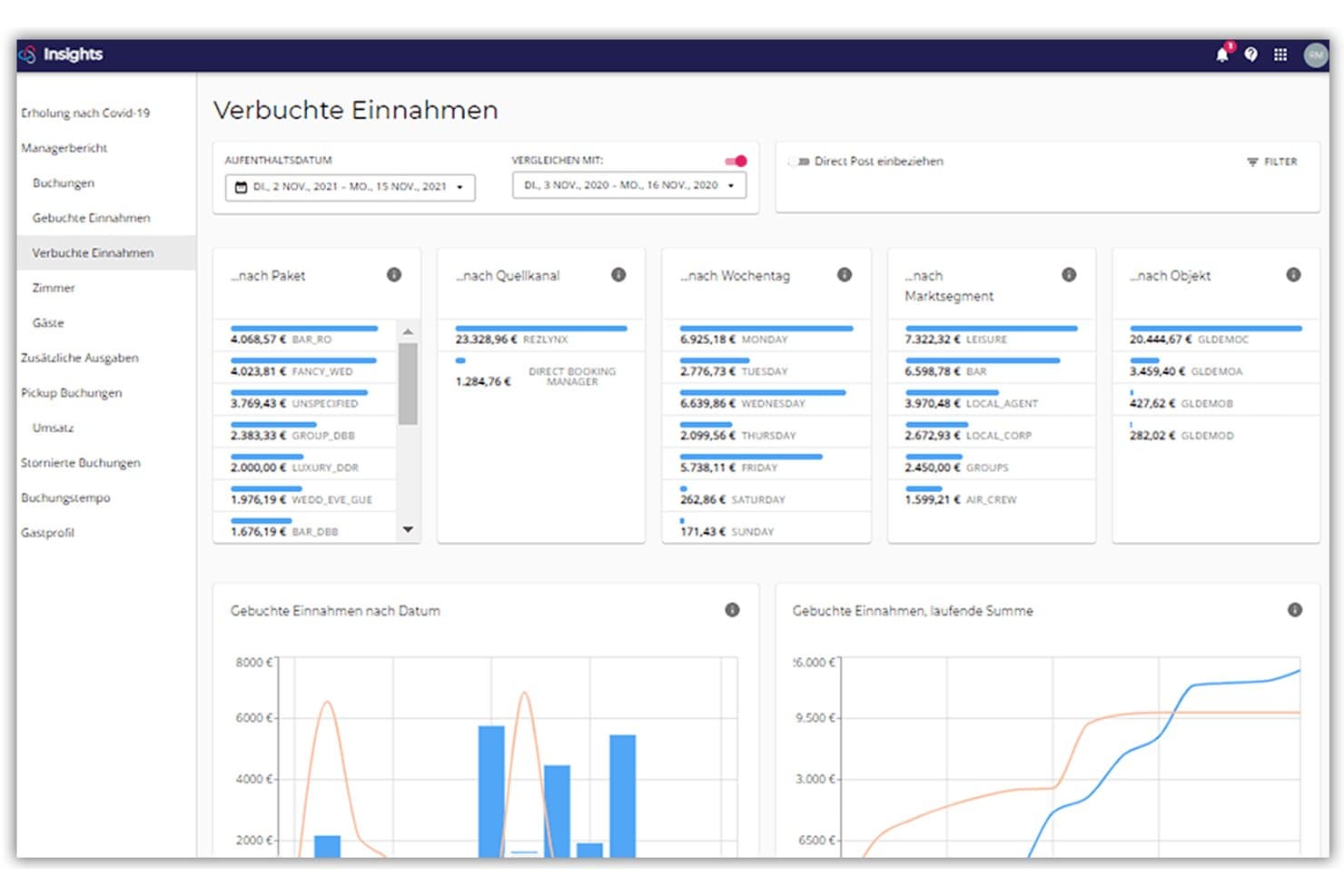
Guestline tracks booked revenue by package, channel, and weekday. Guestline is a cloud-based hotel management platform that brings together a property management system, channel manager, booking engine, revenue management, payments, housekeeping, and guest engagement tools in one integrated suite.
Who Is Guestline Best For?
Guestline is a strong fit for independent hotels and growing hotel groups in the UK and Europe that want a single platform covering property management, distribution, revenue management, and payments without stitching together separate vendors.
Why I Picked Guestline
Guestline earns its spot on my shortlist because it's one of the few hotel management platforms with a native AI revenue management system built directly into the suite rather than bolted on as an afterthought. The Evo Copilot lets you query occupancy trends, RevPAR, and segment revenue in plain language, while the built-in RMS automatically adjusts rates based on competitor pricing and demand signals. I also like that the Distribution Hub syncs those updated rates across 400+ OTA channels in real time, so your pricing stays consistent without manual updates.
Guestline Key Features
- GuestStay kiosk check-in: Self-service kiosks let guests check in, capture registration details, and check out autonomously, 24 hours a day.
- Native hotel EPoS integration: F&B charges post directly to room folios from the point-of-sale system, linking dining and event spend to guest accounts.
- GuestPay payments: PCI-compliant card processing built into the guest folio handles pre-authorization, tokenized card storage, automated deposits, and settlement.
- Multi-property consolidated reporting: The Guestline Insights module delivers real-time dashboards and automatable reports across all properties from a single view.
Guestline Integrations
Guestline offers 500+ marketplace integrations, including Booking.com, Expedia, Trip.com, Agoda, Google Hotel Ads, Duetto, IDeaS, Acteol, Adyen, and Aloha. It connects to 2,000+ distribution partners and provides an Open API for custom integrations.
Pros and Cons
Pros:
- Multi-property management with consolidated dashboards
- Fully integrated contactless guest check-in tools
- Native AI-driven revenue management module
Cons:
- Support quality has declined post-acquisition
- English-only interface restricts international usability
Learn more about Guestline: 6Best for multi-property portfolio management
RMS
- Free demo available
- Pricing upon request
Visit WebsiteCustomer Rating:4.4/5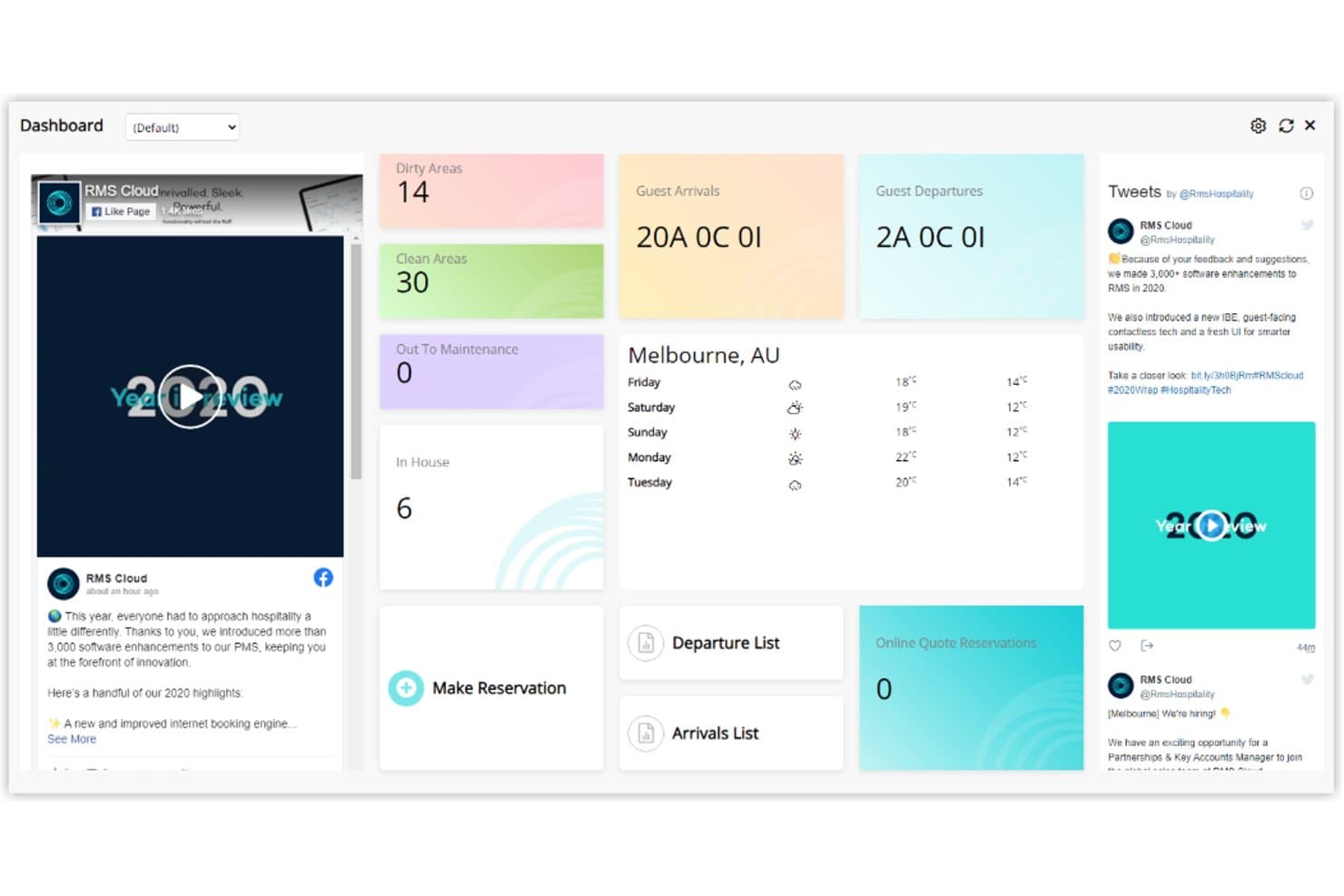
RMS centralizes hotel operations in a real-time cloud dashboard. RMS Cloud is a cloud-based hotel management platform with a native channel manager, multi-property enterprise architecture, reservations and front desk tools, housekeeping and maintenance modules, dynamic rate management, and a built-in booking engine.
Who Is RMS Best For?
RMS Cloud is a strong fit for hotel groups and multi-property operators who need to manage rates, reservations, and reporting across multiple sites from a single login.
Why I Picked RMS
RMS earns its spot on my shortlist because its enterprise multi-property architecture is genuinely rare: all properties share a single database, so your entire portfolio is visible from one login in real time. I especially like the MultiBAR rate management tool, which lets you adjust rates across every room type at every property in seconds. The native channel manager, included as standard, pushes those rate changes live across 100+ OTAs simultaneously without a third-party sync layer in between.
RMS Key Features
- Contactless guest journey: Guests can complete pre-arrival check-in, scan their ID, sign digital registration cards, and check out via a self-service portal without stopping at the front desk.
- RMS Pay: A native, PCI DSS v4.0.1-compliant payment gateway with tokenized card storage, pre-authorizations, Apple Pay support, and automated deposit collection built directly into the platform.
- Guest Rewards loyalty program: A built-in loyalty program that lets you configure custom points structures and promotions, with guest enrollment available across multiple booking channels.
- Sadie AI voice agent: An AI-powered agent that handles inbound guest calls and inquiries automatically, routing or resolving requests without requiring front desk staff intervention.
RMS Cloud Integrations
RMS Cloud’s marketplace lists 100+ technology partners, including Booking.com, Expedia, Airbnb, IDeaS, Duetto, OpenKey, Optii, QuickBooks, Xero, and TrustYou. Its 530+ endpoint REST API, webhooks, and developer sandbox support custom integrations.
Pros and Cons
Pros:
- Contactless guest journey features included
- Consolidated multi-property portfolio visibility
- Native channel manager with real-time two-way sync
Cons:
- Mobile app lacks modern features
- Initial setup and configuration is complex
Learn more about RMS: Best for independent hotels scaling distribution
- Free demo available
- Pricing upon request
Visit WebsiteCustomer Rating:4.3/5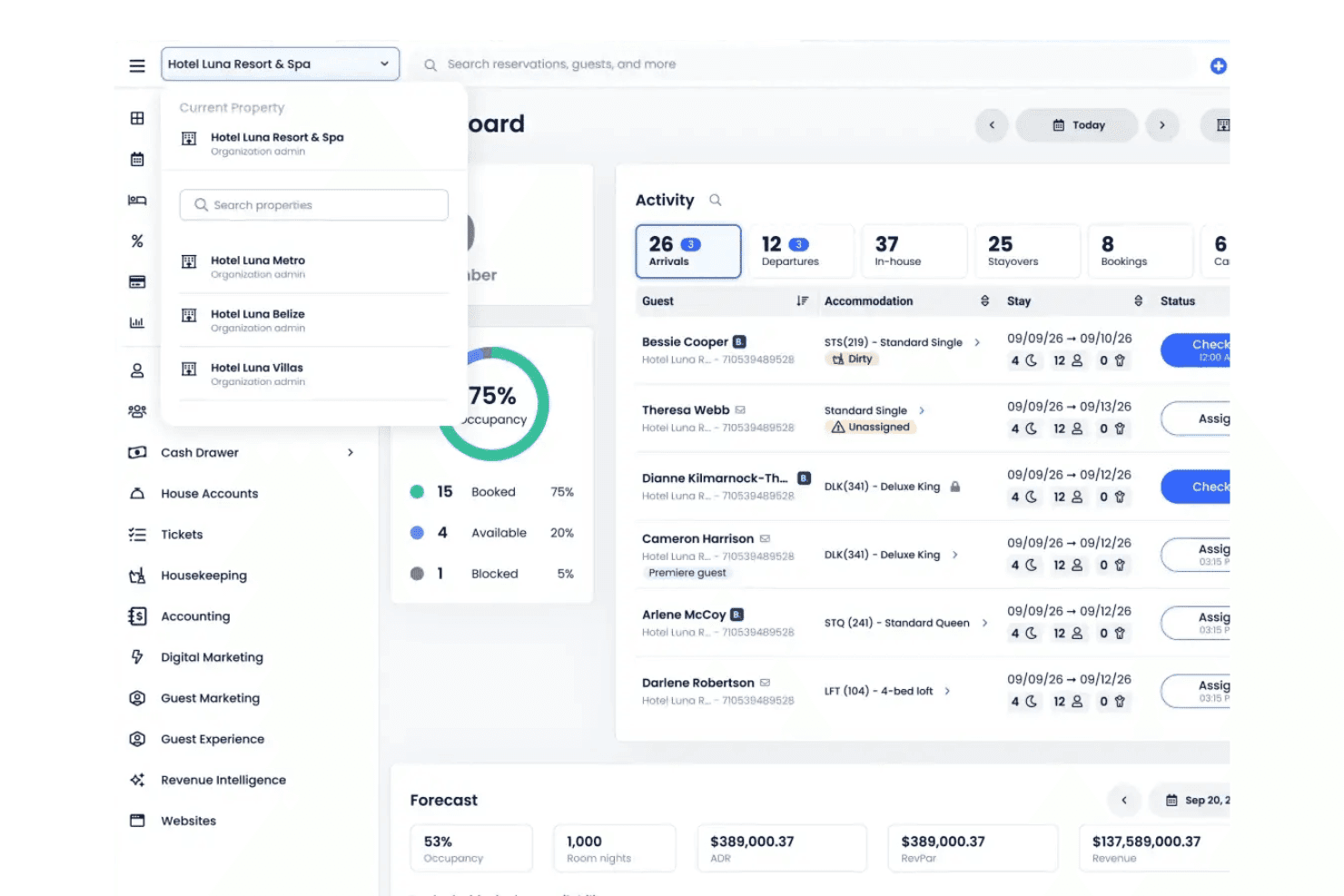
Cloudbeds combines PMS, bookings, payments, channels, and guest experience tools. Cloudbeds is a cloud-native hospitality management system that unifies your PMS, channel manager, booking engine, payments, and guest experience tools on a single shared data model.
Who Is Cloudbeds Best For?
Cloudbeds is a strong fit for independent hotels, boutique properties, and small-to-mid-size hotel groups that want to manage distribution across hundreds of OTA channels without relying on a separate channel manager.
Why I Picked Cloudbeds
I picked Cloudbeds as one of the best because its native channel manager connects to 300–450+ OTAs on a shared inventory pool, meaning rate and availability updates push across every channel in real time with no sync lag. I love that independent hotels get commission-free direct bookings alongside full OTA distribution, all from one login. The built-in Signals AI also generates 90-day demand forecasts and competitor rate comparisons, giving smaller properties revenue intelligence that previously required a dedicated revenue manager.
Cloudbeds Key Features
- Digital registration cards: Collect guest ID scans, signatures, and pre-arrival information digitally, synced directly to the reservation record.
- Unified guest inbox: Aggregate messages from email, SMS, WhatsApp, and OTA platforms like Booking.com, Expedia, and Airbnb into a single interface.
- Drag-and-drop reservation calendar: Manage room assignments, availability, and bookings across up to 4,000 rooms with support for 30+ concurrent users.
- Contactless checkout: Let guests check out via QR code through the self-service guest portal, triggering automated room turnover workflows.
Cloudbeds Integrations
Cloudbeds' native channel manager connects Booking.com, Expedia, Airbnb, Vrbo, Agoda, and Ctrip, while its marketplace offers 450+ partner integrations, including IDeaS, TrustYou, Pricepoint, Klaviyo, and Cendyn. A documented REST API supports custom integrations.
Pros and Cons
Pros:
- AI-driven revenue forecasting and dynamic pricing
- Contactless guest journey with digital registration
- Unified PMS, channel manager, and booking engine
Cons:
- Add-on features significantly increase costs
- No self-serve free trial offered
 Best for independent hotels scaling across OTAs
- Free demo available
- Pricing upon request
Visit WebsiteCustomer Rating:4.4/5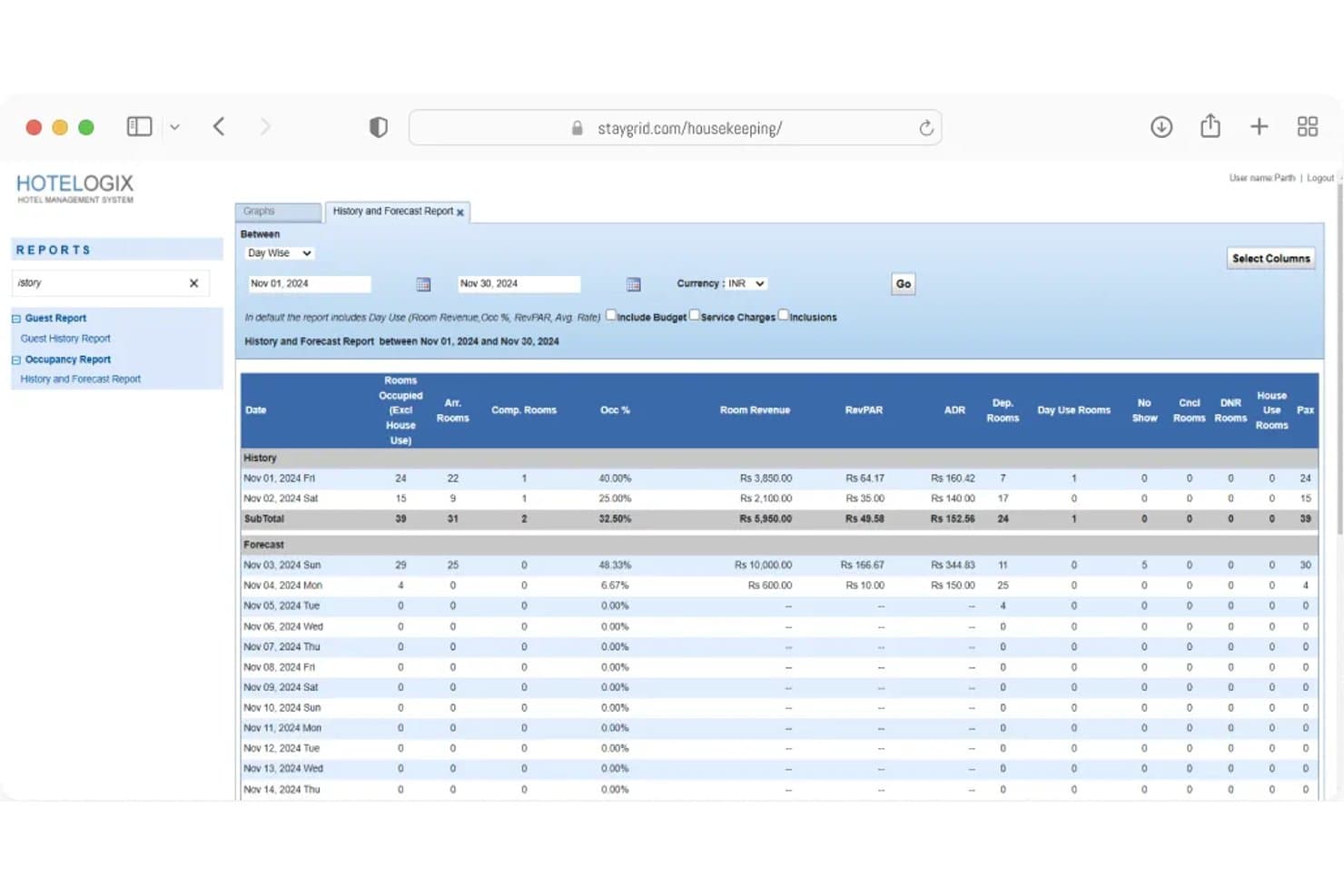
Hotelogix tracks room occupancy, revenue, and forecasts in one report. Hotelogix is a cloud-native hotel PMS that covers front desk operations, reservations, channel management across 50+ OTAs, housekeeping, rate management, and multi-property reporting in one platform.
Who Is Hotelogix Best For?
Hotelogix is a strong fit for independent hotel owners who want enterprise-level OTA distribution and revenue management tools without the price tag of a large PMS.
Why I Picked Hotelogix
I picked Hotelogix as one of the best because its native channel manager connects to 50+ OTAs with real-time two-way sync, which means independent hotels can compete across Booking.com, Expedia, Agoda, and dozens of regional platforms without managing inventory manually. I also like the built-in rate management tools, including dynamic pricing rules, MLOS restrictions, and flash sale configurations that push updates instantly across every connected channel. Add GDS access via RateGain UNO and Alesia (600,000+ travel agency terminals), and an independent property can punch well above its weight in distribution.
Hotelogix Key Features
- Contactless guest journey: Supports pre-arrival online check-in, digital registration cards, WhatsApp and SMS booking alerts, and QR-based checkout from a single connected workflow.
- 100+ exportable reports: Generates revenue, occupancy, housekeeping, night audit, and source-of-business reports in PDF, CSV, and Excel, with daily-to-yearly forecasting views.
- Hourly booking module: Lets your property sell rooms by the hour, capturing non-traditional booking segments that standard nightly rate configurations miss.
- Role-based access with MFA: Assigns staff permissions by department and enforces multi-factor authentication with user-activity audit logs across all logins.
Hotelogix Integrations
Hotelogix offers 100+ marketplace integrations, including SiteMinder, STAAH, RateGain UNO, Alesia, Lybra, Salesforce, Xero, QuickBooks, Restroworks, and Onity. Its open API supports custom connections.
Pros and Cons
Pros:
- Extensive multilingual, multi-currency PMS coverage
- Mobile key and contactless check-in support
- Real-time OTA channel sync and rate updates
Cons:
- Linen and inventory modules not built-in
- Reporting customization options are limited
Learn more about Hotelogix: Best for multi-property enterprise PMS scaling
- Free demo available
- Pricing upon request
Visit WebsiteCustomer Rating:4.6/5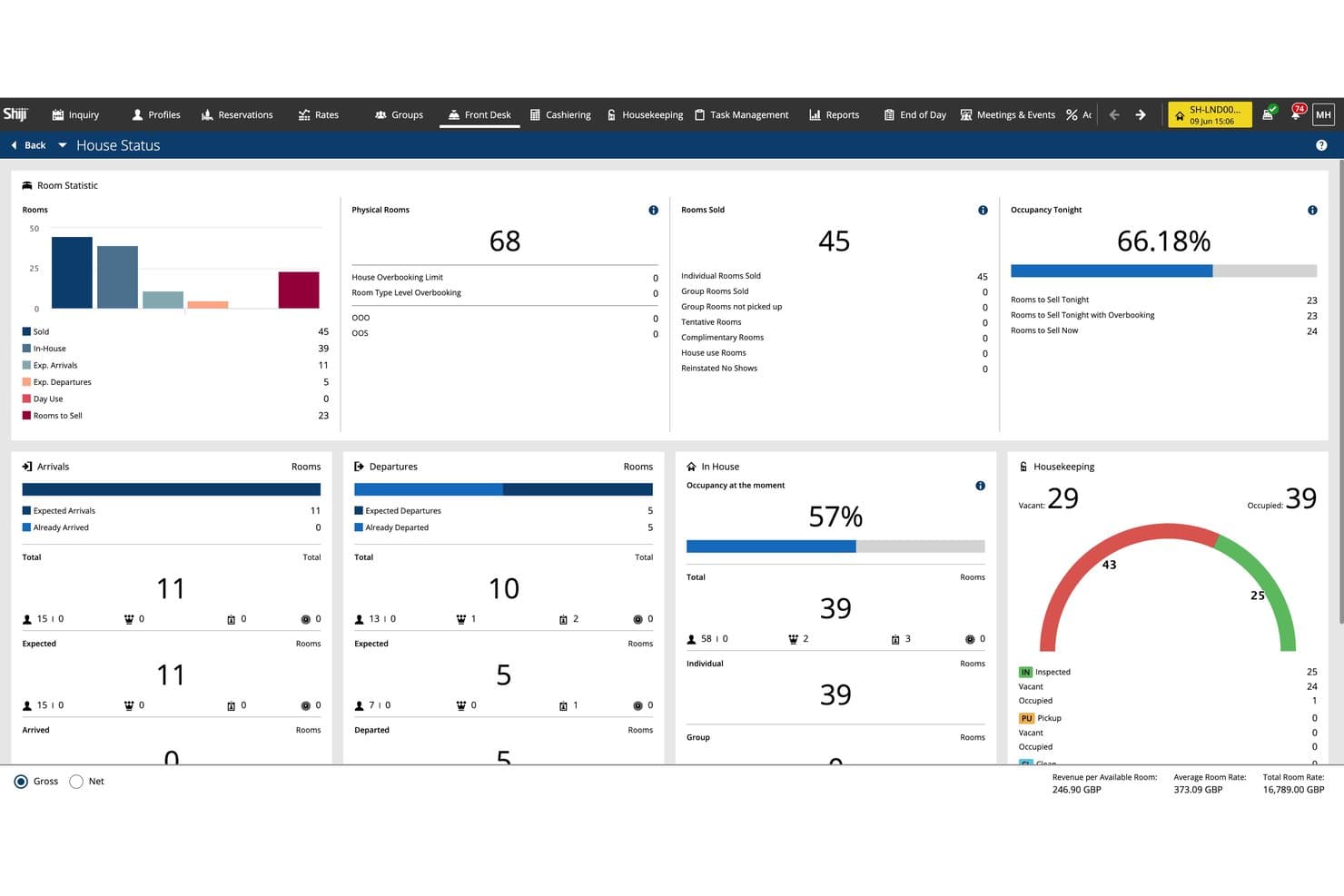
Daylight PMS (Shiji) displays real-time house status and occupancy metrics. Daylight PMS is a cloud-native hotel management platform from Shiji that covers reservations, front desk operations, rate and inventory management, housekeeping, integrated payments, and multi-property guest profile management from a single browser-based system.
Who Is Daylight PMS Best For?
Daylight PMS is built for hotel groups and multi-property operators that need centralized control over rates, inventory, guest profiles, and front desk operations across an entire portfolio.
Why I Picked Daylight PMS
Daylight PMS earns its spot on my shortlist because of how well it handles multi-property scale. I love that a single centralized dashboard lets revenue managers push rate, tax, and policy updates across an entire portfolio at once, with no property-by-property manual work. The Single Guest Profile with match-and-merge deduplication means a guest's preferences, stay history, and loyalty data follow them across every property they visit.
Daylight PMS Key Features
- Contactless kiosk check-in: Self-service lobby kiosks handle guest check-in, payment collection, and key encoding without front desk involvement.
- Astral Payments integration: A native embedded payment layer that handles tokenization, cross-border processing, and automated folio reconciliation directly within the PMS.
- Housekeeping mobile app: Assigns tasks, tracks room status in real time, and syncs updates directly to the front desk as staff work through their shifts.
- Open API with 1,200+ endpoints: A documented REST API framework that lets your team connect third-party CRM, POS, loyalty, and BI tools to the PMS.
Daylight PMS (Shiji) Integrations
Native integrations include Shiji Infrasys POS, Astral Payments, Horizon Distribution, Reviewpro, Meridian Experiences, and Twilight Data + AI. It also integrates with Adyen, Right Revenue, and HotelIQ Decision Cloud, with 1,200+ documented API endpoints for custom connections.
Pros and Cons
Pros:
- Single guest profile across all properties
- Instant rate and policy updates portfolio-wide
- Full contactless guest journey from check-in to checkout
Cons:
- Limited real-time messaging for housekeeping teams
- Quote-only pricing makes budgeting difficult
Learn more about Daylight PMS (Shiji): Best for enterprise multi-property chains
- Free demo available
- Pricing upon request
Visit WebsiteCustomer Rating:4.2/5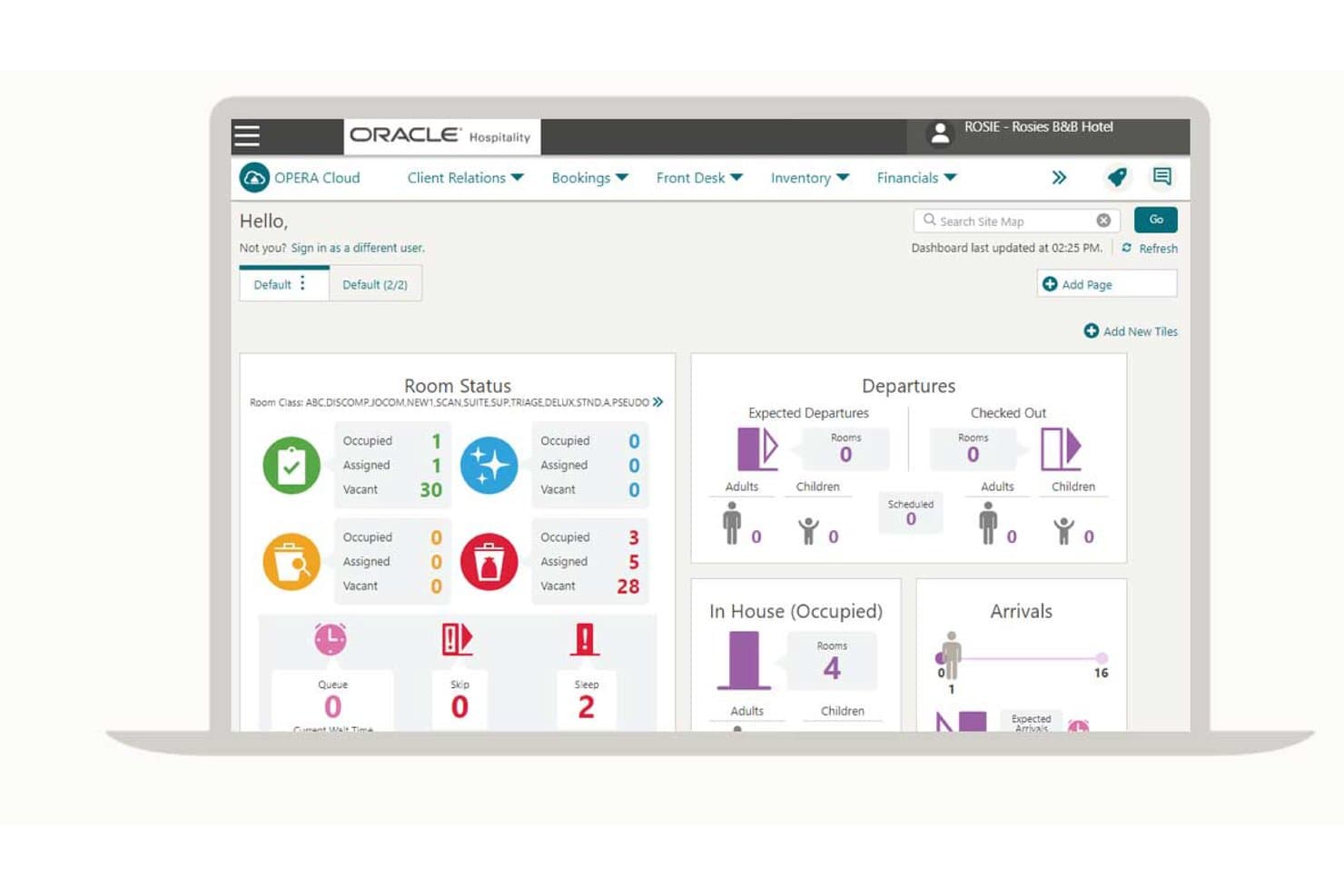
Oracle OPERA Cloud centralizes hotel reservations, front desk, rates, and housekeeping. Oracle Hospitality OPERA Cloud is a cloud-based hotel property management system that covers reservations, front desk operations, rate and inventory management, channel distribution, housekeeping coordination, guest profiles, and multi-property centralization under a single browser-based platform.
Who Is Oracle Hospitality OPERA Cloud Best For?
OPERA Cloud is built for mid-to-large hotel groups and enterprise chains that need a single platform to manage reservations, distribution, and operations across multiple properties.
Why I Picked Oracle Hospitality OPERA Cloud
OPERA Cloud earns its spot on my shortlist because no other cloud PMS comes close to its multi-property centralization capabilities. OPERA Cloud Central unifies reservations, distribution, and loyalty across chains, giving revenue managers a single view across thousands of properties. I also love the native Nor1 PRIME integration, which uses machine learning to automate upsell offers at pre-arrival and check-in for every guest, including third-party bookings.
Oracle Hospitality OPERA Cloud Key Features
- Mobile PWA for staff operations: A progressive web app lets housekeeping, maintenance, and valet staff update room status, log maintenance requests, and post charges from any smartphone.
- Trip Composer: Creates multi-segment reservations in a single workflow, supporting complex itineraries across room types and rate plans.
- OPERA Cloud Central: Centralizes reservations, loyalty, and distribution data across hotel chains, giving multi-property teams a unified view across all locations.
- Oracle Payment Cloud Service: A native, flat-rate payment processing solution supporting credit/debit cards, Apple Pay, Google Pay, and Samsung Pay with full PCI DSS compliance.
Oracle Hospitality OPERA Cloud Integrations
Oracle Hospitality OPERA Cloud connects with Oracle MICROS Simphony, Oracle Nor1, Booking.com, Expedia, Airbnb, Sabre, and Amadeus, with marketplace partners including Duetto and Canary Technologies. OHIP provides REST APIs, 2,000+ integration recipes, and 650+ live Oracle Cloud Marketplace partners.
Pros and Cons
Pros:
- Extensive reporting and analytics capabilities
- Embedded AI for rate and upsell automation
- Centralizes operations across multiple hotel properties
Cons:
- Guest messaging requires third-party integration
- Interface complexity slows high-volume desk workflows
Learn more about Oracle Hospitality OPERA Cloud:
Other Cloud-Based Hotel Management Software
Here are some additional cloud-based hotel management software options that didn’t make it onto my shortlist, but are still worth checking out:
- 11MewsBest for AI-driven pricing without a revenue manager
- 12roommasterBest for independent hotels with AI-driven pricing
- 13ThinkReservationsBest for independents wanting SMS upsells built in
- 14AgilysysBest for resort-wide multi-revenue-center PMS
- 15HotelRunnerBest for OTA distribution across 150+ channels
- 16ProtelBest for PMS and payments under one vendor
- 17PrenoBest for independents with Xero-native accounting
- 18Jonas ChorumBest for hotels keeping ops running during outages
- 19Infor HMSBest for enterprise chains across 75+ countries
- 20Visual MatrixBest for hotels with built-in revenue auto-pricing
How I Evaluate Cloud Based Hotel Management Software
I split my evaluation into core functionality every system must handle—reservations, front desk, rate management, OTA sync, housekeeping, and reporting—and the differentiators that separate a great fit from a generic one.
Core Functionality (Table Stakes For This List)
When I'm selecting tools for my list, I rank each one on a scale from 0 (does not offer the functionality) to 5 (excels in this area) for each core functionality listed below. I then calculate the tool's total score into a percentage, using 65% as a benchmark to help assess its overall fit for the list.
- Cloud-based PMS: I evaluate whether the platform is fully cloud-hosted with browser-based access across devices, not a legacy system with a cloud add-on bolted on.
- Reservations & front desk: The check-in, check-out, folio, and room assignment workflow needs to hold up during a busy morning rush with group arrivals and walk-ins at once.
- Rate & inventory management: I look for real-time rate controls with yield rules like MLOS and CTA restrictions, plus seasonal rate plans across room types.
- Channel manager & OTA integration: Two-way sync with major OTAs like Booking.com, Expedia, and Airbnb is the floor—I check channel breadth and whether a booking engine is included.
- Housekeeping & operations: Room status tracking and task assignment need to work on mobile so housekeepers aren't walking back to the front desk for updates between rooms.
- Guest profiles & reporting: I check whether the system stores meaningful guest history and preferences alongside occupancy and revenue reports a GM can act on without exporting to a spreadsheet.
Once I have a list of tools that meet the criteria, I consider what sets each platform apart.
Differentiating Factors (What Sets Vendors Apart)
Here's how I compare and contrast different vendors:
Standout Features
Revenue management intelligence is where I see the biggest gap between tools. I check whether a platform offers AI-driven rate recommendations based on live competitor pricing and demand signals—not just historical averages. For an independent hotel without a revenue manager, that distinction directly affects RevPAR. I also evaluate each vendor's contactless guest journey end-to-end: pre-arrival check-in, mobile key delivery, and QR-based checkout should all work without a front desk handoff. A documented REST API and a well-maintained integration marketplace round out my assessment, since most hotels need to connect their PMS to door locks, POS, and accounting tools without custom development.
Beyond Features
I evaluate how quickly a property can go live, including legacy PMS data migration and whether the vendor offers parallel operation during the switch. Staff training resources matter just as much—high front desk turnover means your team needs video libraries and live sessions, not just a PDF. I also check total cost of ownership beyond the subscription price, since payment processing fees, channel manager surcharges, and module add-ons can quietly inflate your monthly spend. Finally, 24/7 support from hospitality-trained agents is non-negotiable when a system issue hits during a sold-out weekend.
How to Choose a Cloud-Based Hotel Management Software
Choosing the right cloud-based hotel management software comes down to how well it matches your real-world pressures—like managing OTA integration, automating housekeeping, or modernizing the guest journey. Here’s how to prioritize and verify what matters for your property:
| If your priority is… | Look for… |
|---|---|
| If your priority is…Rapid OTA and booking channel sync | Look for…Two-way, real-time integrations with key OTAs |
| If your priority is…Faster housekeeping and maintenance | Look for…Mobile-first task assignment and live status updates |
| If your priority is…Automating pricing decisions | Look for…AI-driven rate recommendations and dynamic pricing |
| If your priority is…Smooth implementation and training | Look for…Live onboarding, training videos, and migration help |
| If your priority is…Guest self-service | Look for…Mobile check-in/out, digital keys, and contactless flows |
How to Vet Your Shortlist
- Test two-way OTA sync: Run a live channel update and confirm 100% of changes appear across all major OTAs within 30 minutes.
- Trial mobile housekeeping: Assign and complete a room turnover task from a housekeeper’s device during a demo or trial day.
- Request a data migration plan: Ask the vendor for a sample migration checklist and timeline based on your current PMS or booking system.
- Review guest journey features: Ask for a walkthrough video or live demo showing a complete guest experience from mobile check-in to digital key delivery.
- Decide your tradeoff—automation vs. hands-on controls: Pick the platform that matches your preference for automated pricing and guest communication versus systems that give you tighter manual control but require more staff attention.
What Is Cloud-Based Hotel Management Software?
Cloud-based hotel management software handles reservations, operations, guest records, and billing online from any internet-connected device. These platforms centralize tasks like check-in, rate management, housekeeping coordination, and reporting.
Managers, front desk teams, and housekeeping staff can access real-time data remotely to maintain efficient operations and consistent guest service.
Features of Cloud-Based Hotel Management Software
When selecting cloud-based hotel management software, keep an eye out for the following key features:
Cloud-based PMS: A cloud-native PMS gives staff access to reservations, operations, and reports from any internet-connected device across teams and shifts.
Reservations and front desk management: This feature covers booking intake, room assignments, check-in, check-out, and folio creation to keep arrivals accurate and efficient.
Rate and inventory management: Manage pricing and room inventory across all segments. Set seasonal rates, promotions, stay restrictions, and automated price adjustments based on changing demand.
Channel manager and OTA integration: Sync rates, availability, and reservations across OTAs and direct channels in real time to reduce double bookings and manual updates.
Housekeeping and operations tracking: Give housekeeping and maintenance teams live room status updates, task assignments, and the ability to log completion or report issues directly from mobile devices.
Guest profiles and history: Store detailed guest information, including stay preferences, communication records, and past transactions, so front desk and guest services teams can personalize service and recognize repeat guests.
Integrated payments: Accept, store, and reconcile payments securely from various sources. This includes tokenized credit card processing, pre-authorization, refunds, and direct folio reconciliation.
Contactless guest journey: Offer pre-arrival check-in, mobile keys, digital registration, and app-based checkout to reduce front desk contact throughout the guest stay.
Reporting and analytics dashboards: View live occupancy, revenue, staff productivity, and market performance reports to support faster operational and financial decisions.
Open API and integrations: Connect your PMS with accounting, POS, guest messaging, and door lock tools through APIs or the vendor’s integration marketplace.
Benefits of Cloud-Based Hotel Management Software
Implementing cloud-based hotel management software provides several benefits for your team and your business. Here are a few you can look forward to:
- Anywhere, real-time access: Manage reservations, guest data, and operations from any device with internet access, keeping every team member connected on or off site.
- Centralized reservations and operations: Coordinate booking intake, front desk workflow, housekeeping, and billing through one platform, reducing manual errors and duplicate work.
- Automated rate and inventory management: Maintain accurate availability and dynamic pricing using real-time controls, yield rules, and integrated demand signals to maximize occupancy.
- Integrated OTA and channel management: Sync rates and inventory instantly with major OTAs, direct booking engines, and distribution channels to avoid double bookings and missed sales.
- Mobile task assignment for housekeeping: Update room status and assign maintenance or housekeeping tasks on the go, letting staff work efficiently without repeated trips to the front desk.
- Contactless guest experience: Offer digital check-in, mobile key delivery, and app-based checkout to modernize the guest journey and reduce wait times.
- Actionable reporting and analytics: Access dashboards for occupancy, revenue, and guest preferences so leaders can respond quickly to trends without exporting data to spreadsheets.
Costs and Pricing of Cloud Based Hotel Management Software
Selecting cloud-based hotel management software requires an understanding of the various pricing models and plans available. Costs vary based on features, team size, add-ons, and more. The table below summarizes common plans, their average prices, and typical features included in cloud-based hotel management software solutions:
Plan Comparison Table for Cloud-Based Hotel Management Software
| Plan Type | Average Price | Common Features |
|---|---|---|
| Plan TypeFree Plan | Average Price$0–$50/property/month | Common FeaturesAllows basic reservation management, supports limited user accounts, provides essential reporting, and includes basic OTA integration. |
| Plan TypePersonal Plan | Average Price$50–$150/property/month | Common FeaturesAdds email support, offers mobile access, expands OTA/channel manager options, and improves reporting capabilities. |
| Plan TypeBusiness Plan | Average Price$150–$400/property/month | Common FeaturesProvides advanced rate and inventory management, enables mobile housekeeping, adds integrated payments, and unlocks guest communication tools. |
| Plan TypeEnterprise Plan | Average Price$400–$1,200/property/month | Common FeaturesIncludes custom integrations, supports multiple properties, delivers premium onboarding, provides 24/7 support, and offers enhanced security. |
Cloud-Based Hotel Management Software FAQs
Here are some answers to common questions about cloud-based hotel management software:
How secure is cloud-based hotel management software for storing guest data?
Yes, cloud-based hotel management software is designed with high security standards, like encryption, role-based access, and compliance with regulations such as PCI-DSS and GDPR. You still need to set clear user permissions and review vendors’ security documentation to protect guest privacy, especially when handling payment or personal information.
Can cloud-based hotel management software integrate with my existing POS or accounting software?
Yes, most cloud-based hotel management systems offer integrations with common POS systems, payment gateways, and accounting platforms. Look for vendors with open APIs or a robust integration marketplace. Always verify that your specific POS or accounting tools are supported before committing, as integration depth and quality can vary.
What happens if my internet goes down while using cloud-based hotel management software?
Some cloud-based systems offer limited offline modes, allowing front desk teams to access basic reservation info or check guests in during short outages. However, most features require an internet connection. For hotels in areas with unstable internet, prioritize vendors with offline continuity options or local caching as part of their platform.
How long does it take to switch to a cloud-based hotel management system?
Switching usually takes a few weeks up to a couple of months, depending on the size of your property, data migration needs, and team training. Vendors that provide hands-on onboarding, migration checklists, and live support will help your hotel go live faster and minimize disruption to daily operations.
Can I use cloud-based hotel management software on mobile devices?
Yes, you can access these platforms from smartphones and tablets—many vendors even offer dedicated mobile apps for front desk, housekeeping, and maintenance teams. This makes it easier to manage operations on the go and keep all staff in sync, even if they’re away from the front desk or main office.
Is cloud-based hotel management software suitable for small independent hotels?
Yes, there are many options tailored specifically for independent hotels or boutique properties. Look for easy-to-use interfaces, simple pricing structures, and automation features that reduce the need for large admin teams. Some solutions offer basic plans with all the essentials, while others scale up with advanced modules as your needs grow.