

10 Best AI Property Management Software in 2026

10 Best AI Property Management Software Shortlist


AI property management software uses artificial intelligence to automate guest messaging, optimize room rates, simplify multi-property operations, and manage complex hospitality portfolios. If you’re looking to boost occupancy, reduce repetitive work, and keep up with changing guest expectations, these platforms are becoming the new standard. In this guide, you’ll find AI property management software designed for everything from hotels and resorts to vacation rentals, with key features mapped to the challenges hotel managers face—so you can pick a solution that matches your business and supports your team.
Why Trust Our Software Recommendations
Our team has been testing and reviewing software since 2012. As hospitality leaders ourselves, we know how difficult—and important—it is to choose the right software.
For this guide, we evaluated tools using hands-on testing and independent research, scoring tools using our selection criteria.
Our reviews reflect our human editorial judgment, not a sales pitch.
AI Property Management Software Comparison Table
This comparison table summarizes pricing details for my top AI property management software selections:
| Tool | Best For | Trial Info | Price | ||
|---|---|---|---|---|---|
| 1 | Best for STR portfolio AI guest messaging | Free demo available | Pricing upon request | Website | |
| 2 | Best for enterprise multi-property AI portfolio ops | 15-day free trial + free demo | Pricing upon request | Website | |
| 3 | Best for AI-driven hotel revenue and distribution | Free demo available | Pricing upon request | Website | |
| 4 | Best for resort and casino portfolio AI ops | Free demo available | Pricing upon request | Website | |
| 5 | Best for composable AI stacks in hospitality | Free demo available | Pricing upon request | Website | |
| 6 | Best for multi-property vacation rental portfolios | Free demo available | Pricing upon request | Website | |
| 7 | Best for AI-driven revenue forecasting at scale | Free demo available | Pricing upon request | Website | |
| 8 | Best for independent hotels scaling with ML pricing | Free demo available | From $236/month | Website | |
| 9 | Best for independent hotels with 800+ integrations | Free demo available | Pricing upon request | Website | |
| 10 | Best for enterprise hotel portfolio AI operations | Free demo available | Pricing upon request | Website |
AI Property Management Software Reviews
Below are my detailed summaries of the best AI property management software that made it onto my shortlist. My reviews offer a detailed look at the features, best use cases, and integrations of each software to help you find the best one for you.

Hostaway
Best for STR portfolio AI guest messaging
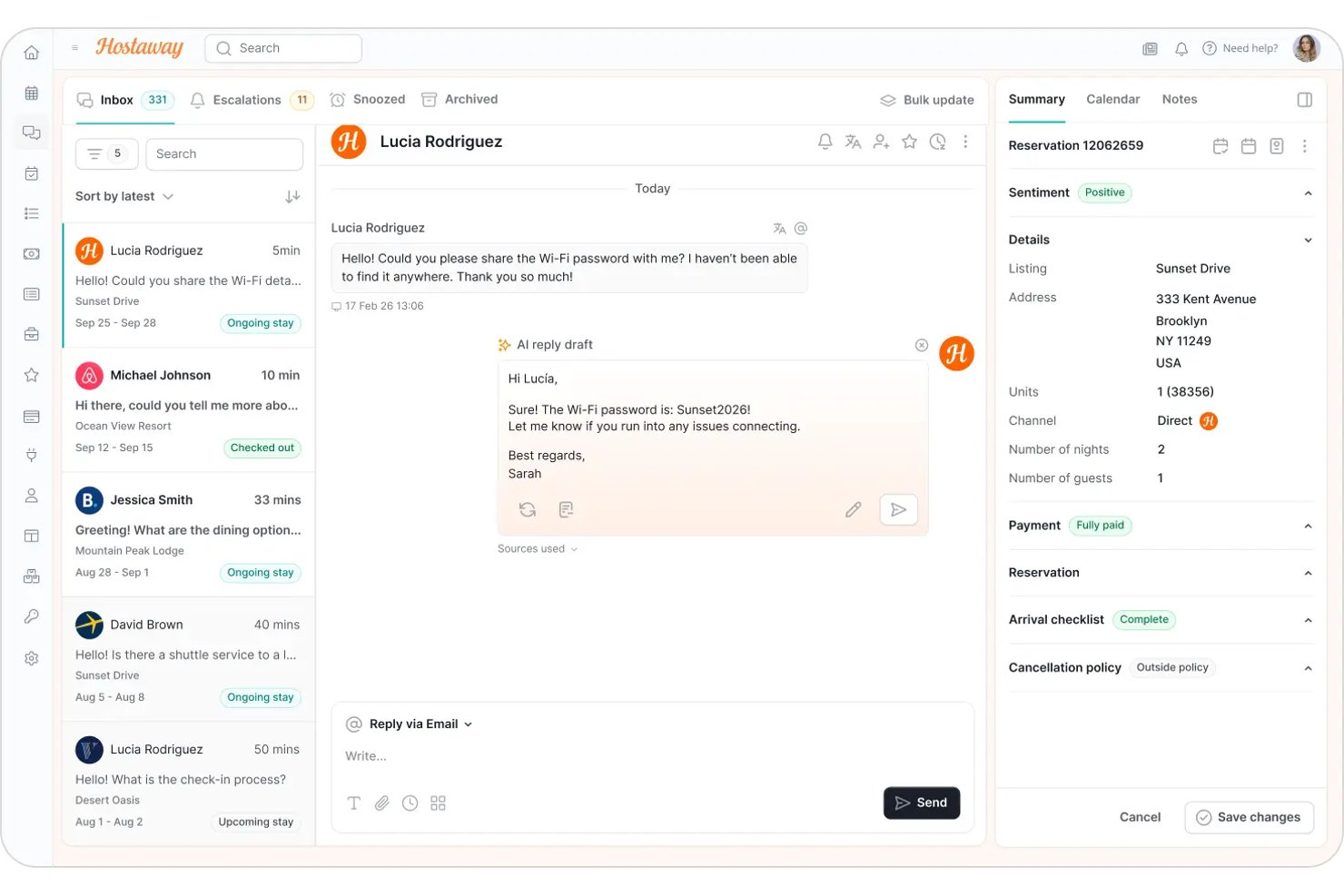
Hostaway is an AI-powered vacation rental property management platform that combines a channel manager, unified guest inbox, direct booking engine, dynamic pricing, and AI-driven guest communication automation across short-term rental portfolios.
Who Is Hostaway Best For?
Hostaway is a strong fit for short-term rental operators managing multi-property portfolios who need AI-driven guest messaging and channel distribution in one platform.
Why I Picked Hostaway
Hostaway earns its spot on my shortlist because of AI CoHost, which can automate up to 90% of guest communications across multi-property portfolios. I particularly like how AI Replies draft and send responses to common guest questions through a unified inbox that pulls in WhatsApp, SMS, and email, so nothing slips through across a busy channel mix. The AI also surfaces live business insights and suggests next moves, which means your response to a late-night check-in question doesn't require a team member on standby.
Hostaway Key Features
- AI-driven dynamic pricing: Hostaway adjusts nightly rates automatically based on demand, seasonality, competitor pricing, and local events.
- Channel manager: Sync listings and calendars across Airbnb, Vrbo, Booking.com, and 300+ OTA partners from one dashboard.
- Direct booking engine: Build SEO-optimized booking websites with built-in email campaigns, promo codes, and upsell tools.
- Owner portal: Automates owner statements, payouts, and financial reports filterable by property, owner, or channel.
Hostaway Integrations
Hostaway offers 200+ marketplace integrations, including Airbnb, Vrbo, Booking.com, Expedia, Google Vacation Rentals, Stripe, QuickBooks, PriceLabs, Breezeway, and RemoteLock. An open API is available for custom integrations.
Pros and Cons
Pros:
- Dynamic pricing adjusts to market trends
- Unified inbox for all communication channels
- AI automates up to 90% guest messaging
Cons:
- Setup complexity increases with large portfolios
- Response accuracy can vary between properties

Best for enterprise multi-property AI portfolio ops
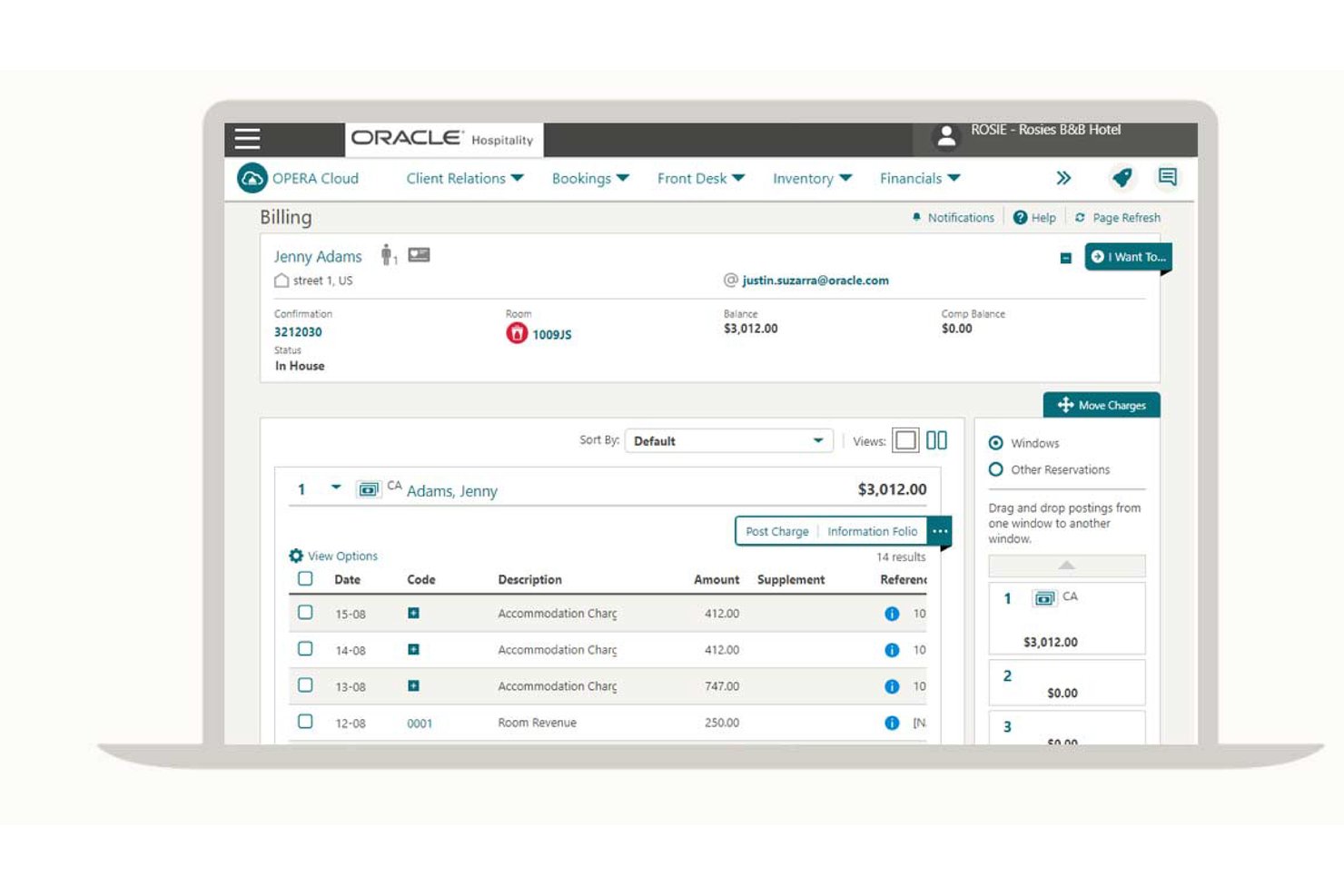
OPERA Cloud is Oracle's cloud-based hotel property management system, offering front desk operations, reservations, housekeeping, guest profiles, loyalty management, and AI-driven reporting across single and multi-property hotel portfolios.
Who Is OPERA Cloud Best For?
OPERA Cloud is built for enterprise hotel groups and large independent properties managing complex, multi-property operations at scale.
Why I Picked OPERA Cloud
OPERA Cloud earns its spot on my shortlist because of how deeply its AI is embedded across a multi-property portfolio. The OPERA Cloud Assistant uses AI-driven room assignment that reads guest history, preferences, and operational parameters to recommend the best room match at check-in, across thousands of properties at once. I also like that AI auto-generates standardized rate code descriptions from package details, which keeps pricing consistent whether you're managing 10 properties or 2,100, as Wyndham does.
OPERA Cloud Key Features
- Customizable PMS dashboard: Access 30+ preconfigured tiles covering front desk, revenue, inventory, and housekeeping, with drill-down actions like check-in and check-out directly from each tile.
- Centralized guest profiles: Consolidate guest communication preferences, spend history, and marketing data across every property in your portfolio in a single profile.
- Loyalty program management: Configure membership tiers, points calculations based on stays or spend, and redemption options for rooms, upgrades, packages, and experiences.
- Mobile staff tools: Give housekeeping, porters, and valet teams mobile access to room status updates, maintenance requests, and minibar restocking tasks from anywhere on-property.
OPERA Cloud Integrations
OPERA Cloud connects with 2,000+ prebuilt integration recipes through the Oracle Hospitality Integration Platform (OHIP), including native integrations with Oracle MICROS Simphony POS, Oracle Payment Interface, Oracle Payment Cloud Service, Nor1, Hapi, Duetto, Alliants, Canary Technologies, InnSpire, and Glowing. Open REST APIs are available for custom integrations across reservations, housekeeping, front desk operations, inventory, rates, and CRM.
Pros and Cons
Pros:
- Loyalty configuration supports complex membership tiers
- Single dashboard manages multi-property operations
- AI-driven room assignment matches guest preferences
Cons:
- Reporting customization limited for boutique operations
- Enterprise-scale setup requires significant onboarding time

Best for AI-driven hotel revenue and distribution
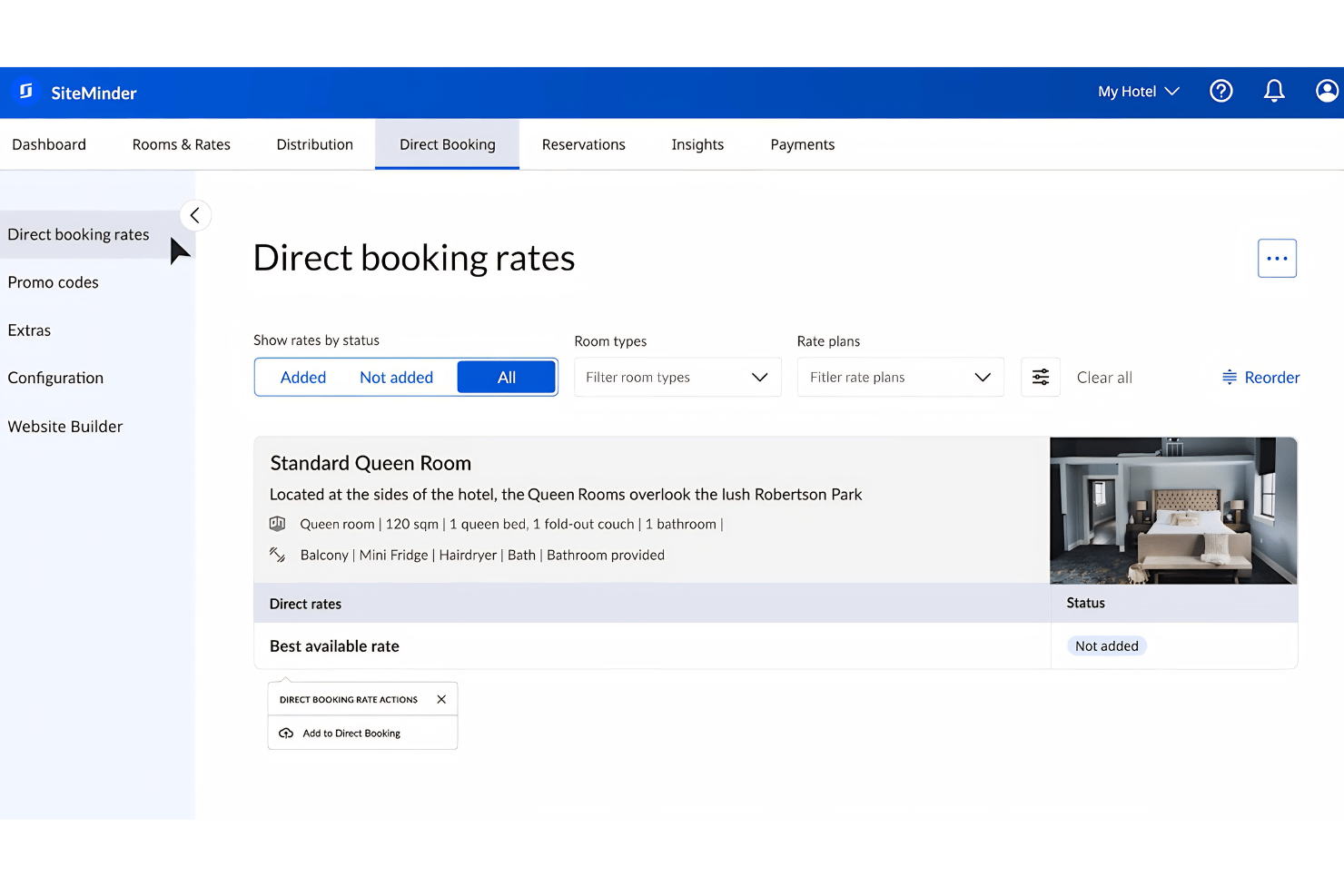
SiteMinder is a hotel commerce platform covering channel management, direct booking, revenue management, and AI-driven demand forecasting across 450+ distribution channels.
Who Is SiteMinder Best For?
SiteMinder is a strong fit for independent hotels and mid-size hotel groups that need centralized control over distribution, pricing, and AI-driven demand forecasting across a high volume of booking channels.
Why I Picked SiteMinder
SiteMinder earns its spot on my shortlist because of SiteMinder iQ, which analyzes nearly 4 billion data points to surface real-time market and competitor pricing insights. I'm also a fan of its AI-driven demand forecasting model, which flags demand shifts before they hit your calendar so you can adjust rates proactively. Pair that with automated pricing updates pushed across 450+ channels in under 60 seconds, and you've got a genuinely tight revenue and distribution loop.
SiteMinder Key Features
- Direct booking engine: A commission-free booking engine lets guests complete a reservation in three steps, with support for multi-room bookings, optional extras, and automated pre-arrival notifications.
- Hotel website builder: A mobile-optimized website builder integrates directly with the booking engine to drive direct reservations without relying on third-party platforms.
- Pooled inventory management: An inventory grid with a pooled inventory model syncs availability across your PMS and all connected channels in real time to prevent overbookings.
- Pace reporting and channel analytics: Built-in pace reporting tracks booking sources and highlights your best-performing channels so you can adjust your distribution mix accordingly.
SiteMinder Integrations
SiteMinder offers 2,350+ integrations across its ecosystem, including 350+ PMS partners like Oracle OPERA Cloud, Mews, Cloudbeds, Stayntouch, and protel, plus distribution connections to 450+ channels such as Booking.com, Expedia, Agoda, and Airbnb. An API is available for custom integrations through the SiteMinder Exchange developer platform.
Pros and Cons
Pros:
- Pooled inventory prevents overbooking across channels
- Direct booking engine with mobile website builder
- AI surfaces real-time demand and rate shifts
Cons:
- Channel grid can feel crowded with many OTAs
- Advanced AI features require initial setup

Agilysys
Best for resort and casino portfolio AI ops
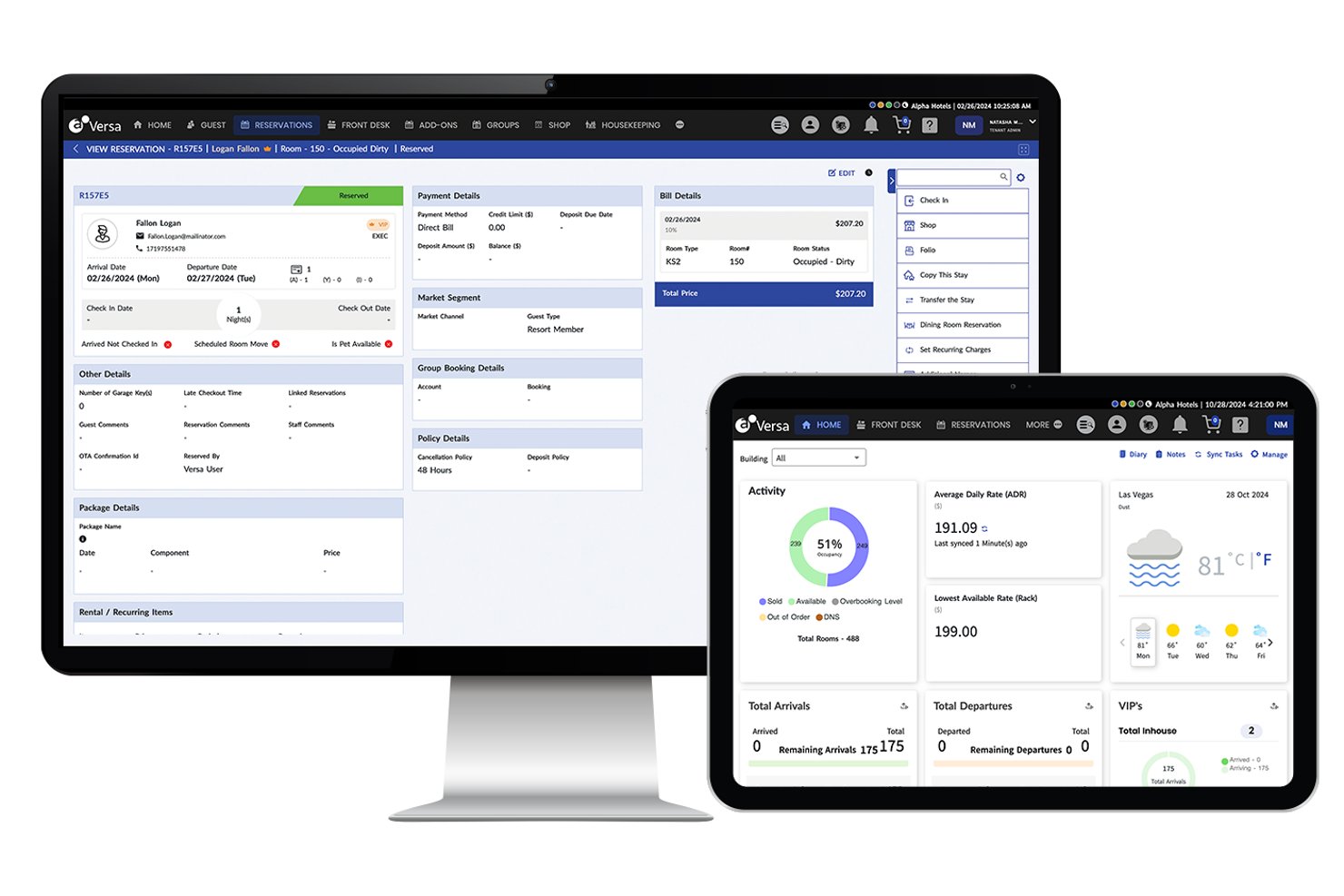
Agilysys is a cloud-based hospitality management platform that brings together property management, point of sale, reservations, and amenity booking under one AI-native system—with purpose-built tools for multi-property operations across hotels, resorts, and casinos.
Who Is Agilysys Best For?
Agilysys is a strong fit for operators running large-scale resorts, casino hotels, or multi-property portfolios that need a single platform to manage rooms, dining, spa, golf, and activities alongside AI-driven upselling and centralized enterprise controls.
Why I Picked Agilysys
Agilysys earns its spot on my shortlist because it's one of the few platforms built from the ground up for the scale and complexity of resort and casino portfolios. I'm particularly impressed by the AI upsell engine, powered by guestsense.ai, which pushes personalized offers across mobile, kiosks, and the front desk based on individual guest profiles. The multi-property controls let you manage rates, policies, and workflows centrally while still giving each property local flexibility.
Agilysys Key Features
- Intelligent guest profiles: Captures guest preferences and spend history across all venues and visits, accessible to any staff member at any touchpoint.
- Housekeeping automation: Automatically assigns rooms and generates prioritized mobile task lists for housekeeping teams based on real-time occupancy status.
- One-cart reservations: Lets guests book rooms, dining, spa, golf, and activities together in a single transaction through one booking flow.
- Open API framework: Connects to CRS, RMS, channel managers, digital key systems, loyalty programs, and payment processors through a documented API layer.
Agilysys Integrations
Agilysys PMS offers 20+ verified partner integrations, including SiteMinder, IDeaS, Duetto, and Revinate, and connects to POS, CRS, RMS, channel managers, payment processors, and loyalty programs through its open API framework, which is also available for custom integrations.
Pros and Cons
Pros:
- One-cart reservations for rooms and amenities
- AI upsell engine for personalized guest offers
- Multi-property controls for large-scale operations
Cons:
- Advanced features may require deep staff training
- Complex setup for smaller hotel portfolios

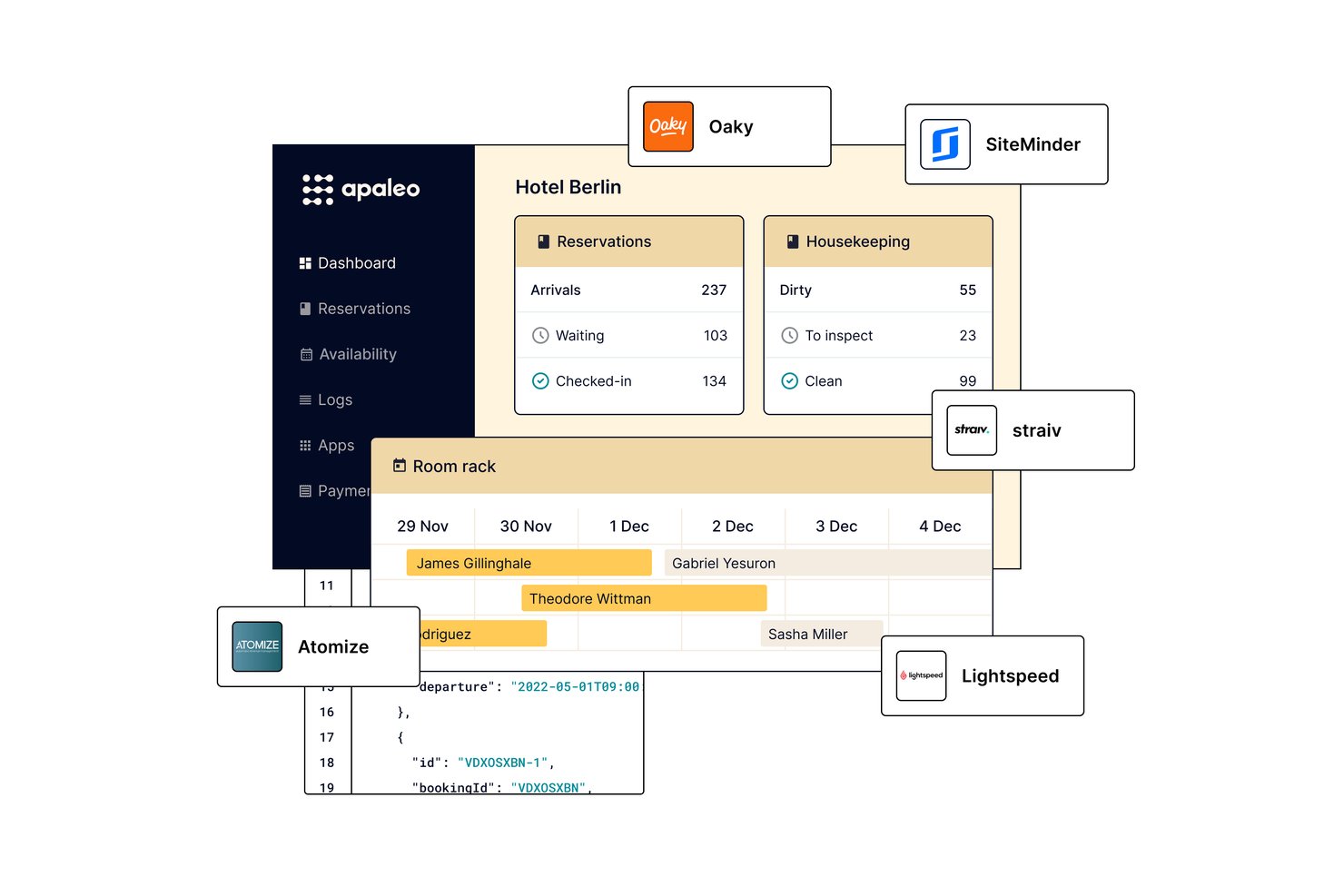
Apaleo is an API-first, cloud-native property management platform built on MACH architecture, offering an open PMS, payment processing, AI agent integration, and a marketplace of hospitality apps for hotels, apartment brands, and serviced apartment operators.
Who Is Apaleo Best For?
Apaleo is a strong fit for hotel chains, apartment brands, and serviced apartment operators that want to build and orchestrate their own AI agent-driven tech stack on an open, API-first platform.
Why I Picked Apaleo
Apaleo earns its spot on my shortlist because its MACH architecture turns the PMS into a true foundation for composable AI, letting you plug in AI agents at any layer of your stack without rebuilding core systems. I particularly like the MCP Server and the AI agents in the Apaleo Store, which include a Sales Agent that creates rate plans and promo codes directly in the PMS, and an Email Agent that handles guest inquiries and reservation changes autonomously. The open API layer means these agents read and write live data in real time, so automation isn't just surface-level.
Apaleo Key Features
- Multi-property management: Manage all your properties under one login, with cloneable property templates and a single consolidated data view across your entire portfolio.
- Apaleo Pay: Process guest payments across every touchpoint—booking engine, terminals, payment links, and kiosks—with built-in PCI-DSS, PSD2, and SOC2 compliance.
- Unified reservations: Sell rooms, long stays, beds, meeting space, and parking all from a single reservation system without needing separate tools.
- Real-time double-entry bookkeeping: Track all financial transactions live, with customizable invoice templates and exportable finance reports built directly into the PMS.
Apaleo Integrations
Apaleo offers hundreds of native integrations through the Apaleo Store, including SiteMinder, Booking.com, RoomPriceGenie, Flexkeeping, Chekin, Xero, DATEV, Tuya Hotel, Minut, and DerbySoft. It connects with Make for workflow automation, and its open API and MCP Server let you build custom integrations and AI agent connections directly into the PMS.
Pros and Cons
Pros:
- Real-time financial and reservation updates
- Multi-property admin in one dashboard
- MACH architecture supports deep AI customization
Cons:
- No transparent self-serve pricing model
- Setup requires technical resources or expertise

Guesty
Best for multi-property vacation rental portfolios
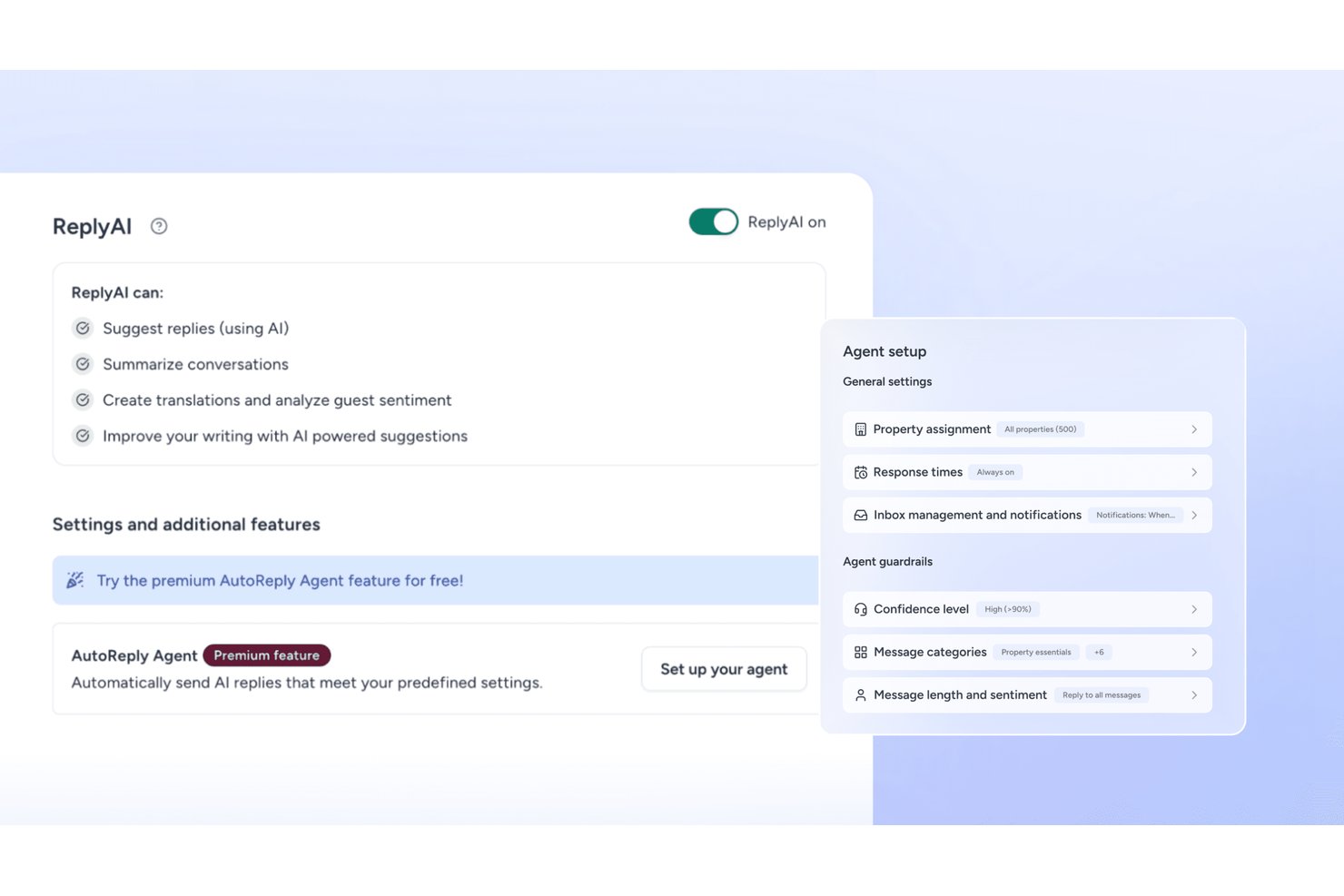
Guesty is an AI-powered property management platform built for short-term rental hosts and managers, covering channel distribution across 60+ booking sites, centralized reservation management, automated guest messaging, dynamic pricing, and trust accounting.
Who Is Guesty Best For?
Guesty is a strong fit for property managers and short-term rental operators running portfolios of multiple listings across platforms like Airbnb, Booking.com, and Vrbo.
Why I Picked Guesty
Guesty earns its spot on my shortlist because it's purpose-built for scaling multi-property short-term rental portfolios, with a multi-calendar and real-time channel sync across 60+ OTAs using direct API connections rather than iCal feeds. I particularly like how its AI agents handle dynamic pricing adjustments and personalized guest messaging automatically, so operators managing dozens or hundreds of listings aren't manually juggling rates or inbox responses across platforms.
Guesty Key Features
- Trust accounting: Manage owner payouts, reconcile funds, and generate financial reports with a built-in accounting system designed for short-term rental operators.
- Unified inbox: View and respond to guest messages from all connected booking platforms in one centralized inbox, with AI-suggested replies.
- Owner portal: Give property owners real-time access to booking activity, revenue reports, and statements through a dedicated self-service portal.
- Housekeeping management: Assign, schedule, and track cleaning tasks across your properties, with automated triggers based on checkout times and booking changes.
Guesty Integrations
Guesty offers 240+ native integrations through its marketplace, including Airbnb, Booking.com, Vrbo, Expedia, Google Travel, PriceLabs, Beyond, Breezeway, Turno, and Minut, alongside connections to 60+ booking channels through its channel manager. An Open API is available for custom integrations.
Pros and Cons
Pros:
- Owner portal provides real-time financial reporting
- Multi-calendar view for managing large portfolios
- AI agents automate guest messaging and pricing
Cons:
- Trust accounting features can be complex
- Setup process is time-intensive for new users

Best for AI-driven revenue forecasting at scale
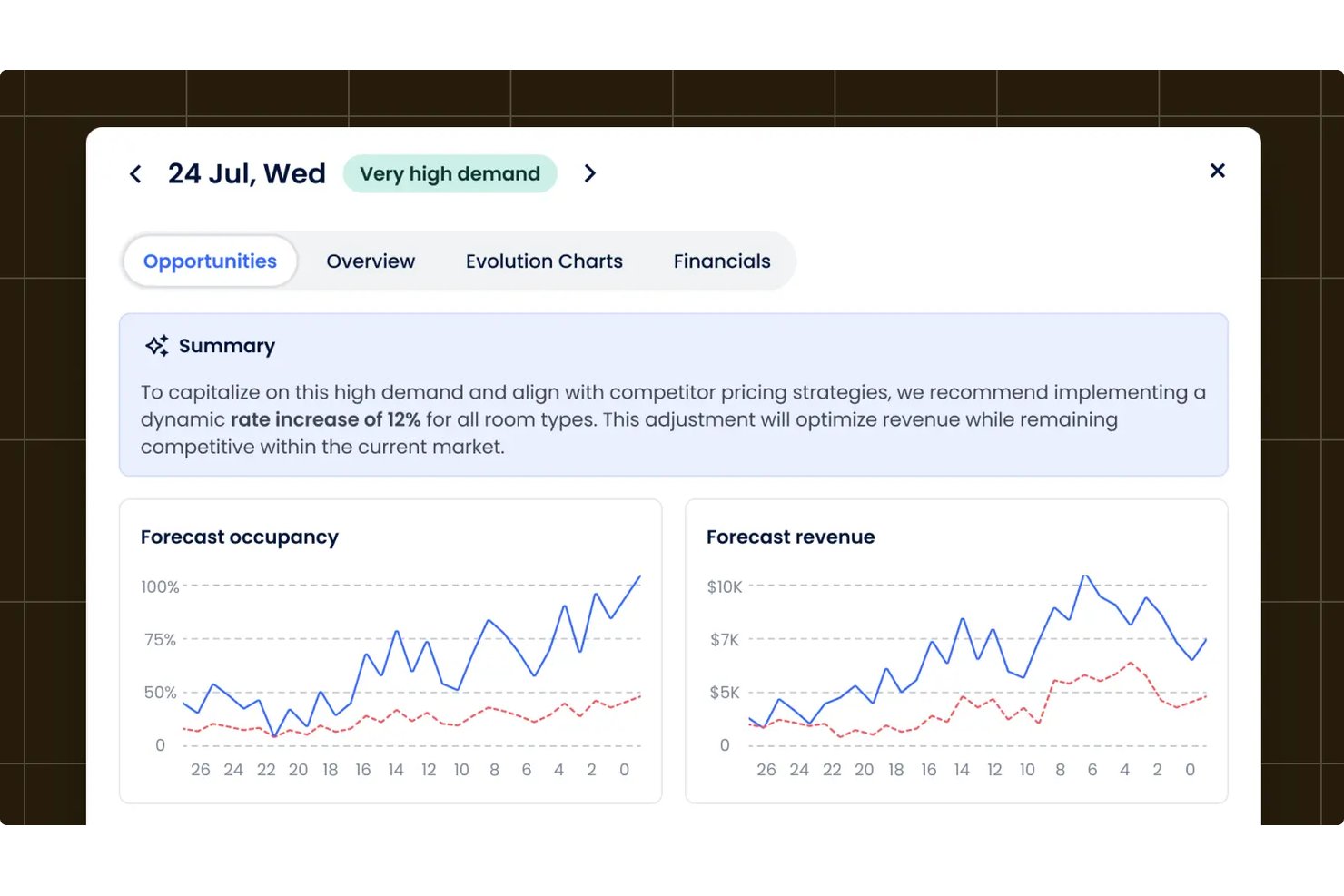
Cloudbeds is a cloud-based hospitality platform that combines property management, channel distribution, revenue management, and guest experience tools—with AI-driven pricing optimization and forecasting built directly into the core system.
Who Is Cloudbeds Best For?
Cloudbeds is a strong fit for growing hotel groups and multi-property operators who need enterprise-grade revenue forecasting without managing a separate tech stack.
Why I Picked Cloudbeds
Cloudbeds earns its spot on my shortlist because of Signals, its proprietary causal AI model that analyzes 4 billion data points hourly to deliver demand forecasts with up to 95% accuracy across a 90-day window. I find that level of forecasting precision genuinely useful for multi-property operators who need to make confident decisions on staffing, purchasing, and rate strategy well in advance. The Revenue Intelligence module pushes rate recommendations within 30 minutes of booking or availability changes, with floor and ceiling controls so your team stays in charge.
Cloudbeds Key Features
- Unified guest profiles: Cloudbeds automatically merges and deduplicates guest records across properties, giving your team a single, consolidated view of each guest's history.
- Group and space management: Create professional quotes, manage room blocks, and book dedicated spaces like meeting rooms or ballrooms from a single calendar view.
- Channel manager: Sync rates and availability in real time across 300+ distribution channels, including OTAs and GDS connections, to keep inventory consistent everywhere.
- Mobile housekeeping and maintenance management: Assign, track, and update housekeeping tasks and maintenance requests from any mobile device, keeping operations moving between departments.
Cloudbeds Integrations
Cloudbeds offers 450+ marketplace integrations, including Xero, QuickBooks Online, Booking.com, Expedia, Airbnb, Stripe, PayMaya, Tevalis, RemoteLock, and Mailchimp. It also provides REST and GraphQL APIs with real-time webhooks for custom integrations.
Pros and Cons
Pros:
- Mobile housekeeping tasks for remote teams
- Unified profiles consolidate guest history data
- AI demand forecasts update every 30 minutes
Cons:
- Reporting exports limited without custom API work
- Forecasting tools require significant setup time

Best for independent hotels scaling with ML pricing
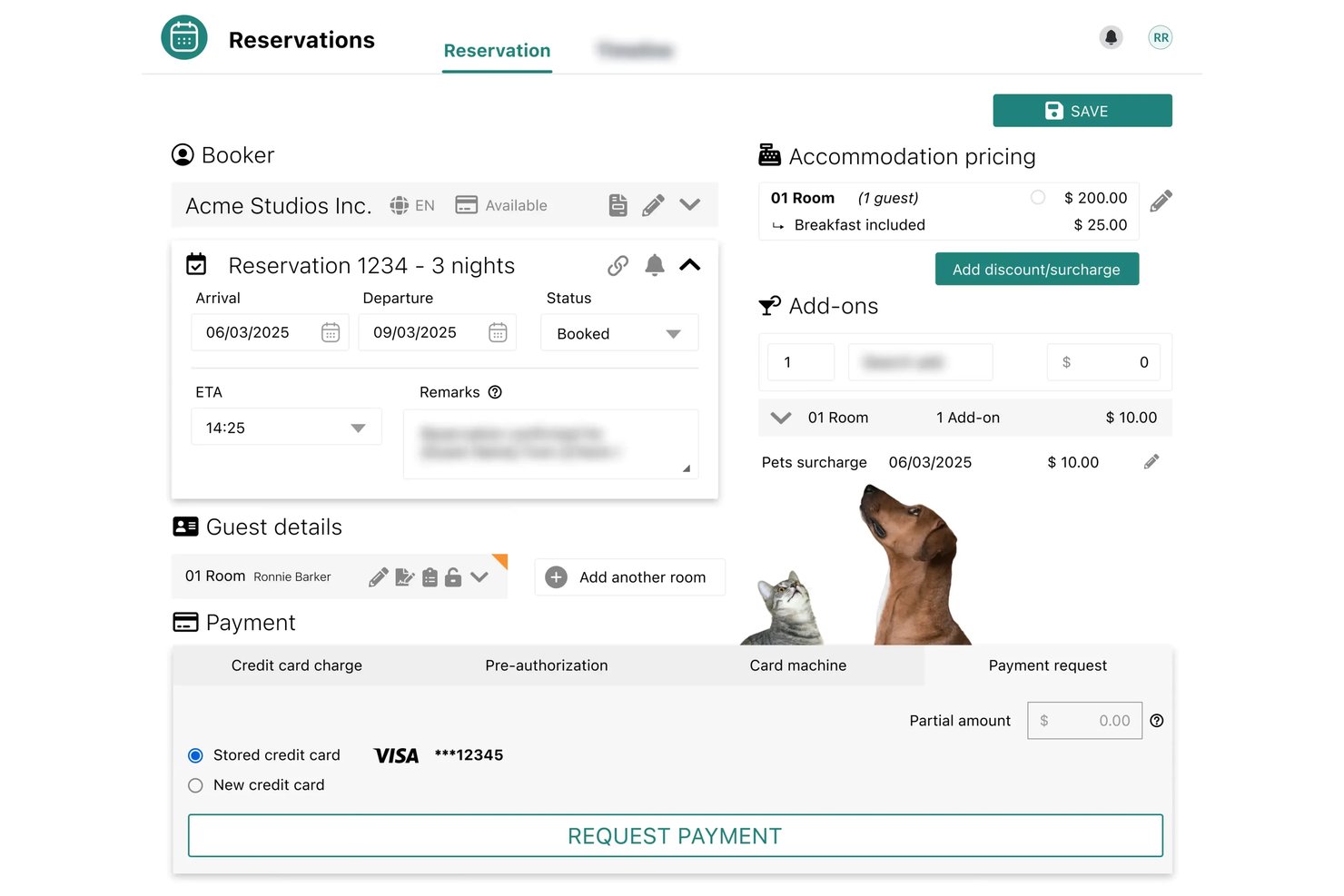
RoomRaccoon is a cloud-based hotel management platform that combines a property management system, channel manager, booking engine, and AI-driven revenue management tools, including dynamic pricing and upselling, in one system built for independent properties.
Who Is RoomRaccoon Best For?
RoomRaccoon is a strong fit for independent hotels and boutique properties that want a single platform for front desk operations, distribution, and ML-driven dynamic pricing without relying on multiple disconnected tools.
Why I Picked RoomRaccoon
I picked RoomRaccoon as one of the best because of how its AI pricing tier, RaccoonRev Plus, goes beyond simple rule-based logic. It pulls in demand trends, local events, and even weather data to set rates automatically across all channels in real time. I also like that RaccoonRev's competitor rate shopping tracks rivals' room categories, sold-out dates, and min/max pricing so you're positioning against the market, not just reacting to it.
RoomRaccoon Key Features
- Reservation calendar: A drag-and-drop calendar with color-coded booking statuses, payment visibility per booking, and the ability to sell alternative spaces like conference rooms or parking via the Grey Rooms feature.
- Automated guest messaging: RoomRaccoon automates pre-arrival, in-stay, and post-stay guest communications so your front desk team isn't manually sending routine emails.
- RaccoonHousekeeping: A mobile-accessible housekeeping and maintenance task manager that lets you assign, track, and update room status in real time across your property.
- Built-in reporting dashboard: Visual dashboards track occupancy rate, ADR, RevPAR, booking pace, and channel performance, with one-click exports for operational and financial reporting.
RoomRaccoon Integrations
RoomRaccoon offers 400+ integrations through its Integrations Hub, including Booking.com, Expedia, Google Hotel Ads, QuickBooks, Xero, Twinfield, Exact, Lightspeed, GuestRevu, and PriceLabs. An API is available for custom integrations.
Pros and Cons
Pros:
- Visual dashboards consolidate operational and financial metrics
- Upselling and ancillary spaces supported in one system
- Dynamic pricing uses demand, events, and weather data
Cons:
- Channel manager setup can be time-consuming
- Advanced AI pricing requires premium tier upgrade

Best for independent hotels with 800+ integrations
Maestro PMS is a hotel and resort property management system offering front office, CRM, sales and catering, spa, golf, and multi-property management across cloud, on-premise, or private cloud deployments.
Who Is Maestro PMS Best For?
Maestro PMS is a strong fit for independent hotels, resorts, and multi-property operators that need a flexible deployment model and a wide integration ecosystem.
Why I Picked Maestro PMS
Maestro PMS earns its spot on my shortlist because it's one of the few hotel management systems built specifically around the needs of independent properties, with a single-database architecture that connects 20+ modules spanning front office, spa, sales and catering, and guest engagement. I like that the AI-driven capabilities are embedded directly into the PMS rather than bolted on: the platform uses AI-powered chatbots tied to guest behavioral data to handle routine inquiries and escalate sensitive issues to live staff. The 2026 roadmap also introduces dynamic pricing for non-room revenue categories like spa and ancillary charges, giving independent operators tools to grow yield beyond the room.
Maestro PMS Key Features
- Online booking engine: A direct booking tool built into the PMS that lets guests reserve rooms without leaving your website.
- MezzoPay embedded payment processing: A PCI-certified, EMV-ready payment processing module that handles transactions directly within the PMS.
- Two-way SMS guest messaging: A built-in messaging tool that lets your team send and receive text messages with guests throughout their stay.
- Analytics and data mining: A reporting module that surfaces guest history, occupancy trends, and revenue data across all properties in a single view.
Maestro PMS Integrations
Maestro PMS offers 800+ vendor integrations, including SiteMinder, Shift4 Payments, Revinate, QuickBooks, Cendyn, Canary, Salto, Assa Abloy, Ideas, and Agilysys InfoGenesis POS. It supports open APIs for custom integrations and connects to additional systems through the Comtrol Lodging Link and HTNG/OTA standards.
Pros and Cons
Pros:
- Handles non-room revenue management
- Embeds AI guest messaging into PMS
- Built around independent hotel workflows
Cons:
- User interface looks dated on some modules
- Reporting can feel unintuitive to new users

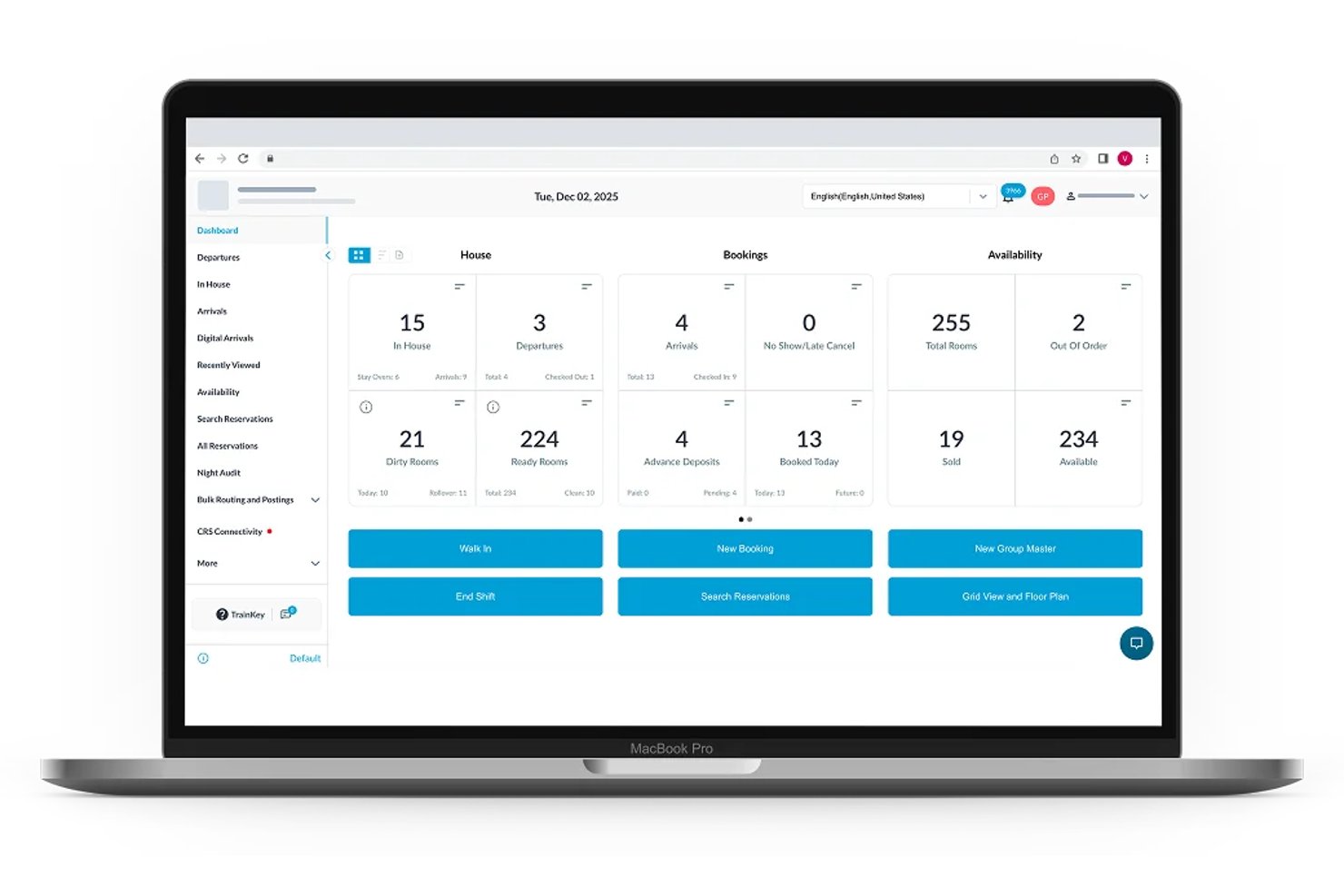
HotelKey is a cloud-based property management system (PMS) built for large hotel chains and enterprise portfolios, covering front desk operations, central reservations, revenue management, housekeeping, POS, and event management from a single platform.
Who Is HotelKey Best For?
HotelKey is built for large hotel chains and enterprise portfolio operators managing multiple branded properties at scale.
Why I Picked HotelKey
HotelKey earns its spot as one of the best on my shortlist because of how well it handles AI-driven operations at enterprise scale. I'm particularly impressed by its AI-guided training modules, which use embedded tooltips and AI insights to adapt learning paths for staff across a large portfolio. Add to that the Manager App's real-time portfolio dashboards and instant alerts, and I think operators managing dozens or hundreds of branded properties will find centralized visibility genuinely useful.
HotelKey Key Features
- Smart CRS: A central reservation system that connects directly to OTAs and GDS channels with real-time inventory management and private APIs for instant rate updates.
- Digital front desk operations: Supports digital check-ins, integrated ID scanning, automated folio creation, and upsell prompts at the point of check-in.
- Housekeeping and maintenance module: Automates task scheduling and assignments, with a mobile app for task management and maintenance logging tied to inventory adjustments.
- Event management tools: Manages spaces, packages, and sub-events with flexible cancellation policies, automated fee calculations, and integrated invoicing and payment reporting.
HotelKey Integrations
HotelKey offers 40+ native integrations across accounting, payments, guest communication, kiosks, operations, and access control, including M3, Sage, Revinate, TrustYou, Virdee, Assa Abloy, Dormakaba, Shift4, FreedomPay, Adyen, Stripe, and Elavon. Private APIs are available for custom third-party integrations, and it connects directly to OTA and GDS channels through its Smart CRS.
Pros and Cons
Pros:
- Automated maintenance and housekeeping assignments
- Central real-time dashboard for all locations
- AI-guided staff training across property portfolio
Cons:
- Event tools lack advanced group block features
- Best suited for large hotel groups
Other AI Property Management Software
Here are some additional AI property management software options that didn’t make it onto my shortlist, but are still worth checking out:
- Smartness
For AI-driven hotel rate optimization
- Mews
For native AI revenue and ops in one PMS
- WebRezPro
For AI guest comms via Claude integration
- StayNTouch
For mobile-first multi-property operations
- RMS Cloud
For multi-property AI-ready open PMS
- Canary Technologies
For AI guest messaging across hotel channels
- Duve
For AI-driven guest messaging at scale
- Atomize
For AI-driven hotel revenue pricing


How I Evaluate AI Property Management Software
Any tool on this list has to deliver AI that moves the needle—whether that's dynamically pricing rooms during a compression event or automatically triaging a 2 a.m. guest message without waking your front desk team. I split my evaluation into core functionality every platform must meet to qualify, and differentiating factors that separate the best options from the rest.
Core Functionality (Table Stakes for This List)
When I'm selecting tools for my list, I rank each one on a scale from 0 (does not offer the functionality) to 5 (excels in this area) for each core functionality listed below. I then calculate the tool's total score into a percentage, using 65% as a benchmark to help assess its overall fit for the list.
- AI Reservation Automation: I evaluate how well each platform handles booking, room assignments, and check-in/check-out across multiple channels without manual intervention.
- Predictive Revenue Optimization: Each tool's ability to forecast demand and adjust rates using market signals, competitor data, and occupancy patterns is a key area I check.
- Intelligent Guest Communication: I look for AI-driven messaging that goes beyond scripted templates—think chatbots or virtual concierges that handle guest inquiries across SMS, email, and in-app.
- AI Operations & Housekeeping: How a platform assigns housekeeping tasks and maintenance requests based on real-time occupancy and room status tells me a lot about its operational depth.
- Predictive Analytics & Reporting: I check whether dashboards surface AI-generated forecasts on occupancy, revenue, and guest sentiment rather than just static historical reports.
- Unified PMS Integrations: The breadth of integrations with channel managers, booking engines, POS systems, and CRMs determines how well AI models can work with unified property data.
Once I have a list of tools that meet the criteria, I consider what sets each platform apart.
Differentiating Factors (What Sets Vendors Apart)
Here's how I compare and contrast different vendors:
Standout Features
I look for AI upsell engines that surface personalized upgrade and ancillary offers—like a late-checkout or spa package—at the right moment in the guest journey, with revenue attribution so you can track what's actually converting. Contactless guest journey tools matter just as much: I evaluate how well a platform handles digital key issuance, ID-scan check-in, and in-app room controls to let guests self-serve from arrival to departure. I also check for multi-property portfolio controls, especially centralized dashboards with cross-property rate parity monitoring and consolidated KPI benchmarking across brands or regions.
Beyond Features
I evaluate tech stack interoperability first—certified integrations with channel managers, OTAs, RMS platforms, POS, and door-lock systems determine whether AI models actually receive unified data. Open APIs matter just as much, since portfolio owners often need to connect a PMS to BI tools or loyalty programs. I also check deployment and scalability: cloud-native architecture with 99.9%+ uptime SLAs and geographic failover is non-negotiable when a PMS outage halts check-ins mid-shift. Finally, pricing transparency counts—I look at per-room-per-month structures and whether AI modules carry hidden add-on fees.
How to Choose AI Property Management Software
What should you look for to make sure an AI property management platform actually fits your hotel’s unique mix of operational needs, scale, and system requirements?
| If your priority is | Look for |
| Handling multi-property operations | Centralized dashboards with multi-brand views |
| Maximizing revenue and occupancy | Dynamic pricing and AI-driven rate management |
| Automating guest communications | Unified messaging tools with multi-channel AI |
| Integrating with existing tech | Certified PMS, POS, and channel manager APIs |
| Scaling across regions or asset types | Cloud-native deployment and geographic failover |
How to Vet Your Shortlist
- Test cross-property controls: Run a demo with real occupancy and rate inputs across at least 2 property profiles.
- Verify AI revenue features: Ask for sample pricing logic or AI adjustment logs during a live screen share to inspect historical decision data.
- Check integrations firsthand: Request a workflow using your POS or CRM in a sandbox or trial—don’t rely on integration lists.
- Request deployment SLAs: Get a written uptime commitment (99.9% or above) plus documented failover procedures.
- Key tradeoff to weigh: Choose between plug-and-play AI platforms with rapid onboarding vs. fully composable stacks that require more IT investment but offer greater customization.
What Is AI Property Management Software?
AI property management software is a digital system that applies artificial intelligence to automate and optimize key hotel tasks, such as guest communication, revenue management, and multi-property coordination. These platforms analyze data from bookings, rates, and guest interactions to power decision-making and predict trends. AI property management software helps hotel teams increase efficiency, reduce manual workload, and deliver a more personalized guest experience across all property types.
Features of AI Property Management Software
When selecting AI property management software, keep an eye out for the following key features:
- AI reservation automation: Automates booking management, room assignments, and check-in/check-out across direct and third-party channels to reduce manual work and boost accuracy.
- Predictive revenue optimization: Uses real-time data and trend analysis to suggest or automatically adjust rates, helping you maximize occupancy and revenue based on forecasted demand and competitor activity.
- Intelligent guest communication: Powers chatbots, automated messaging, and multi-channel responses so guests get quick answers and you save your team from repetitive questions at all hours.
- AI housekeeping and task scheduling: Assigns housekeeping and maintenance tasks dynamically based on live occupancy and guest turnover, improving staff productivity and response times.
- Unified PMS integrations: Connects with channel managers, POS systems, payment processors, and CRM tools, letting you centralize guest data and deliver more personalized service.
- Predictive analytics and reporting: Surfaces actionable insights with AI-generated dashboards, forecasting occupancy, revenue, guest sentiment, and identifying trends that drive better decision-making.
- Contactless guest journey tools: Supports digital check-in, mobile key access, and in-app service requests, allowing guests to manage their stay with minimal face-to-face interaction.
- Ancillary upsell automation: Identifies personalized upgrade and add-on opportunities for each guest, sending timely offers—like late checkout or spa packages—and tracking what converts to extra revenue.
- Portfolio and multi-property controls: Provides centralized visibility and management for brands or properties in different locations, with cross-property rate, occupancy, and KPI benchmarking.
- Open API and customization options: Enables you to tailor workflows and connect with new or legacy systems, supporting flexibility as your portfolio or operational needs change.
Benefits of AI Property Management Software
Implementing AI property management software provides several benefits for your team and your business. Here are a few you can look forward to:
- Automated reservation management: Reduce manual booking and check-in tasks with AI that handles room assignments, channel updates, and guest arrivals across all your properties.
- Dynamic revenue optimization: Use predictive analytics and market data to automatically adjust rates, capturing more bookings during peak demand and maximizing total revenue.
- Personalized guest communication: Respond to guest inquiries instantly across SMS, email, and in-app messaging with AI-powered chatbots and communication tools.
- Smart housekeeping coordination: Automatically assign housekeeping and maintenance tasks based on real-time room status and guest turnover to improve operational efficiency.
- Centralized portfolio controls: Manage multiple properties from a unified dashboard with cross-property benchmarking and rate monitoring, giving you better visibility across your portfolio.
- Contactless guest experience: Offer digital check-in, mobile key access, and in-app service requests so guests can manage their stay with minimal face-to-face interaction.
- Seamless tech stack integration: Connect with POS, channel managers, payment processors, and CRMs through certified integrations and open APIs, ensuring unified data across your ecosystem.
Costs and Pricing of AI Property Management Software
Selecting AI property management software requires an understanding of the various pricing models and plans available. Costs vary based on features, team size, add-ons, and more. The table below summarizes common plans, their average prices, and typical features included in AI property management software solutions:
Plan Comparison Table for AI Property Management Software
| Plan Type | Average Price | Common Features |
| Free Plan | $0 | Basic reservation management, limited guest messaging, and simple reporting. |
| Personal Plan | $25-$50/month | Room assignment automation, essential predictive analytics, single-property support, and basic housekeeping tools. |
| Business Plan | $100-$300/month | Multi-property operations, AI-driven revenue optimization, intelligent guest communication, and integration with key POS and channel managers. |
| Enterprise Plan | $500-$2000/month | Centralized dashboards, portfolio controls, advanced analytics, open API access, priority support, and custom deployment options. |
AI Property Management Software FAQs
Here are some answers to common questions about AI property management software:
How do I assess if AI property management software can handle my multi-property needs?
Start by checking for centralized dashboards, cross-property controls, and unified reporting. The best options let you benchmark key metrics, manage rates, and coordinate operations across multiple properties—without logging in and out of separate accounts.
Can AI property management software automate guest communications around the clock?
Yes, most AI property management software lets you set up automated responses for guest inquiries 24/7 over channels like SMS, email, and in-app chat. Look for platforms with AI chatbots or messaging engines that can personalize answers, escalate urgent issues, and handle common requests even when your team is offline.
What should I look for to ensure the AI features truly add operational value?
Ask vendors to demo AI-driven workflows—like revenue optimizations in response to demand shifts or auto-assignment of housekeeping based on live occupancy. Request to see decision logs and analytics dashboards to judge whether the AI provides actionable insights or just basic automation.
How do integrations affect the value of AI property management software?
Integrations connect your PMS with POS, channel managers, and other tools, so AI models can access complete, accurate data. This improves forecasting, automates manual work, and lets you deliver better guest experiences. Always verify integrations work with the systems you already use.
Can I start with a basic plan and add features as my portfolio grows?
Yes, many AI property management platforms offer tiered plans. You can start with essentials—like reservation automation—and add modules for multi-property controls, advanced analytics, or upsell automation as your business expands. Be sure to ask about add-on costs and upgrade paths.