
Key Takeaways
Financial Close Speed: Hotel accounting software benefits include faster monthly financial closes, letting owners access timely profit and cost data.
Error Reduction: Automation and integrated systems minimize costly accounting errors, reducing corrections, disputes, and reliability concerns for stakeholders.
Cash Flow Clarity: Real-time cash flow dashboards enable better operational planning, prioritize payments, and reduce unnecessary borrowing or late fees.
Labor Cost Oversight: Payroll integration offers clearer labor cost control, helping managers prevent overstaffing and unauthorized overtime expenses.
Decision-Making Power: Centralizing financial, revenue, and labor data gives leadership the insights needed for more informed, effective business decisions.
The main benefits of hotel accounting software include faster financial closes and tighter cost control—two things that directly affect your bottom line. When your books are scattered across spreadsheets and disconnected systems, small errors compound and reporting takes longer than it should.
The right software changes that picture. This article covers eight concrete benefits that help your finance team work with more accuracy, speed, and confidence.
What Is Hotel Accounting Software?
Hotel accounting software is a financial platform built to manage a property’s revenue, expenses, invoices, payroll, and reporting. It can connect with property management systems (PMS) and point-of-sale (POS) systems, reducing manual data entry between departments. Features such as accounts payable, general ledger management, bank reconciliation, and automated reporting help your team maintain accurate records and make faster operating decisions.
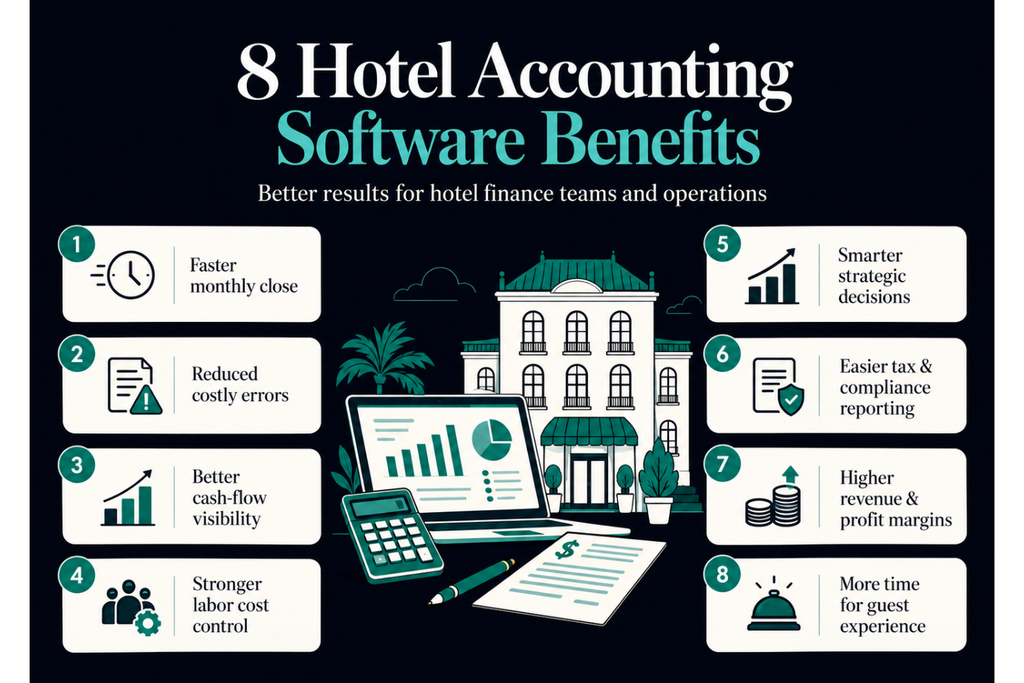
Top 8 Benefits of Hotel Accounting Software
Here are the key benefits of hotel accounting software:

Have an account? Log In
1. Faster Monthly Financial Close
Connected PMS and POS integrations bring room, restaurant, and ancillary revenue into the general ledger without repeated spreadsheet entry. Automated bank reconciliations, recurring journal entries, invoice workflows, and close checklists reduce missing data and late adjustments.
Use these features to shorten the close and improve decision-making:
- Centralized data: Finance teams work from consistent revenue and expense records.
- Automated reconciliations: Accountants identify unmatched transactions before they delay reporting.
- Close visibility: Managers track outstanding tasks, approvals, and supporting documents in one place.
- Earlier insights: General managers and department heads receive current occupancy, labor, and cost information sooner.
A shorter close gives owners more timely profit data, helping them adjust staffing, purchasing, pricing, and departmental budgets before the next reporting cycle. It also reduces overtime spent chasing errors and compiling reports.
The impact is evident in Renascent Hospitality's experience with Inn-Flow. Robyn Mounce, the company's CFO, shared:
"Monthly close previously would take me a week, whereas now it only takes a couple of days, if that."
Her experience reinforces why I consider faster financial closing one of the most valuable benefits of hotel accounting software. Less time spent reconciling transactions means finance teams can focus on analyzing financial performance and addressing issues before the next reporting cycle.
2. Reduced Risk of Costly Errors
Automated data entry and approval controls help prevent mistakes that affect guest charges, supplier payments, payroll, and financial reports. Hotel accounting software connects PMS and POS records with the general ledger, reducing duplicate entries and transcription errors.
Use these controls to protect margins and improve accountability:
- Validation rules: Flag missing fields, duplicate invoices, unusual amounts, and mismatched transactions before posting.
- Approval workflows: Route purchases, refunds, and payments to the right manager, creating a clear audit trail.
- Role-based access: Limit sensitive changes to authorized users and record who edited each transaction.
- Integrated records: Match room revenue, restaurant sales, deposits, and payment settlements across departments.
Fewer errors mean less time spent correcting journals and investigating variances. Finance teams can close accounts with fewer adjustments, while department managers avoid incorrect budgets and supplier disputes. Owners also gain more reliable profit figures for staffing and purchasing decisions.
Robert McCluskey, Financial Controller at The Spa Hotel, experienced this firsthand after adopting Aqilla and its Sharperlight reporting tool. He explained:
"Drawing reports from Aqilla via Sharperlight means my reporting is always in sync."
What stands out to me is how consistent financial reporting reduces the need to investigate discrepancies between spreadsheets and accounting records. McCluskey's experience shows why keeping reports aligned with the general ledger matters just as much as preventing data entry errors.
3. Improved Cash Flow Visibility
Real-time dashboards show what money is coming in, what’s due, and where cash is tied up. Hotel accounting software combines PMS deposits, POS sales, invoice schedules, payroll commitments, and bank balances in one view. This helps you plan payments and operating decisions before cash gaps affect service.
Use these features to improve cash control:
- Forecasting tools: Compare expected room revenue, event income, supplier bills, and payroll against available cash.
- Receivables tracking: Flag overdue group deposits, corporate balances, and unsettled payment transactions.
- Payment scheduling: Prioritize invoices by due date, approval status, and available funds.
- Department reporting: Give finance, purchasing, and general managers shared data for staffing and buying decisions.
Better visibility helps prevent late-payment fees, unnecessary borrowing, and rushed purchasing. It also supports timely supplier payments, protects guest service during low-demand periods, and gives owners clearer information for investment decisions.
Joshua Herron, Director of Platform Technology and Business Intelligence at Innisfree Hotels, described how Workday improved access to financial data:
This example shows how daily access to financial data reduces manual reporting and improves cash flow visibility. Finance teams can anticipate payment obligations, manage operating expenses, and make better financial decisions before cash shortages arise.
4. Stronger Labor Cost Control
Payroll integrations connect hours, wages, overtime, and benefits with department-level reports. You can compare scheduled labor with occupancy, room revenue, and outlet sales before payroll closes. This helps managers spot overstaffing, missed approvals, and overtime that spreadsheets often hide.
Use these features to manage labor spending:
- Department allocation: Assign payroll costs to rooms, food service, housekeeping, and other departments for clearer margins.
- Variance alerts: Flag unusual wage changes, excess overtime, and differences between forecast and actual labor costs.
- Labor forecasting: Match staffing budgets with occupancy forecasts, events, and expected service demand.
- Payroll reconciliation: Compare approved timesheets with payroll records before payment processing.
Finance teams gain more accurate labor reports, while department managers can adjust shifts sooner. Owners receive clearer departmental profit figures and can reduce avoidable overtime without cutting staffing that supports guest service.
Andy Aulakh, Chief Business Development Officer at Onvo Hospitality, highlighted the value of monitoring labor expenses before they affect financial performance:
What stands out to me is how daily labor monitoring allows managers to control costs before payroll closes. According to an Actabl case study, Onvo Hospitality reported saving over $10,000 monthly using Hotel Effectiveness and ProfitSword. This shows how better labor visibility can reduce overtime and operating costs without compromising guest service.
5. Better-Informed Strategic Decision-Making
Hotel leaders can make better decisions when revenue, costs, labor, and cash data sit in one reliable system. Instead of waiting for month-end spreadsheets, you can compare current performance with budgets, forecasts, and department targets.
Use these features to guide higher-value decisions:
- Live dashboards: Review occupancy revenue, labor costs, outlet sales, and profit by department.
- Scenario planning: Model staffing, pricing, purchasing, or renovation choices before committing funds.
- Variance reporting: Investigate gaps between forecast and actual results while the cause remains clear.
- Shared reporting: Give finance, operations, revenue, and ownership consistent figures for planning meetings.
This visibility helps finance teams direct spending, managers adjust staffing, and revenue teams protect margins during demand changes. Owners gain clearer evidence for investments, expansion, and budget approvals.
Vincent Rafanan, CFO at Hotel Nikko San Francisco, highlighted the value of detailed financial reporting after adopting Aptech's accounting and forecasting software:
"Today our team is easily comparing and contrasting any scenario from month to month."
What stands out to me is how historical financial data allows hotel leaders to compare scenarios, improve forecasts, and make smarter investment decisions. This can reduce unnecessary costs and direct resources toward more profitable services.
6. Simplified Regulatory and Tax Compliance
Accurate records and consistent reporting help you meet tax deadlines and respond to audits with less manual work. Hotel accounting software supports compliance by connecting transactions across rooms, outlets, payroll, and suppliers.
Use these features to reduce compliance risks:
- Tax configuration: Apply tax rates, exemptions, and service charges by transaction type or jurisdiction.
- Audit trails: Track edits, approvals, refunds, and journal entries with user and timestamp details.
- Document storage: Attach invoices, receipts, and supporting records to transactions for faster reviews.
- Regulatory reports: Prepare tax filings, financial statements, and management reports from consistent ledger data.
These controls reduce duplicate work for finance teams and limit penalties caused by missing records or incorrect calculations. Managers spend less time gathering documents, while owners gain clearer oversight of tax liabilities and compliance costs.
Lynda Redman, Director of Finance at Dart Marina Hotel, highlighted the importance of regulatory compliance when replacing the hotel's accounting system:
Her experience reinforces why I consider regulatory compliance essential when choosing hotel accounting software. Accurate records and consistent reporting reduce errors, audit preparation time, and late-filing risks while giving owners better oversight of compliance costs.
7. Increased Revenue and Profit Margins
Accurate revenue and cost data helps you price rooms, control leakage, and protect profit on every booking. PMS and POS integrations consolidate room, outlet, and ancillary sales, while departmental profit-and-loss reports show which services generate healthy returns.
Use these features to convert better visibility into measurable returns:
- Revenue reconciliation: Match bookings, payments, refunds, and deposits to catch missed charges or posting errors.
- Margin reporting: Compare revenue with labor, supplier, and operating costs by department.
- Forecasting: Give revenue managers and general managers reliable figures for pricing, staffing, and purchasing decisions.
- Variance alerts: Flag unusual discounts, voids, costs, and settlement differences before they reduce monthly results.
Wes Hallmark, Director of Accounting at Makan Hospitality, highlighted the value of comparing financial performance across multiple properties:
What stands out to me is how comparing costs across properties can reveal savings opportunities that individual financial reports might miss. With cleaner performance data, revenue management teams can refine pricing decisions, while operations managers can control expenses and protect departmental margins.
More Articles
8. More Time for Guest Experience
Automated invoice processing, reconciliations, payroll entries, and financial reports reduce the hours finance and operations teams spend fixing spreadsheets. This gives managers more time to support staff, resolve guest issues, and improve the overall guest experience through better daily service.
Use these features to return time to guest-facing work:
- Workflow automation: Route invoices, approvals, and payment tasks without repeated email follow-ups.
- Shared dashboards: Give general managers current labor, revenue, and expense data without manual report building.
- System integrations: Transfer PMS, POS, and payroll data directly into accounting records.
- Exception alerts: Focus attention on unusual charges, missing approvals, or reconciliation differences.
Lara Brooks, Senior Vice President of Finance Shared Services at MGM Resorts International, highlighted the connection between financial automation and guest satisfaction:
"We're much more efficient now because we've simplified how we work."
MGM Resorts reported that employees could investigate guest billing questions without switching between systems. What stands out to me is how faster access to financial records reduces administrative work, allowing staff to resolve issues sooner and maintain consistent guest service during busy periods.
Start Putting the Benefits to Work
Now that you know the benefits of hotel accounting software, you might be ready to try one but don't have the budget for a paid tool. My roundup of the best free hotel accounting software covers options worth exploring, including their features and limitations, so you can find a suitable starting point without adding to your operating costs.