

10 Hotel PMS Benefits That Improve Operations


Efficiency Gains: Hotel PMS benefits include streamlined operations and improved communication between front desk, housekeeping, and reservations, reducing costly mistakes.
Revenue Improvement: Centralized control of rates, inventory, and bookings helps maximize occupancy, increase direct bookings, and lower distribution costs.
Stronger Guest Experience: Automated check-ins, guest profiles, and service tracking enable faster arrivals and more personalized service for every guest.
Real-Time Insights: Dashboards and reports provide current data for demand forecasting, staffing, and performance tracking to improve daily decisions.
Centralized Data Security: Role-based access and secure storage ensure guest, payment, and reservation records remain protected and easy for authorized staff to manage.
The main benefits of hotel property management software include faster front desk operations and better coordination across housekeeping, reservations, and guest services. When every department works from the same real-time data, costly errors shrink and your team spends less time chasing information.
What that means in practice is more capacity to focus on guests—the part of the job that actually drives loyalty and revenue. This guide covers 10 specific benefits so you can evaluate whether a PMS fits your property's needs.
What Is Hotel Property Management Software?
Hotel property management software is a platform that centralizes reservations, room assignments, guest records, payments, and daily operations. It connects front desk, housekeeping, maintenance, and management teams through shared, up-to-date information. Features such as automated check-in workflows, room-status updates, and occupancy reports help reduce manual errors, coordinate tasks, and support better guest service. A PMS can also connect with booking channels, payment systems, and other hotel technology.

Top 10 Benefits of Hotel Property Management Software
Here are the key benefits of hotel property management software:
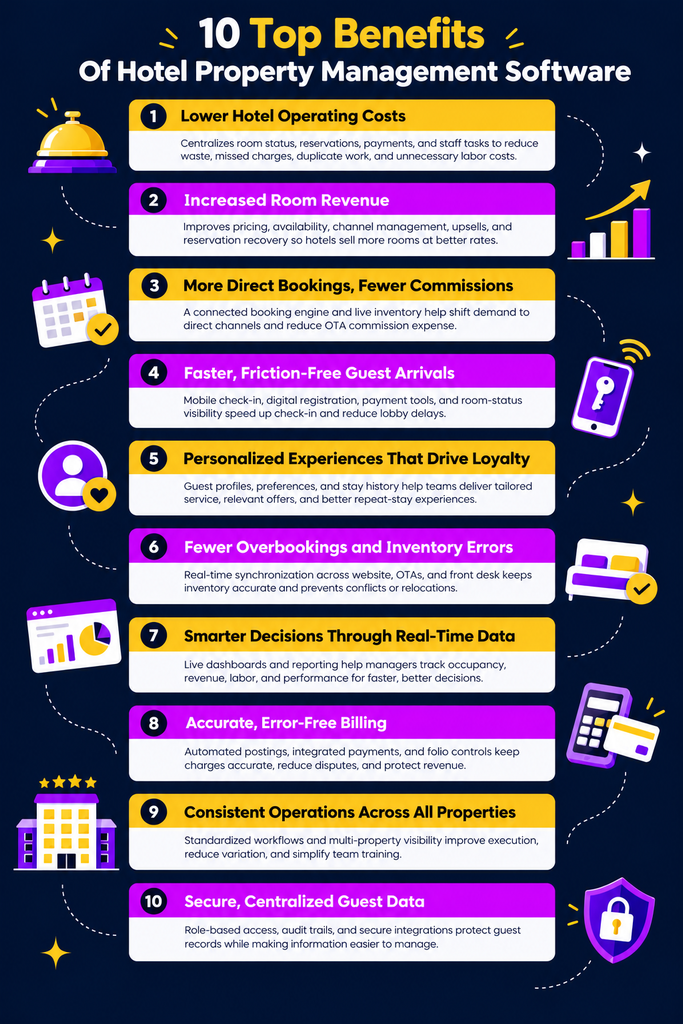
1. Lower Hotel Operating Costs
A PMS reduces avoidable expenses by connecting room status, reservations, payments, and staff tasks in one system. Real-time updates help prevent duplicate bookings, missed charges, unnecessary room cleaning, and manual data entry.
These features translate into measurable savings across departments:
- Room control: Housekeeping sees current room status, reducing wasted trips and premature cleaning.
- Labor planning: Occupancy forecasts and task boards help managers schedule staff around actual demand.
- Revenue capture: Integrated payment tools and folio controls reduce missed charges and correction work.
- Inventory accuracy: Centralized availability prevents overbooking, relocations, and compensation costs.
“Thanks to Hotelogix, our operating costs have come down drastically since we’ve cut down on commissions, labor, and overall reservation costs.”
Lower operating costs improve margins without requiring across-the-board service cuts. Front desk teams spend less time correcting records, housekeeping receives updated priorities, and managers gain reports that reveal recurring waste. According to HotelTechReport's 2026 Hotel PMS Impact Study, 88% of surveyed hoteliers reported measurable cost savings from their PMS, with 42% describing those savings as significant.
2. Increased Room Revenue
A PMS helps you sell more rooms at better rates by connecting demand data, availability, and booking channels. Key revenue drivers include:
- Rate control: Revenue teams can update room prices by occupancy, booking pace, dates, and demand patterns.
- Inventory accuracy: Real-time availability prevents rooms from remaining unsold or appearing open after reservations arrive.
- Channel distribution: Connections with online travel agencies and direct booking tools reduce manual updates and duplicate reservations.
- Upselling workflows: Front desk teams can offer room upgrades, extended stays, and paid add-ons during booking or check-in.
- Reservation recovery: Waitlists, cancellation tracking, and automated follow-ups help fill rooms after cancellations.
Higher room revenue improves RevPAR and gives managers more return from existing inventory. The PMS also helps reservations and revenue teams spend less time correcting rates and availability.
Revenue management is critical to running a profitable hotel business because it allows hoteliers to optimize their revenue opportunities.
3. More Direct Bookings, Fewer Commissions
A connected booking engine lets guests reserve through your website while seeing current rates, room types, and availability. This shifts demand away from commission-based channels and gives your team more control over the guest relationship.
Key PMS features support this shift:
- Direct booking tools: Embed a booking engine on your website and social profiles.
- Live inventory: Update availability across direct and third-party channels to prevent conflicting reservations.
- Payment processing: Accept deposits and payments during booking without manual follow-up.
- Guest profiles: Store preferences and stay history for targeted email offers and repeat bookings.
- Upselling: Present upgrades, packages, and add-ons during the reservation process.
Direct bookings reduce commission expense on each reservation. Marketing teams gain first-party guest data, reservations teams handle fewer corrections, and management can reinvest savings in website conversion, service, or demand generation.
4. Faster, Friction-Free Guest Arrivals
Guests spend less time waiting when the front desk can pull up reservations, verify details, and process payments from one screen. A PMS also supports mobile check-in, digital registration forms, key integrations, and automated room-status updates. Guest portals can let travelers complete much of the check-in process electronically before reaching the front desk.
These features address common arrival delays:
- Ready room visibility: Front desk staff can assign clean, inspected rooms without calling housekeeping.
- Digital registration: Guests can complete forms before arrival, reducing queues and manual data entry.
- Payment controls: Stored payment details and integrated terminals reduce billing corrections.
- Key coordination: PMS integrations can trigger mobile or electronic key access after check-in.
- Guest preferences: Profiles give staff relevant details before welcoming returning guests.
Faster arrivals reduce lobby congestion and give front desk teams more time for personal service. Higher throughput can support more check-ins per shift, lower overtime, and better conversion of early-arrival or upgrade requests.
5. Personalized Experiences That Drive Loyalty
Guest profiles, stay history, preferences, and service notes give your team context before each arrival. A PMS makes this information available to front desk, reservations, and guest services staff, so returning guests receive relevant recognition without relying on memory or spreadsheets.
“We prioritize a personalized approach to the guest experience.”
Use these features to turn guest data into practical service:
- Preference tracking: Record room, pillow, dietary, and communication preferences for future stays.
- Pre-arrival messaging: Send tailored instructions, upgrade offers, or celebration packages based on reservation details.
- Guest segmentation: Group guests by stay history, source, or preferences for relevant offers.
- Service recovery: Share complaint history and resolution notes so teams avoid repeating past mistakes.
Personalized service can increase repeat bookings, direct reservations, and add-on revenue. Front desk teams gain useful context, while marketing teams can target past guests without rebuilding lists manually.
Personalization isn’t just a marketing ‘add-on’ anymore—it’s an architectural requirement.
6. Fewer Overbookings and Inventory Errors
A shared inventory record keeps room availability accurate across your website, OTAs, and front desk. The PMS updates reservations and room status in real time, so staff don’t sell rooms that another channel has already reserved. Real-time synchronization reduces overbooking risk by keeping rates and availability aligned across connected booking channels.
These features address the errors that create relocations, refunds, and guest frustration:
- Channel synchronization: Push availability, rates, and restrictions to connected booking channels.
- Room-type controls: Track individual room types, out-of-order units, blocks, and maintenance holds.
- Reservation safeguards: Flag duplicate bookings, invalid dates, and conflicting room assignments.
- Housekeeping updates: Send inspected-room status to the front desk before new arrivals.
- Audit trails: Show who changed inventory, rates, or reservation details.
Reservations teams spend less time correcting records. Front desk staff avoid difficult relocation conversations, while managers protect occupancy, revenue, and reputation. Fewer compensation payments and manual corrections create measurable operational savings.
7. Smarter Decisions Through Real-Time Data
When occupancy, room status, rates, and payments update in one system, managers can act on current information instead of outdated spreadsheets. Real-time hotel performance data helps teams track occupancy, revenue, and booking trends as they change.
Use these data capabilities to improve daily decisions:
- Live dashboards: Managers spot occupancy changes and adjust staffing, rates, or room availability.
- Forecasting reports: Revenue teams compare pickup, booking channels, and room demand before changing pricing.
- Department updates: Front desk and housekeeping coordinate assignments using current room-status data.
- Exception alerts: Teams address payment failures, overbookings, and maintenance holds before they affect arrivals.
- Performance reporting: Owners measure occupancy, RevPAR, labor costs, and channel commissions for clearer ROI decisions.
This shared visibility reduces guesswork, limits costly errors, and helps each department direct resources where they produce the greatest return.
There’s a lot of data out there, but it needs to be blended together for it to make sense.
8. Accurate, Error-Free Billing
A PMS links reservations, room charges, payments, and folios in one record. Automated billing and payment reconciliation reduces manual financial work and helps keep guest accounts accurate.
Use these billing features to protect revenue and guest trust:
- Automated postings: Add room, tax, minibar, dining, and service charges to the correct folio.
- Integrated payments: Match deposits, card authorizations, refunds, and receipts with each reservation.
- Folio controls: Separate charges by guest, company, room, or group while preserving an audit trail.
- Exception alerts: Flag declined payments, missing deposits, duplicate entries, and unusual adjustments.
- Department access: Let front desk, finance, and service teams review current balances without duplicate data entry.
Accurate folios reduce checkout disputes, write-offs, refunds, and finance corrections. Front desk staff spend less time investigating charges, while finance teams close accounts with fewer manual adjustments. Capturing billable services also improves revenue per stay.
9. Consistent Operations Across All Properties
Shared workflows help every property follow the same standards for reservations, check-ins, housekeeping, billing, and service recovery. A multi-property PMS gives regional managers visibility without forcing each site to maintain separate spreadsheets or procedures.
Key features support consistent execution across locations:
- Centralized standards: Apply common room types, rate rules, policies, and task templates.
- Property controls: Let each hotel manage local inventory while preserving approved brand settings.
- Shared guest profiles: Give teams access to stay history and preferences across participating properties.
- Performance dashboards: Compare occupancy, RevPAR, labor costs, and service issues by location.
- Role permissions: Control access while maintaining clear accountability for changes.
Standardized processes reduce training time, data errors, and variation in guest service. Corporate teams can identify underperforming properties sooner, while local managers spend less time rebuilding workflows. Those gains reduce administrative labor, limit revenue leakage, and support more predictable returns across the portfolio.
10. Secure, Centralized Guest Data
Keep guest profiles, identification details, payment records, preferences, and stay history in one controlled system. Hotel property management software replaces scattered spreadsheets and paper files with role-based access, encrypted storage, audit trails, and permission settings. These features help prevent duplicate records, unauthorized changes, and misplaced guest information.
Use these capabilities to protect data and support daily service:
- Role-based access: Give front desk, finance, and managers only the permissions their work requires.
- Centralized profiles: Let authorized teams view current preferences, requests, and history without copying data between systems.
- Audit trails: Track changes to reservations, folios, and guest records for accountability.
- Secure integrations: Connect payment and booking tools while limiting repeated manual entry.
Fewer data errors reduce billing corrections and privacy risks. Staff spend less time searching for records, while managers gain clearer oversight and lower administrative costs.
A PMS Delivers—but Only if You Choose the Right One
Once you know what a PMS can do for your property, the next step is finding one that fits your systems, team, and scale—and our guide on how to choose a hotel property management system walks you through a practical framework for evaluating vendors, building a shortlist, and making the case to leadership.