
Gerir um hotel não é tarefa fácil. Tem de conciliar as expectativas dos hóspedes, a gestão da equipa e as operações diárias. É fácil sentir-se sobrecarregado. É aqui que entram as soluções tecnológicas para hotelaria. Estas ferramentas foram concebidas para facilitar a sua vida, ajudando-o a gerir reservas, melhorar a experiência dos hóspedes e manter tudo a funcionar sem problemas.
Com base na minha experiência, nem todo o software é igual. Testo e analiso estas soluções de forma independente, concentrando-me naquilo que realmente o beneficia a si e à sua equipa. Este artigo irá guiá-lo pelas melhores opções disponíveis, destacando os seus pontos fortes na resolução dos seus desafios específicos.
Continue a ler para obter uma análise detalhada de como estas ferramentas podem contribuir para o sucesso do seu hotel.
Why Trust Our Software Recommendations
6,700+
Reviews
20
Industry experts
16+
Evaluation factors
14
Years
Our team has been testing and reviewing software since 2012. As hospitality leaders ourselves, we know how difficult—and important—it is to choose the right software.
For this guide, we evaluated tools using hands-on testing and independent research, scoring tools using our selection criteria.
Our reviews reflect our human editorial judgment, not a sales pitch.
Tabela comparativa de soluções tecnológicas para hotelaria
Esta tabela comparativa resume os detalhes de preços das minhas principais escolhas de soluções tecnológicas para hotelaria:
| Tool | Best For | Trial Info | Price | ||
|---|---|---|---|---|---|
| 1 | Best for end-to-end AI guest experience management | Free demo available | Pricing upon request | Website | |
| 2 | Best for preventive maintenance scheduling | 30-day free trial + free demo available | Single plan at $35 per user/month (billed annually) | Website | |
| 3 | Best for centralized guest communication | 14-day free trial + free demo available | From $5/screen/month | Website | |
| 4 | Best for independent hotel management | Free demo available | Pricing upon request | Website | |
| 5 | Best for secure hospitality IT infrastructure | 30-day free trial | Pay-as-you-go | Website | |
| 6 | Best for enterprise hotel ecosystems | Free demo available | Pricing upon request | Website | |
| 7 | Best for frontline, mobile hospitality devices | Free demo available | Pricing upon request | Website | |
| 8 | Best for automated hotel operations | Free demo available | Pricing upon request | Website | |
| 9 | Best for property management in an ERP ecosystem | Free demo available | Pricing upon request | Website | |
| 10 | Best for guest feedback and data insights | Free demo available | Pricing upon request | Website |


Análises das melhores soluções tecnológicas para hotelaria
Abaixo encontrará os meus resumos detalhados das melhores soluções tecnológicas para hotelaria que entraram na minha lista. As minhas análises apresentam uma visão detalhada das principais funcionalidades, vantagens e desvantagens, integrações e casos de utilização ideais de cada ferramenta, para o ajudar a encontrar a melhor opção para si.
 Best for end-to-end AI guest experience management
- Free demo available
- Pricing upon request
Visit WebsiteCustomer Rating:4.8/5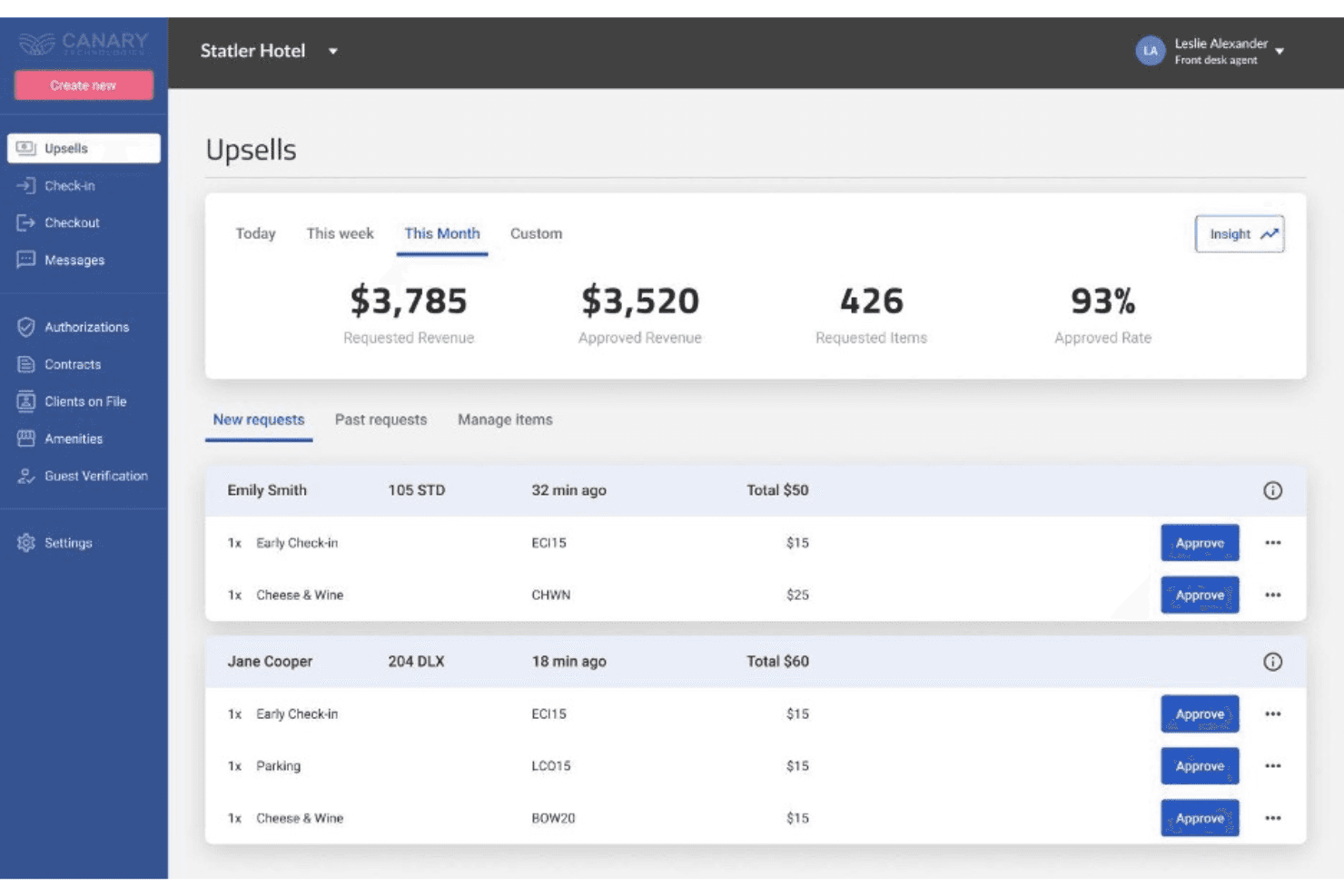
Canary Technologies supports contactless check-in, payments, and messaging. Canary Technologies is a guest experience platform that covers the full guest journey—from AI-powered messaging and mobile check-in to dynamic upsells, F&B mobile ordering, and digital checkout—layering AI automation across property operations.
Who Is Canary Technologies Best For?
Canary Technologies is a strong fit for hotel general managers and revenue managers who want AI automation layered across every stage of the guest journey—from pre-arrival through departure.
Why I Picked Canary Technologies
I've included Canary Technologies in my top picks because it covers the full guest journey with AI automation layered across every stage, from pre-arrival through departure. I particularly like how AI Guest Messaging handles over 80% of routine inquiries automatically, while Dynamic Upsells drive incremental revenue on room upgrades, F&B, and extras without third-party commissions. Add self-service kiosks, mobile keys, and Smart Checkout, and you get a platform that reduces front desk load at both ends of the stay.
Canary Technologies Key Features
- AI Voice: Handles inbound guest calls around the clock, reducing front-desk call volume and freeing staff for on-property service.
- Mobile keys: Lets guests access their rooms and hotel amenities directly from their own smart devices, without stopping at the front desk.
- F&B mobile ordering: Provides a mobile-first food-and-beverage ordering experience guests can use anywhere on property.
- Digital Tipping: Gives guests a quick way to tip staff via QR code or in-app, supporting team earnings without requiring cash.
Canary Technologies Integrations
Canary Technologies lists integrations with Oracle Hospitality, Cloudbeds, Mews, SiteMinder, Booking.com, Shift4 Payments, Adyen, Fiserv, and protel. It offers an API, including a two-way, real-time protel connection.
Pros and Cons
Pros:
- Upsells and mobile ordering create revenue opportunities
- AI messaging and voice ease front-desk load
- Pre-arrival check-in reduces lobby waits
Cons:
- Guests may mistake pending upsells as confirmed
- Requires an external PMS for reservations
Learn more about Canary Technologies: Best for preventive maintenance scheduling
- 30-day free trial + free demo available
- Single plan at $35 per user/month (billed annually)
Visit WebsiteCustomer Rating:4.7/5
Monitor maintenance performance with Click Maint CMMS's reporting dashboard, featuring real-time KPIs, work order completion trends, and detailed maintenance metrics to improve operational efficiency. Click Maint CMMS is a maintenance management platform built for hotels, facilities, and multi-site operations, covering work order management, preventive maintenance scheduling, asset tracking, and parts inventory.
Who Is Click Maint CMMS Best For?
Click Maint CMMS is a strong fit for small to mid-sized hotel and resort operations teams that need a straightforward maintenance management tool without enterprise-level complexity.
Why I Picked Click Maint CMMS
I've included Click Maint CMMS in my top picks because its preventive maintenance scheduling is one of the most flexible I've seen for hotel and resort operations. You can set PMs to trigger on hourly, daily, weekly, monthly, or annual cycles, and associate each task with a specific asset or location. I also like that each PM includes task checklists, so recurring jobs like HVAC filter changes or pool equipment inspections follow the same steps every time.
Click Maint CMMS Key Features
- Work order request portal: Lets hotel staff submit maintenance requests directly, which route to technicians for assignment and approval.
- Mobile app: iOS and Android app gives technicians access to work orders, asset details, and checklists from anywhere on property.
- Parts and inventory management: Track parts stock across storerooms, set low-stock alerts, and link parts usage directly to work orders.
- Maintenance reporting: Built-in dashboards track KPIs like work order completion rates and asset downtime across your property.
Click Maint CMMS Integrations
Click Maint CMMS integrates with Slack, and its open API makes it easy to integrate with ERP, accounting, and other business systems. Tools like Zapier and Tray.io can also serve as middleware to connect Click Maint with additional applications.
Pros and Cons
Pros:
- Flexible PM scheduling intervals available
- QR code scanning from mobile app
- Unlimited free requesters on paid plan
Cons:
- No predictive or condition-based maintenance
- Reporting and KPI customization is limited
Learn more about Click Maint CMMS: Best for centralized guest communication
- 14-day free trial + free demo available
- From $5/screen/month
Visit WebsiteCustomer Rating:5/5
Buzzblender offers a digital signage solution with cloud-based content scheduling, device management, and multi-location screen displays across retail, restaurant, and corporate environments. Buzzblender is a cloud-based digital signage platform that lets hotels manage promotional content across in-room and lobby screens, with tools for playlist scheduling, content delivery, and screen monitoring.
Who Is Buzzblender Best For?
Buzzblender is a good fit for hotel marketing and operations teams that manage on-screen content across multiple guest-facing displays.
Why I Picked Buzzblender
I picked Buzzblender as one of the best because its centralized admin panel lets hotel teams push content to every guest-facing screen from a single dashboard. In practice, that means my team can display spa promotions, F&B offers, and in-room dining specials without touching each display manually. The Hotel Mode for Android TVs is especially useful, activating promotional content whenever a TV enters idle mode, so guest messaging is always on without requiring staff action.
Buzzblender Key Features
- Playlist scheduling: Build time-based content queues so the right promotions appear on screen at the right time of day.
- QR code overlays: Add scannable QR codes directly to any screen, linking guests to menus, offers, or booking pages.
- Screen monitoring: View the live status of all connected displays from one dashboard to catch outages quickly.
- Multi-user access: Assign different content permissions to team members based on their role or property.
Buzzblender Integrations
Native integrations are not clearly documented.
Pros and Cons
Pros:
- QR code overlays track guest engagement
- Supports multi-location screen management remotely
- Works on existing hotel TV hardware
Cons:
- Limited interactive touchscreen kiosk capabilities
- No native third-party software integrations
Learn more about Buzzblender: Best for independent hotel management
- Free demo available
- Pricing upon request
Visit WebsiteCustomer Rating:4.3/5
Cloudbeds helps manage bookings, channels, and daily operations. Cloudbeds is a PMS designed for independent hotels, hostels, and vacation rentals. It helps manage reservations, guest check-ins, and day-to-day operations. The platform focuses on simplifying tasks for smaller hospitality businesses to improve their efficiency and service.
Why I picked Cloudbeds: Cloudbeds excels in serving independent hotels by offering features that simplify operations. Its intuitive interface makes it easy for smaller teams to manage bookings and payments. The platform's Channel Manager connects your property to various booking sites, ensuring a wider reach. Additionally, the centralized reservation system helps you keep track of all bookings in one place.
Standout Features and Integrations:
Features include a Channel Manager that connects to multiple booking sites, a centralized reservation system for easy management, and automated payment processing for smooth transactions.
Integrations include Booking.com, Expedia, TripAdvisor, Google Hotel Ads, Stripe, QuickBooks, Mailchimp, Xero, and more.
Pros and Cons
Pros:
- Central view of reservations
- Simplifies daily booking tasks
- Built primarily for independents
Cons:
- Customization range feels narrow
- Limited growth for big groups
 Best for secure hospitality IT infrastructure
- 30-day free trial
- Pay-as-you-go

HPE supports hospitality operations with scalable infrastructure. HPE provides hospitality technology solutions focused on data security and infrastructure for hotels and resorts. It serves large hospitality businesses by offering secure, reliable, and scalable solutions to manage operations and guest experiences. Key functions include infrastructure management, data protection, and network security.
Why I picked HPE: HPE is known for its strong focus on data security, making it ideal for hoteliers concerned with protecting sensitive information. Its solutions include secure networking options and infrastructure management tools. HPE's hybrid cloud services ensure flexibility and reliability. Additionally, its in-depth support for IT infrastructure helps maintain operational efficiency.
Standout Features and Integrations:
Features include hybrid cloud services for flexible operations, secure networking solutions to protect data, and infrastructure management tools for efficient resource allocation.
Integrations are not currently listed by HPE.
Pros and Cons
Pros:
- Flexible hybrid cloud choices
- Scales infrastructure for growth
- Strong security-first approach
Cons:
- Best fits large enterprises
- Needs experienced IT staff for full feature utilization
Learn more about Hewlett Packard Enterprise (HPE): Best for enterprise hotel ecosystems
- Free demo available
- Pricing upon request

Oracle Hospitality provides enterprise-level PMS and cloud tools. Oracle Hospitality is a detailed hotel technology solution designed for large enterprises. It primarily serves hotels, casinos, and food service sectors, focusing on improving the customer experience and optimizing operations. Key functions include property management, sales and event management, and finance management.
Why I picked Oracle Hospitality: Oracle Hospitality offers an extensive property management system (PMS) that handles all hotel operations efficiently. Its cloud digital assistant automates routine tasks, aligning with the company's strength in serving large enterprises. OPERA Cloud Central provides centralized sales and distribution management, which is vital for large-scale operations. Additionally, its AI-driven channel and rate management systems ensure optimal pricing strategies.
Standout Features and Integrations:
Features include a loyalty program to strengthen customer relationships, a hotel cloud POS system for food and beverage services, and mobile guest experiences for pre-registration and check-in.
Integrations include Oracle Cloud Infrastructure, OPERA Cloud Central, other Oracle solutions, and more.
Pros and Cons
Pros:
- Supports complex hotel groups
- Strong end-to-end coverage
- Smooth integration with Oracle solutions across various systems
Cons:
- Can be expensive to implement, maintain, and integrate
- Better fit for large chains
Learn more about Oracle Hospitality: Best for frontline, mobile hospitality devices
- Free demo available
- Pricing upon request

Zebra gives hotels devices for on-the-go orders, payments, and coordination. Zebra provides hardware and software solutions that cater to hospitality businesses such as hotels, restaurants, and entertainment venues. Its product offering centers on mobile computers, tablets, printers, and related software to enable functions including mobile ordering, payments, inventory tracking, guest access management, and staff communications.
Why I picked Zebra: Zebra gives you handheld and mobile device options that let your staff take orders, process payments, and manage inventory right from wherever they are — not just from a fixed terminal. If your operation relies on mobility (servers going to tables or staff moving through hotel floors, events, and venues), Zebra’s mobile POS, printing, and communication tools let your team stay flexible. Its devices support mobile payment (via their own payment solution), on-demand access-card printing, and real-time inventory tracking to help your team react faster to guest needs. Because everything is built for mobile use, it reduces bottlenecks from fixed stations and helps your staff serve guests more efficiently.
Standout Features and Integrations:
Features include mobile computers and tablets for ordering and payments, on-demand printing for access cards or guest passes, and real-time inventory tracking across your hospitality operation. Zebra also offers food safety and food-labeling tools to help you manage compliance and guest safety. Additionally, its communication devices include push-to-talk and VoIP capabilities to keep your staff connected across different areas of your facility.
Integrations include Zebra Pay, Workforce Connect, StageNow Android Device Staging, Mobility Extensions (Mx), and more.
Pros and Cons
Pros:
- Enables portable card printing
- Supports roaming staff work
- Strong mobile device options
Cons:
- Higher hardware and licensing costs
- Scheduling tools offer limited customization
Learn more about Zebra:

Mews automates reservations, billing, and reporting so you can focus on guests. Mews is a cloud-based PMS designed for hotels, hostels, and serviced apartments. It helps manage reservations, payments, and guest services efficiently. The platform is known for automating many manual processes and allows your team to focus more on guest experiences.
Why I picked Mews: Mews offers advanced automation features that simplify daily operations. The automated billing and invoicing system reduces manual entry, saving your team time. Smart reservation management helps optimize room allocations and availability. The platform's reporting tools provide insights into business performance, aiding in decision-making.
Standout Features and Integrations:
Features include automated billing for easy financial management, smart reservation tools to optimize bookings, and detailed reporting for business insights.
Integrations include Lightspeed, Dataria Revenue Management, Duetto Research, and more.
Pros and Cons
Pros:
- Helps optimize room usage
- Handles complex billing flows
- Strong process automation focus
Cons:
- Requires early staff training
- Setup is tricky for beginners
Learn more about Mews: Best for property management in an ERP ecosystem
- Free demo available
- Pricing upon request

Infor offers hotel management with strong property, data, and analytics control. Infor provides an enterprise-oriented hotel management solution tailored for hotels and resorts. It serves large hospitality businesses by offering tools for property management, financial planning, and guest services. The platform focuses on improving operational efficiency and improving guest experiences.
Why I picked Infor: Infor excels in property management, providing a centralized system to handle all hotel operations. Its cloud-based technology allows for real-time data access, which is essential for large hotels. The platform's analytics tools help you make informed decisions based on guest trends and behaviors. Additionally, its customizable reporting features support strategic planning and financial forecasting.
Standout Features and Integrations:
Features include real-time data access for informed decision-making, analytics tools to understand guest trends, and customizable reporting for strategic planning.
Integrations include Deloitte Consulting, Intellias, Courtesy Point, and more.
Pros and Cons
Pros:
- Suits large hotel operations
- Real-time operational insight
- Central hub for properties
Cons:
- Aimed mainly at bigger groups
- Implementation can be time-consuming
Learn more about Infor:

Otelier unifies guest feedback, finance tools, and insights for hoteliers. Otelier is a detailed hotel management software designed for the hospitality industry. It caters to hotels and resorts by providing tools for operations, finance, and revenue management. The software helps improve decision-making and automate routine tasks.
Why I picked Otelier: Otelier excels in collecting and managing guest feedback, which is key to improving service quality. Its IntelliSight tool provides data-driven insights, allowing your team to make informed decisions. DigiAudit ensures compliance with night audits, while TruePlan aids in budgeting and financial planning. The platform's automation capabilities save time and improve accuracy in financial operations.
Standout Features and Integrations:
Features include operations management for smooth workflows, finance tools for accurate budgeting, and business intelligence for data-driven insights.
Integrations include Stayntouch, Paycor, Aptech, and more.
Pros and Cons
Pros:
- Automates hotel finance tasks
- Strong analytics for decisions
- Focuses on feedback programs
Cons:
- Occasional system lags and bugs
- Fewer custom layout options
Learn more about Otelier:
Outras soluções tecnológicas para hotelaria
Eis algumas opções adicionais de soluções tecnológicas para hotelaria que não entraram na minha lista, mas que ainda vale a pena conhecer:
- 11Comcast BusinessBest for reliable hotel network infrastructure
- 12HTSBest for core operations for small hotels
- 13Aven HospitalityBest for global OTA distribution control
- 14TripleseatBest for catering management
- 15Mara SolutionsBest for online reputation
- 16Cvent Event DiagrammingBest for event planning
How I Evaluate Hospitality Technology Solutions
I evaluate every platform in two layers: whether it handles the PMS, channel management, and booking engine basics, then how it differentiates on revenue, guest experience, and integrations.
Core Functionality (Table Stakes For This List)
When I'm selecting tools for my list, I rank each one on a scale from 0 (does not offer the functionality) to 5 (excels in this area) for each core functionality listed below. Then, I calculate the tool's total score into a percentage. Each tool needs to achieve a minimum total score of 75% to be considered for inclusion.
- Property Management System: I check whether the PMS handles reservations, folios, guest profiles, and check-in/out—plus whether it supports group blocks and multi-property setups.
- Channel Manager & Distribution: Real-time two-way sync across OTAs and GDS matters here, so I look at channel breadth and how quickly rate and inventory changes push out.
- Booking Engine: I evaluate the direct booking engine for mobile responsiveness, payment capture, and promotional features like discount codes or room-type upsells.
- Rate & Revenue Management: Dynamic pricing tied to occupancy and demand data is what I look for—whether the tool offers yield rules, rate plans, and competitor benchmarking.
- Guest Experience Tools: From automated pre-arrival emails to digital check-in and post-stay review requests, I evaluate how much of the guest journey the platform covers.
- Hospitality Integrations: I look at connectivity with the tools hotels actually rely on daily—POS for F&B, electronic door locks, housekeeping apps, payment gateways, and accounting software.
Once I have a list of tools that meet this criteria, I consider what sets each platform apart.
Differentiating Factors (What Sets Vendors Apart)
Here's how I compare and contrast different vendors:
Standout Features
AI-driven revenue optimization separates the best tools here. I look at whether a platform auto-adjusts rates based on demand forecasts and competitor pricing, not just static yield rules. Business intelligence dashboards also carry weight—I evaluate whether you get real-time KPIs like RevPAR, ADR, and pace reports across properties in one view. Upsell automation is another area I check: platforms that trigger room upgrade or early check-in offers before arrival can meaningfully boost ancillary revenue.
Beyond Features
Property type fit matters a lot. A platform built for a 10-room boutique hotel won't serve a 200-room resort with multiple F&B outlets well, so I evaluate whether each vendor targets independents, groups, or both. Implementation is another key factor—migrating from a legacy PMS mid-season can disrupt operations, so I check whether vendors offer dedicated onboarding support and realistic go-live timelines. I also look at pricing structure, especially whether costs scale per room, per property, or per transaction.
Como escolher uma solução tecnológica para hotelaria
É fácil perder-se em listas extensas de funcionalidades e estruturas de preços complexas. Para o ajudar a manter-se concentrado enquanto analisa o seu processo específico de seleção de software, eis uma lista de verificação dos fatores a ter em conta:
| Fator | O que considerar |
| Escalabilidade | A solução pode acompanhar o crescimento do seu negócio? Considere se consegue gerir mais quartos ou localizações sem problemas. Procure planos flexíveis que possam ser ampliados. |
| Integrações | Funciona com os seus sistemas atuais? Verifique a compatibilidade com o seu motor de reservas, processadores de pagamentos e outras ferramentas essenciais. |
| Personalização | Pode adaptá-la às suas necessidades específicas? Procure opções para ajustar fluxos de trabalho, funções de utilizador e elementos de marca de modo a adaptar-se perfeitamente às suas operações. |
| Facilidade de utilização | É fácil de aprender para a sua equipa? Uma interface simples reduz o tempo de formação e os erros. Procure disposições intuitivas e instruções claras. |
| Implementação e integração inicial | Com que rapidez pode começar? Avalie os recursos necessários para a configuração e a formação. Procure ferramentas com integração inicial orientada e apoio. |
| Custo | Encaixa-se no seu orçamento? Compare os modelos de preços e certifique-se de que compreende todas as taxas. Esteja atento a custos ocultos relacionados com funcionalidades ou apoio. |
| Medidas de segurança | Como protege os seus dados? Certifique-se de que dispõe de encriptação forte, cópias de segurança regulares e conformidade com as normas de proteção de dados. |
| Disponibilidade do apoio | Pode obter ajuda quando precisa? Procure apoio 24 horas por dia, 7 dias por semana, e vários métodos de contacto, como chat e telefone, para garantir que a assistência está sempre disponível. |
O que são soluções tecnológicas para a hotelaria?
As soluções tecnológicas para a hotelaria são ferramentas e sistemas concebidos para ajudar hotéis e empresas semelhantes a gerir as suas operações de forma eficiente. Os gestores de hotéis, os funcionários da receção e as equipas de operações utilizam normalmente estas ferramentas para melhorar a experiência dos hóspedes e otimizar as tarefas diárias. As funcionalidades de gestão de reservas, processamento de pagamentos e comunicação com os hóspedes contribuem para operações mais fluidas e uma melhor prestação de serviços. De um modo geral, estas ferramentas aumentam a eficiência e a satisfação dos hóspedes no setor da hotelaria.
Funcionalidades
Ao selecionar soluções tecnológicas para a hotelaria, esteja atento às seguintes funcionalidades principais:
- Gestão de reservas: Simplifica os processos de reserva e assegura uma atribuição precisa dos quartos para melhorar a experiência dos hóspedes.
- Processamento de pagamentos: Facilita o tratamento seguro e eficiente das transações, reforçando as operações financeiras.
- Comunicação com os hóspedes: Disponibiliza ferramentas para uma interação eficaz com os hóspedes, melhorando a satisfação e a fidelização.
- Gestão de canais: Liga os estabelecimentos a várias plataformas de reservas, aumentando a visibilidade e as taxas de ocupação.
- Relatórios e análise: Fornece informações sobre o desempenho do negócio, ajudando na tomada de decisões fundamentadas e no planeamento estratégico.
- Capacidades de automatização: Reduz as tarefas manuais, permitindo que os funcionários se concentrem nos serviços aos hóspedes e na eficiência operacional.
- Interfaces personalizáveis: Permitem adaptar o sistema às necessidades específicas do negócio e aos requisitos da marca.
- Suporte de integração: Garante a compatibilidade com os sistemas existentes, melhorando a funcionalidade geral e a facilidade de utilização.
- Acesso móvel: Permite aos funcionários gerir as operações em qualquer lugar, aumentando a flexibilidade e a capacidade de resposta.
- Medidas de segurança: Protegem os dados sensíveis através de encriptação e conformidade com as normas do setor, garantindo confiança e fiabilidade.
Vantagens
A implementação de soluções tecnológicas para a hotelaria proporciona várias vantagens à sua equipa e ao seu negócio. Eis algumas das vantagens que pode esperar:
- Maior eficiência: A automatização e a simplificação dos processos reduzem o trabalho manual, permitindo que a sua equipa se concentre nos serviços aos hóspedes.
- Maior satisfação dos hóspedes: As ferramentas de comunicação eficazes e os serviços personalizados conduzem a hóspedes mais satisfeitos e ao regresso dos clientes.
- Melhor tomada de decisões: As funcionalidades de análise e elaboração de relatórios fornecem informações baseadas em dados, apoiando o planeamento estratégico e as melhorias operacionais.
- Aumento das taxas de ocupação: A gestão de canais amplia o alcance do seu estabelecimento, preenchendo mais quartos e maximizando as receitas.
- Transações seguras: O processamento avançado de pagamentos garante operações financeiras seguras e fiáveis, protegendo tanto o seu negócio como os seus hóspedes.
- Flexibilidade e mobilidade: O acesso móvel permite aos funcionários gerir tarefas em qualquer lugar, melhorando a capacidade de resposta e adaptação.
- Opções de personalização: Adaptar as interfaces e os fluxos de trabalho às suas necessidades específicas melhora a experiência do utilizador e o alinhamento operacional.
Custos e preços
A seleção de soluções tecnológicas para hotelaria requer uma compreensão dos vários modelos de preços e planos disponíveis. Os custos variam consoante as funcionalidades, a dimensão da equipa, os complementos e outros fatores. A tabela abaixo resume os planos comuns, os respetivos preços médios e as funcionalidades normalmente incluídas nas soluções tecnológicas para hotelaria:
Tabela de Comparação de Planos para Soluções Tecnológicas para Hotelaria
| Tipo de Plano | Preço Médio | Funcionalidades Comuns |
| Plano Gratuito | $0 | Gestão básica de reservas, suporte limitado e relatórios básicos. |
| Plano Pessoal | $60-$180/utilizador/mês | Gestão de reservas, ferramentas de comunicação com os hóspedes e análise básica. |
| Plano Empresarial | $149-$320/utilizador/mês | Análise avançada, processamento de pagamentos e gestão de canais. |
| Plano Empresarial de Grande Dimensão | Personalizado | Interfaces personalizáveis, suporte à integração e medidas de segurança avançadas. |
Perguntas Frequentes sobre Soluções Tecnológicas para Hotelaria
Eis algumas respostas a perguntas comuns sobre soluções tecnológicas para hotelaria.
Como podem as soluções tecnológicas para hotelaria ajudar os pequenos hotéis a competir com grandes marcas?
Os pequenos hotéis podem utilizar soluções tecnológicas para hotelaria para parecerem tão organizados e disponíveis como as grandes cadeias. Pode utilizar as mesmas ferramentas de gestão de canais, mensagens para hóspedes e pagamentos em que as marcas maiores confiam. Isto ajuda-o a responder mais rapidamente, evitar reservas excessivas e proporcionar estadias mais tranquilas. Mesmo com uma equipa pequena, pode manter bons registos, personalizar as estadias e gerir períodos movimentados sem caos.
O que devo saber antes de mudar de sistemas antigos para soluções tecnológicas para hotelaria na nuvem?
Antes de passar de um sistema antigo para uma ferramenta na nuvem, faça um levantamento de todos os dados que precisa de transferir e do local onde ficarão armazenados. Deve verificar se o novo sistema consegue substituir todas as funções essenciais ou se continuará a manter alguma coisa localmente. É aconselhável utilizar ambos os sistemas em paralelo durante um curto período, enquanto testa os fluxos de trabalho reais. Reserve tempo adicional para a formação e para pequenas correções, para que a sua equipa não se sinta pressionada durante a mudança.
Como posso evitar ficar dependente de um fornecedor de soluções tecnológicas para hotelaria?
Para evitar ficar dependente de um fornecedor, procure ferramentas que suportem padrões abertos e opções claras de exportação de dados. Pergunte aos fornecedores como pode obter os seus dados caso algum dia abandone o serviço e em que formato. Verifique se o sistema disponibiliza APIs ou conectores comuns, para que possa mudar ou adicionar ferramentas mais tarde. Sentir-se-á mais confiante ao assinar um contrato quando souber que pode seguir em frente sem perder o seu histórico.
Como podem as soluções tecnológicas para hotelaria apoiar grupos hoteleiros com várias propriedades?
As soluções tecnológicas para hotelaria podem proporcionar uma visão centralizada de todas as suas propriedades. Pode consultar reservas, receitas e tendências dos hóspedes por hotel, região ou marca num único local. Isto ajuda-o a partilhar tarifas, políticas e processos sem ter sistemas separados em todo o lado. As suas equipas podem continuar a tratar das tarefas locais, enquanto a sede acompanha o desempenho de todo o portefólio.
Com que frequência devo rever ou atualizar as minhas soluções tecnológicas para hotelaria?
É aconselhável rever a sua configuração pelo menos uma vez por ano. Analise a forma como a sua equipa utiliza efetivamente as ferramentas e identifique as áreas em que ainda depende de folhas de cálculo ou de trabalho manual. Deve também verificar se o sistema atual continua adequado ao número de quartos, aos canais e às expectativas dos hóspedes. As revisões regulares ajudam-no a planear atualizações com tranquilidade, em vez de agir à pressa depois de surgir uma avaria.
O que devo perguntar aos fornecedores sobre a titularidade dos dados nas soluções tecnológicas para hotelaria?
Deve perguntar aos fornecedores quem é o proprietário dos dados dos hóspedes e dos dados operacionais armazenados no sistema. Certifique-se de que o contrato estabelece que mantém a titularidade dos seus dados e que pode exportá-los quando necessário. Pergunte durante quanto tempo mantêm as cópias de segurança e o que acontece se cancelar o serviço. Respostas claras a estas questões ajudam-no a proteger a sua marca, os perfis dos hóspedes e os seus planos a longo prazo.