

Hotel spa management software is a platform that manages spa bookings, treatments, staff schedules, guest profiles, payments, and hotel folio charges in one system. The best hotel spa management software also connects with your property management system, helping front-desk and spa teams coordinate reservations without duplicate records or posting errors. This guide compares options for independent hotel spas, luxury resorts, and multi-property groups based on integrations, scheduling tools, reporting, and day-to-day usability.
Why Trust Our Software Recommendations
6,700+
Reviews
20
Industry experts
16+
Evaluation factors
14
Years
Our team has been testing and reviewing software since 2012. As hospitality leaders ourselves, we know how difficult—and important—it is to choose the right software.
For this guide, we evaluated tools using hands-on testing and independent research, scoring tools using our selection criteria.
Our reviews reflect our human editorial judgment, not a sales pitch.
Comparison Table: Hotel Spa Management Software
Compare pricing and specs side by side for the hotel spa management software that made it onto my shortlist.
| Tool | Best For | Trial Info | Price | ||
|---|---|---|---|---|---|
| 1 | Best for all-in-one spa ops without PMS needs | 30-day free trial + free demo available | From $30/month | Website | |
| 2 | Best for AI-driven spa ops at hotel scale | Not available | Pricing upon request | Website | |
| 3 | Best for hotel spa groups managing multiple locations | Free demo available | From $139 | Website | |
| 4 | Best for multi-location spa booking and guest profiles | Free demo available | From $79/month | Website | |
| 5 | Best for luxury hotel chains and resort groups | Free demo available | Pricing upon request | Website | |
| 6 | Best for hotel stack-native spa scheduling | Free demo available | Pricing upon request | Website | |
| 7 | Best for Forbes Five-Star resort spa operations | Free demo available | Pricing upon request | Website | |
| 8 | Best for posting spa charges to hotel folios | Free demo available | From $10/month | Website | |
| 9 | Best for hotel groups with multi-PMS integration | Free demo available | Pricing upon request | Website | |
| 10 | Best for hotel PMS-connected spa operations | Free demo available | Pricing upon request | Website |


Hotel Spa Management Software Reviews
Below are my summaries of the best hotel spa management software on my shortlist. My reviews examine the integrations, scheduling features, and reporting capabilities of each software option to help you find the best fit.
 Best for all-in-one spa ops without PMS needs
- 30-day free trial + free demo available
- From $30/month
Visit WebsiteCustomer Rating:4.7/5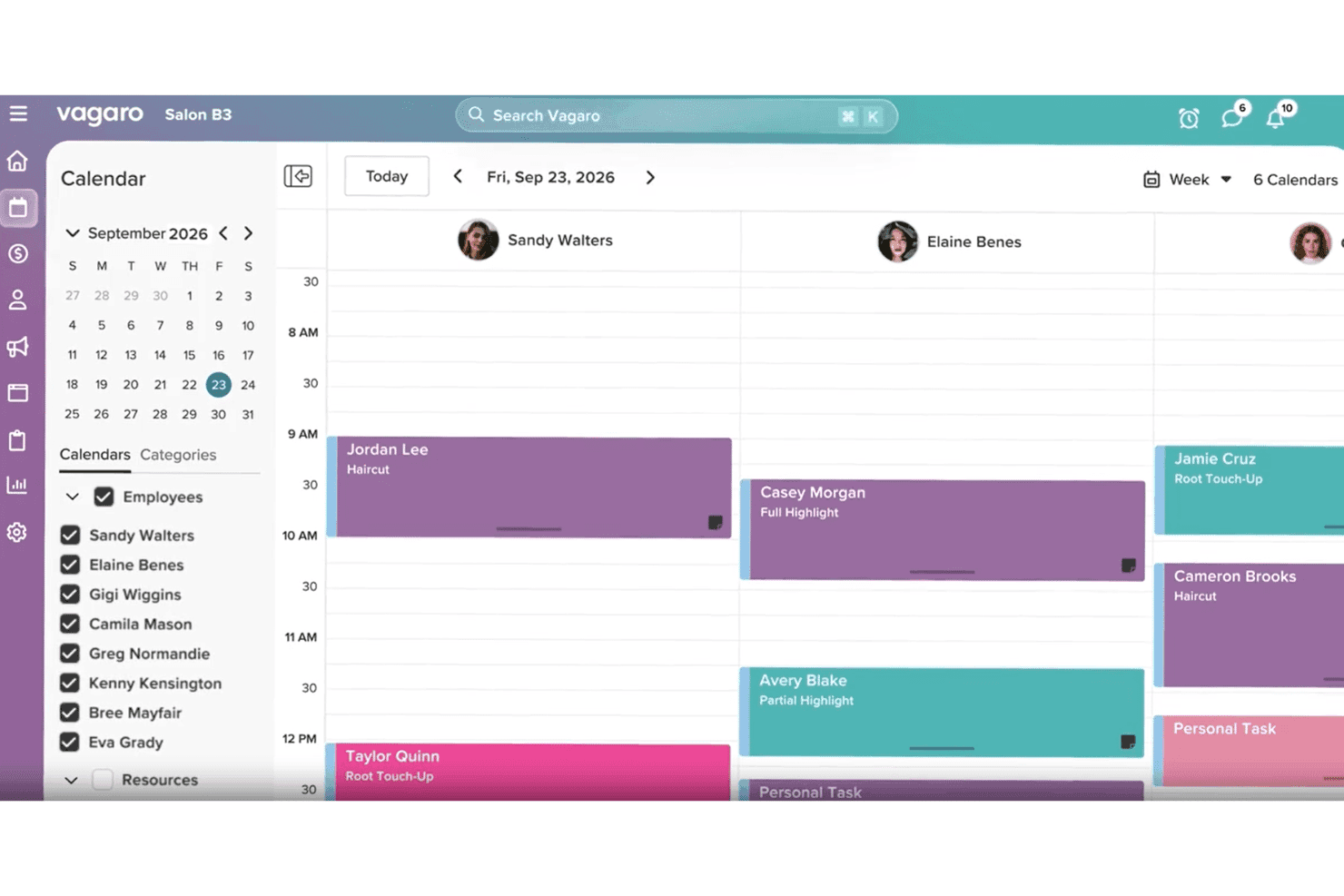
Vagaro lets staff view daily appointments across multiple calendars. Vagaro is a cloud-based spa and salon management platform with appointment scheduling, staff and resource management, point of sale, inventory tracking, and built-in CRM tools.
Who Is Vagaro Best For?
Vagaro is a strong fit for standalone or multi-location spa businesses that need a full-featured scheduling, POS, and inventory system without hotel PMS integration.
Why I Picked Vagaro
I've included Vagaro in my top picks because it covers the full operational stack a standalone spa needs without requiring any hotel PMS connection. I particularly like its "Minimize Gaps" scheduling logic, which clusters open slots around existing bookings to keep therapists and treatment rooms consistently occupied. The backbar tracking is genuinely useful too: Vagaro logs treatment supply usage down to the vial, lot number, and expiration date, which most scheduling tools skip entirely.
Vagaro Key Features
- Multi-calendar view: Display staff and treatment room calendars side by side, with filtering by service category to match clients with the right provider.
- Client SOAP notes: Record treatment details, photos, face mapping, and skin notes directly on each guest profile for personalized follow-up visits.
- Automated email and text campaigns: Trigger marketing messages based on client behavior, including birthday promotions with promo codes and re-engagement campaigns.
- Membership management: Build memberships that bundle services, products, and packages, with autopay, real-time reporting, and automatic savings applied at booking.
Vagaro Integrations
Vagaro offers documented integrations with QuickBooks, Xero, Power BI, Tableau, Salesforce, HubSpot, NetSuite, and Sage through paid add-ons. APIs and webhooks support custom connections, but no hotel PMS integration is documented.
Pros and Cons
Pros:
- Memberships bundle services and products
- Backbar tracks lot and expiration details
- Multi-calendar room and therapist scheduling
Cons:
- Busy-period POS performance receives complaints
- Designed for standalone spas, not hotels
Learn more about Vagaro: Best for AI-driven spa ops at hotel scale
- Not available
- Pricing upon request
Visit WebsiteCustomer Rating:4.4/5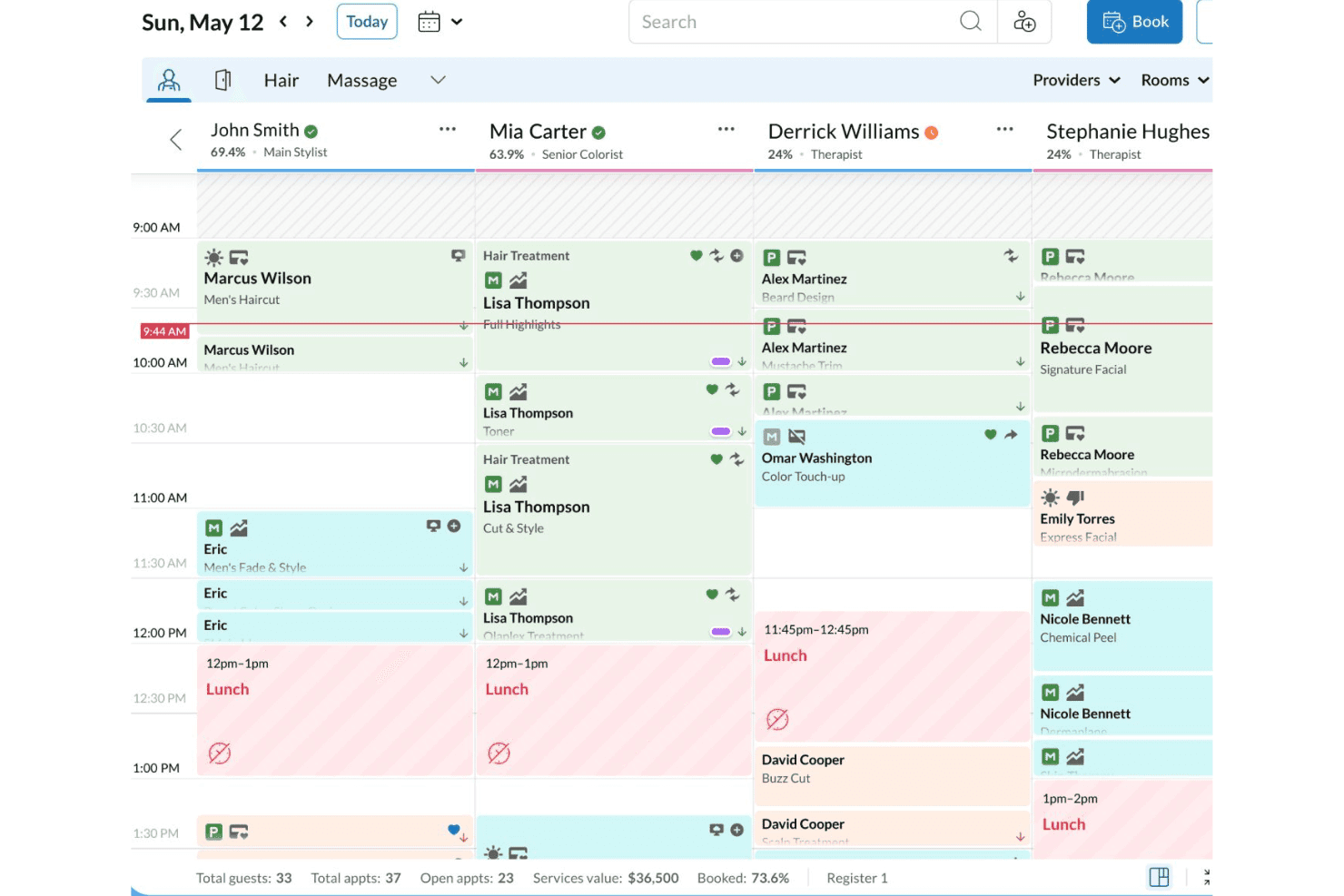
Zenoti features a daily appointment calendar for multiple providers. Zenoti is a cloud-based spa management platform built for hotel and resort spas, covering appointment scheduling, staff management, guest profiles, PMS folio integration, retail inventory, memberships, and automated marketing.
Who Is Zenoti Best For?
Zenoti is a strong fit for multi-property hotel and resort spa operations that need deep PMS integration, enterprise-scale scheduling, and AI-driven staff and revenue tools.
Why I Picked Zenoti
Zenoti earns its spot on my shortlist because of how seriously it's built for hotel-scale spa operations, specifically the AI tools that run beneath the surface. I'm particularly impressed by the AI Employee Scheduler, which forecasts demand and builds staff rosters automatically, and the AI Inventory Manager, which predicts product usage and generates purchase orders before you run out. Both tools matter in a hotel spa context, where a sold-out weekend can expose staffing gaps and empty shelves fast.
Zenoti Key Features
- Online self-booking widget: Embed a booking tool directly into your hotel website, app, or pre-arrival emails, with room number capture at the point of booking for automatic folio linking.
- Multi-property dashboard: Manage 2 to 200+ properties from one account, with group-level reporting you can drill into by property, region, or brand.
- Automated marketing suite: Send pre-arrival reminders, rebooking prompts, birthday offers, and win-back campaigns through the AI Concierge, with churn prediction built in.
- Opera PMS folio integration: Post services, retail, tips, and discounts directly to guest folios in real time, with room numbers filling in automatically at checkout.
Zenoti Integrations
Zenoti offers a native two-way integration with Oracle Opera, plus integrations with Mews, Apaleo, and Cloudbeds. It also provides APIs for custom integrations.
Pros and Cons
Pros:
- Stores cross-property guest preferences and history
- Sequences packages, rooms, and therapists automatically
- Handles multi-property spa operations centrally
Cons:
- Some workflows require several setup steps
- Implementation can take several weeks
Learn more about Zenoti: Best for hotel spa groups managing multiple locations
- Free demo available
- From $139
Visit WebsiteCustomer Rating:4.1/5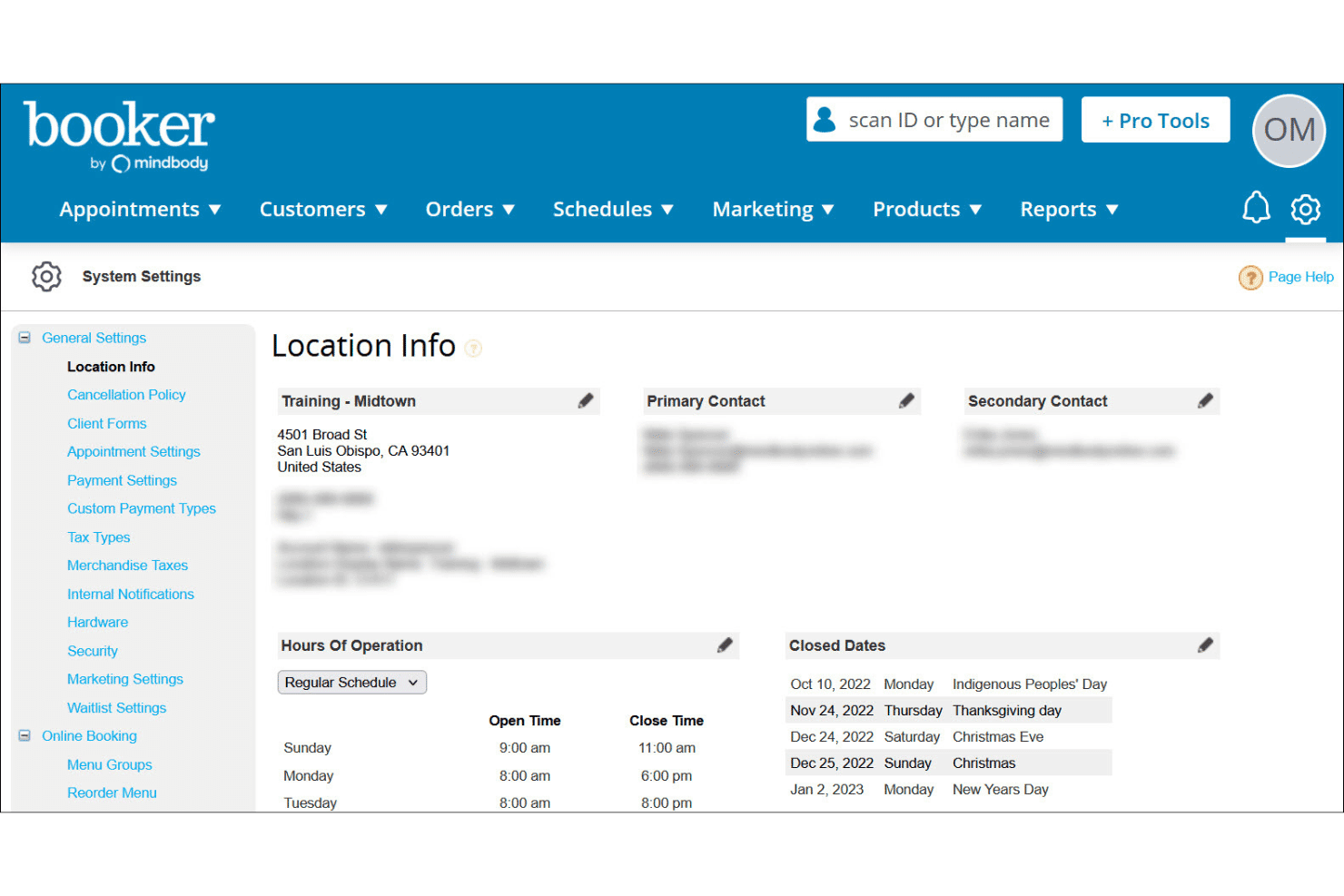
Booker lets users manage location info, hours, and closed dates. Booker is a cloud-based spa and salon management platform that combines appointment scheduling, staff and resource management, guest profiles, POS, inventory tracking, and multi-location support.
Who Is Booker Best For?
Booker is a strong fit for hotel spa directors overseeing multiple locations who need one platform to manage scheduling, staff pay, and guest profiles across properties.
Why I Picked Booker
Booker earns its spot on my shortlist because its Enterprise plan is purpose-built for spa groups running multiple properties under one roof. I especially like how each location gets its own booking flows, pricing rules, and staff schedules while still feeding into centralized reporting. The room and resource-aware scheduling handles couples and group bookings across locations without double-booking treatment rooms or therapists.
Booker Key Features
- Guest profile management: Store treatment history, allergies, preferences, and SOAP notes in individual guest profiles that staff can access at the point of booking.
- Automated back-bar deduction: Products used during a service are automatically deducted from stock, feeding directly into usage and shrinkage reporting.
- Membership and series management: Sell and manage recurring memberships, prepaid bundles, and multi-visit series with flexible redemption rules.
- Automated marketing tools: Set up triggered email and text campaigns, review prompts, referral tracking, and rebooking reminders from within the platform.
Booker Integrations
Booker supports hotel PMS integrations through Pure Informatique, including Oracle OPERA Cloud, Infor HMS, Mews, Stayntouch, Protel, and Apaleo. It also connects with Revinate Marketing and offers an API for custom BI, CRM, inventory, and workflow integrations.
Pros and Cons
Pros:
- Automatic back-bar deductions track product usage
- Separate booking flows serve hotel guests
- Room-aware scheduling supports couples and groups
Cons:
- Support responses can be inconsistent during issues
- Reviewers report frequent glitches and slowdowns
Learn more about Booker: Best for multi-location spa booking and guest profiles
- Free demo available
- From $79/month
Visit WebsiteCustomer Rating:4/5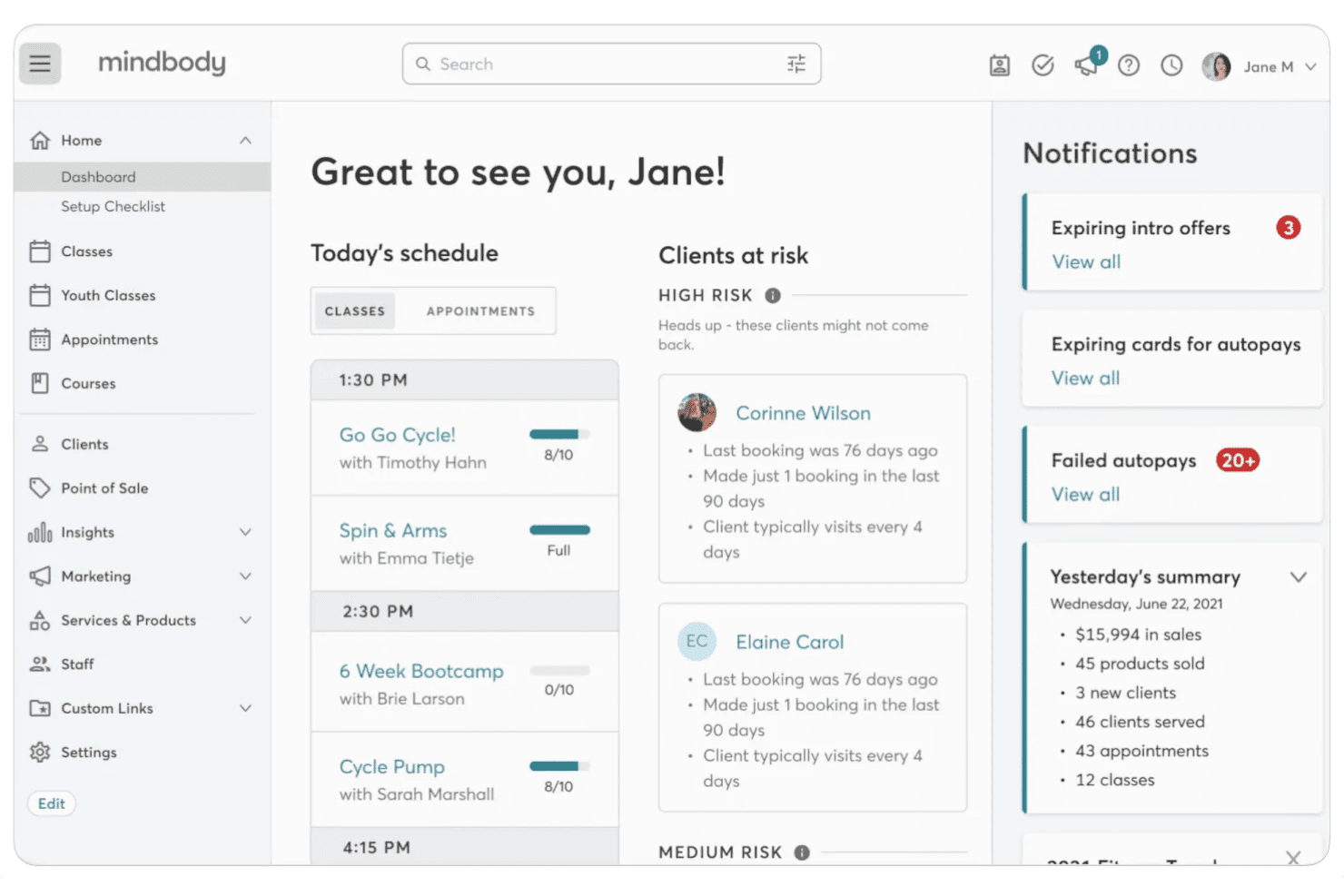
Mindbody flags at-risk clients and lets staff view today's class schedule. Mindbody is a spa and wellness management platform that covers appointment scheduling, staff and resource management, guest profiles, retail inventory, and point-of-sale across single and multi-location operations.
Who Is Mindbody Best For?
Mindbody is a strong fit for spa directors managing multi-location operations who need a single platform for scheduling, guest profiles, staff management, and retail inventory.
Why I Picked MindBody
I've included Mindbody in my top picks because it handles multi-location spa operations better than most tools I've tested, with a corporate dashboard that lets you compare performance across properties, roll out settings to all locations, and share memberships between them. The room-based calendar view in Booker is something I genuinely rely on, letting you see availability by treatment room rather than by staff member. Guest profiles store allergies, medications, and service history, all surfaced at the point of booking so your therapists are never walking in blind.
MindBody Key Features
- Automated waitlist management: When a cancellation opens up, Mindbody automatically moves the next waitlisted guest into the slot.
- Back-bar product deduction: Booker deducts professional product usage from inventory automatically each time a service is completed, including partial amounts.
- Digital intake forms and waivers: Forms are sent to guests automatically ahead of their appointment and tied directly to their client profile.
- AI Concierge: An add-on that handles texts and chats from guests, answering questions and booking, rescheduling, or cancelling appointments without staff involvement.
MindBody Integrations
Mindbody lists 90+ integrations and an open API, including partner connections with Oracle OPERA Cloud, Mews, Stayntouch, Infor HMS, Shopify, Mailchimp, and ADP. Hotel PMS connectivity is supplied through Pure Informatique, a separate Booker reseller.
Pros and Cons
Pros:
- Back-bar deductions tie products to treatments
- Room-based calendars prevent treatment conflicts
- Multi-property controls support shared memberships
Cons:
- Support experiences vary for complex issues
- Interface changes can disrupt established workflows
Learn more about MindBody: Best for luxury hotel chains and resort groups
- Free demo available
- Pricing upon request
Visit WebsiteCustomer Rating:5/5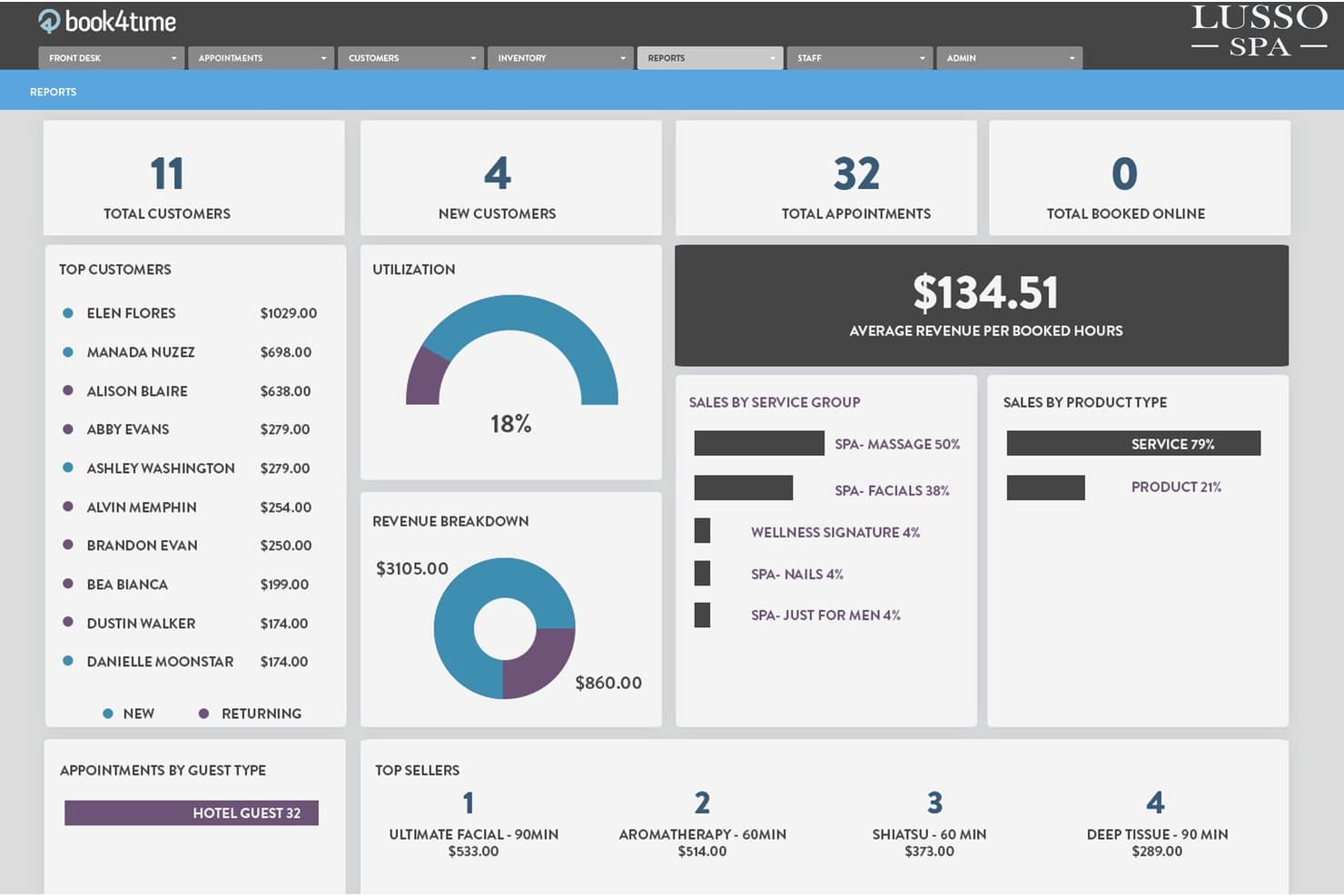
Book4Time lets users review spa revenue, appointments, and customer insights. Book4Time is a cloud-based hotel spa management platform that covers appointment scheduling, guest profiles, staff and commission management, retail inventory, and integrated point of sale across single and multi-property operations.
Who Is Book4Time Best For?
Book4Time is a strong fit for multi-property luxury hotel groups and resort brands that need centralized spa operations tied directly into their PMS.
Why I Picked Book4Time
Book4Time earns its spot on my shortlist because of how it handles multi-property spa operations at enterprise scale. I love that Smart Scheduling assigns therapists and treatment rooms across locations in real time, while dynamic yield management (RevStream Analytics) adjusts pricing based on demand, occupancy, and lead time. For a luxury brand running spas across dozens of properties, that kind of centralized control is genuinely hard to replicate.
Book4Time Key Features
- Guest CRM and intake forms: Store guest history, treatment preferences, and digital waiver forms in a unified profile that staff can access at the point of booking.
- Online self-booking: Guests book appointments through a branded, mobile-friendly portal with real-time availability and integrated payment processing.
- Multi-currency POS: The built-in point of sale handles memberships, gift cards, packages, promotions, and retail alongside services, with support for multiple currencies and payment methods.
- Enterprise reporting dashboards: Real-time reports and custom views span revenue, inventory, and cash audits across all locations, with deeper analytics available through Agilysys Analyze.
Book4Time Integrations
Book4Time connects with 100+ partners, including Agilysys PMS, InfoGenesis POS, Oracle OPERA Cloud, Mews, Infor, HubSpot, and Salesforce. It also supports payment gateways, RFID systems, and an open API for custom integrations.
Pros and Cons
Pros:
- Detailed revenue, inventory, and cash reporting
- Dynamic pricing responds to spa demand
- Smart scheduling spans therapists and treatment rooms
Cons:
- Package and inventory setup requires patience
- POS workflows feel dated and cumbersome
Learn more about Book4Time: Best for hotel stack-native spa scheduling
- Free demo available
- Pricing upon request
Visit WebsiteCustomer Rating:4.3/5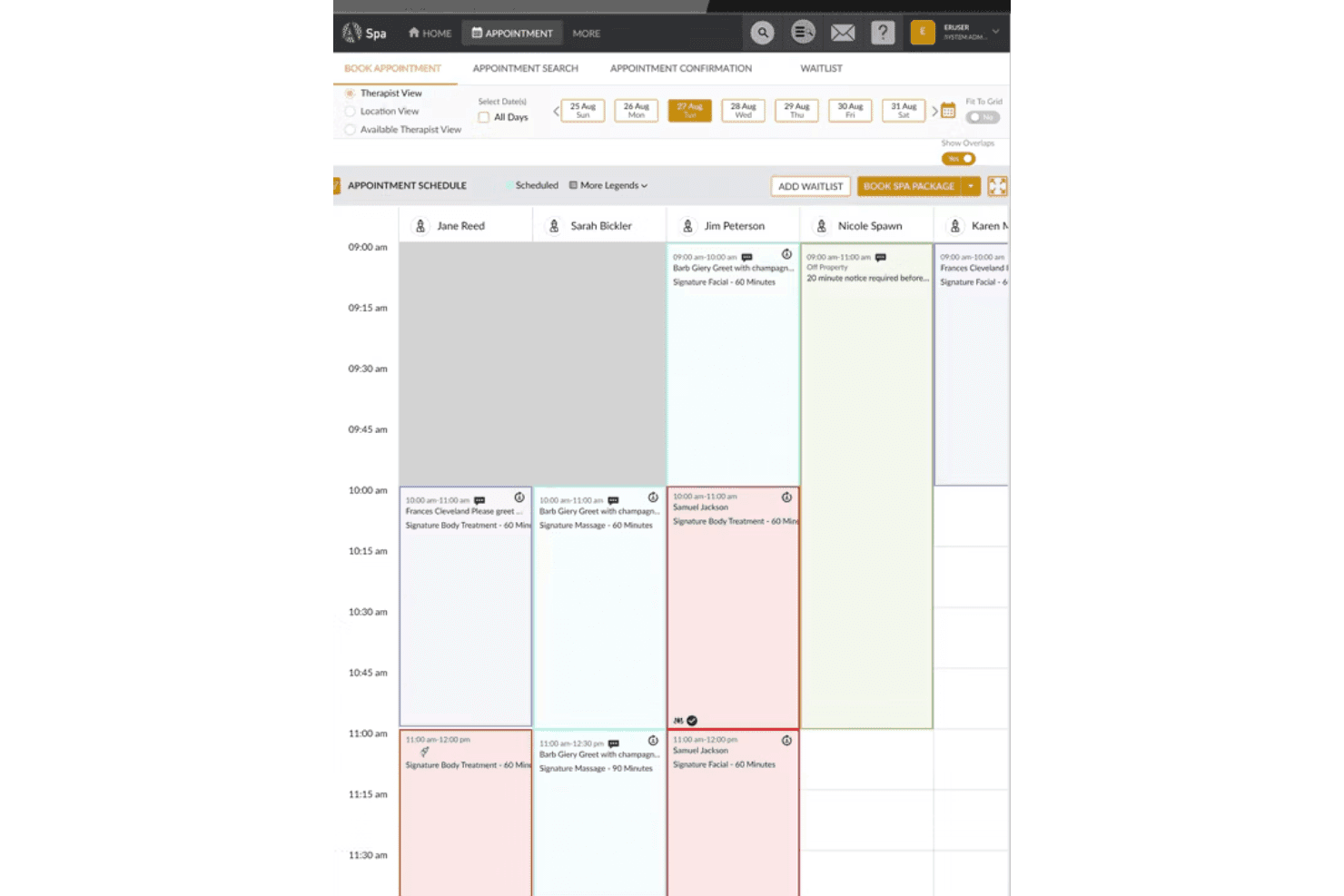
Agilysys Spa lets users view therapist schedules and appointments in a daily calendar. Agilysys Spa is a cloud-based spa management platform built for hotels and resorts that combines appointment scheduling, guest profile management, therapist and resource scheduling, point of sale, and multi-property reporting.
Who Is Agilysys Spa Best For?
Agilysys Spa is a strong fit for hotel and resort groups already running Agilysys or OPERA PMS who want spa scheduling that connects natively to their existing property stack.
Why I Picked Agilysys Spa
I picked Agilysys Spa because it's purpose-built to sit inside the hotel technology stack rather than alongside it. If your property runs Agilysys PMS or Oracle OPERA, spa charges post directly to guest folios and guest profiles sync across spa, dining, golf, and rooms automatically. I'm also a fan of the Minimum Gap Restriction feature, which mirrors how an experienced spa coordinator manually blocks unsellable time between bookings and applies that logic automatically to online availability.
Agilysys Spa Key Features
- Therapist Portal: Gives therapists direct access to their personal schedules, commission breakdowns, earnings, and performance data.
- Multi-property reporting: Centralizes dashboards and service menus across locations while letting each property maintain its own settings.
- InfoGenesis POS integration: Handles spa services and retail sales in one place, including gift cards, membership billing, and dynamic pricing.
- AI conversational reservations: An AI concierge built with PolyAI takes bookings through natural-language conversation around the clock.
Agilysys Spa Integrations
Agilysys Spa integrates with Agilysys PMS, Oracle OPERA PMS, InfoGenesis POS, Agilysys Analyze, and Agilysys SWS/Eatec. It also supports API access for custom integrations, while PolyAI powers its conversational reservations feature.
Pros and Cons
Pros:
- Centralized profiles capture preferences and treatment history
- AI-driven controls protect revenue between bookings
- Intelligent scheduling coordinates therapists, rooms, and equipment
Cons:
- Current user sentiment lacks recent review coverage
- Treatment supply tracking remains poorly documented
Learn more about Agilysys Spa: Best for Forbes Five-Star resort spa operations
- Free demo available
- Pricing upon request
Visit WebsiteCustomer Rating:3/5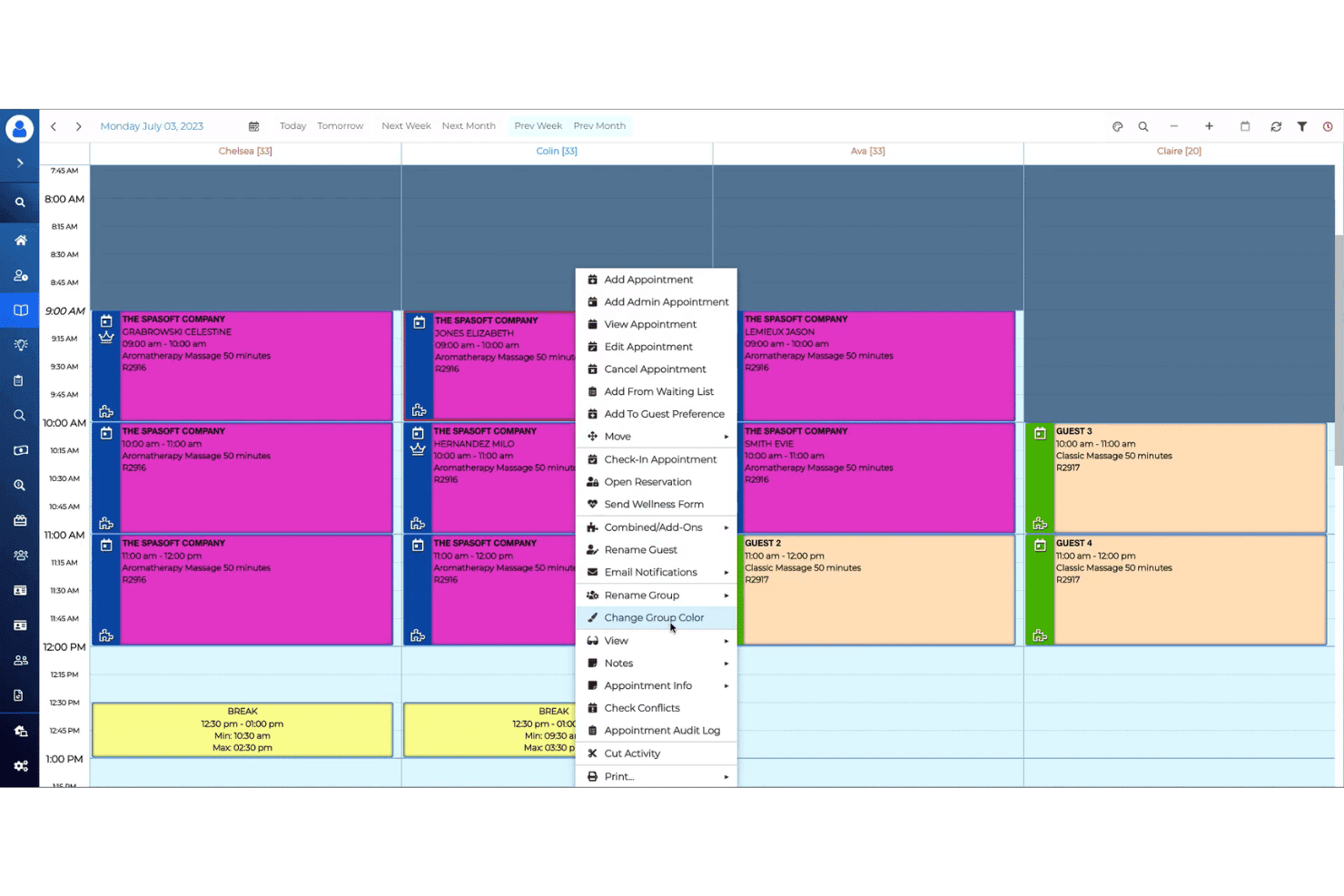
SpaSoft lets users manage and customize group appointments via a right-click context menu. SpaSoft is a hotel and resort spa management platform that covers appointment scheduling, staff management, guest profiles, point of sale, retail inventory, and PMS integration.
Who Is SpaSoft Best For?
SpaSoft is built for spa directors and operations managers at luxury hotels, destination resorts, and casinos that need deep PMS integration and full-service spa management in one platform.
Why I Picked SpaSoft
SpaSoft earns its spot on my shortlist because over 70% of Forbes Travel Guide Five-Star spas run on it, and once you see how it handles luxury resort operations, that figure makes sense. I'm particularly impressed by Smart Booking, which pulls a guest's treatment history and preferences in real time to guide staff toward the right appointment. The SpaSoft Staff Suite mobile app also means therapists walk into every session already briefed on guest notes and schedule changes, without a paper handoff.
SpaSoft Key Features
- Digital intake forms: Guests complete branded health and waiver forms before arrival, with answers sent directly to the therapist's queue.
- PMS room charging: Staff can post spa charges to a guest's folio by looking up their name, room number, or reservation across eight major PMS platforms.
- Membership and loyalty management: Built-in tools handle membership billing, freeze options, perks, points-based loyalty programs, and gift cards.
- Online booking engine: Guests self-book around the clock via web or mobile, with real-time availability, instant confirmations, and automated reminders.
SpaSoft Integrations
SpaSoft lists 70+ hospitality integrations, including Oracle Hospitality, Infor, Agilysys, SMS|Host, Stayntouch, Maestro, InnQuest, and IQware. Its cloud platform connects through APIs, while payment integrations include Adyen, FreedomPay, Shift4, and Worldpay by FIS.
Pros and Cons
Pros:
- Therapists get live mobile schedule updates
- Guest history guides Smart Booking decisions
- Resort-ready room and resource scheduling
Cons:
- On-premise workflows feel dated
- Some schedules load slowly
Learn more about SpaSoft:
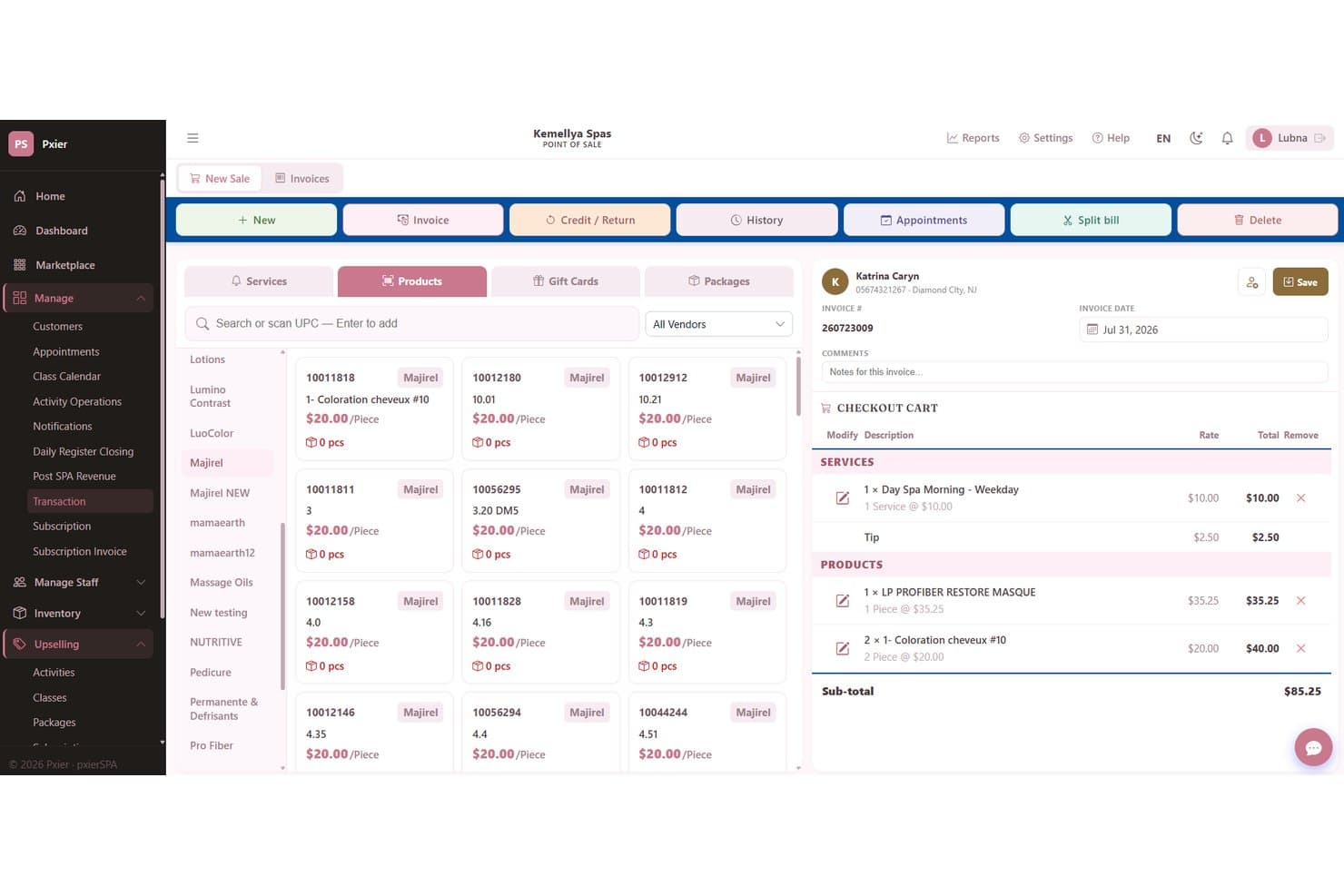
PXier lets staff process spa services, product charges, and guest invoices. PXier is a cloud-based hotel spa management platform that covers appointment scheduling, staff and resource management, guest profiles, point of sale, retail inventory tracking, and native PMS folio posting.
Who Is PXier Best For?
PXier is a strong fit for hotel spa teams that need spa charges to post directly to guest folios inside their PMS.
Why I Picked PXier
PXier earns its spot on my shortlist because of how it handles PMS folio posting. When a guest books a massage, the charge posts directly to their room folio in real time, mapped to the correct ledger code inside your PMS. I also like the AI Auto-Assign feature, which matches each booking to a qualified therapist and available treatment room automatically. Two-way sync with Mews, Cloudbeds, and Oracle OPERA means guest profiles stay current across both systems without manual updates.
PXier Key Features
- Drag-and-drop scheduling calendar: View appointments by employee, treatment room, or shift, and reschedule bookings by dragging them across daily, weekly, or hourly views.
- E-signed consent forms: Set up intake and consent forms per service, collect digital signatures from guests, and store completed forms directly in their profile.
- Real-unit inventory consumption tracking: Link products to services so stock is deducted automatically in measurable units (mL, oz, grams) each time a treatment is delivered or a product is sold.
- Online guest self-booking engine: Let guests browse services, check availability, and book appointments from any device, with automatic confirmation emails and configurable deposit and cancellation policies.
PXier Integrations
PXier offers native PMS integrations with Mews, Cloudbeds, Oracle OPERA, Apaleo, Lean PMS, and RoomRaccoon, plus accounting integrations with QuickBooks, Xero, and Sage. Enterprise plans include a REST API for custom integrations.
Pros and Cons
Pros:
- Real-unit treatment consumption tracks product usage
- AI assignment matches therapists and rooms
- Reviewers praise responsive customer support
Cons:
- Payment processor options remain unclear
- Waitlist functionality is not documented
Learn more about PXier: Best for hotel groups with multi-PMS integration
- Free demo available
- Pricing upon request
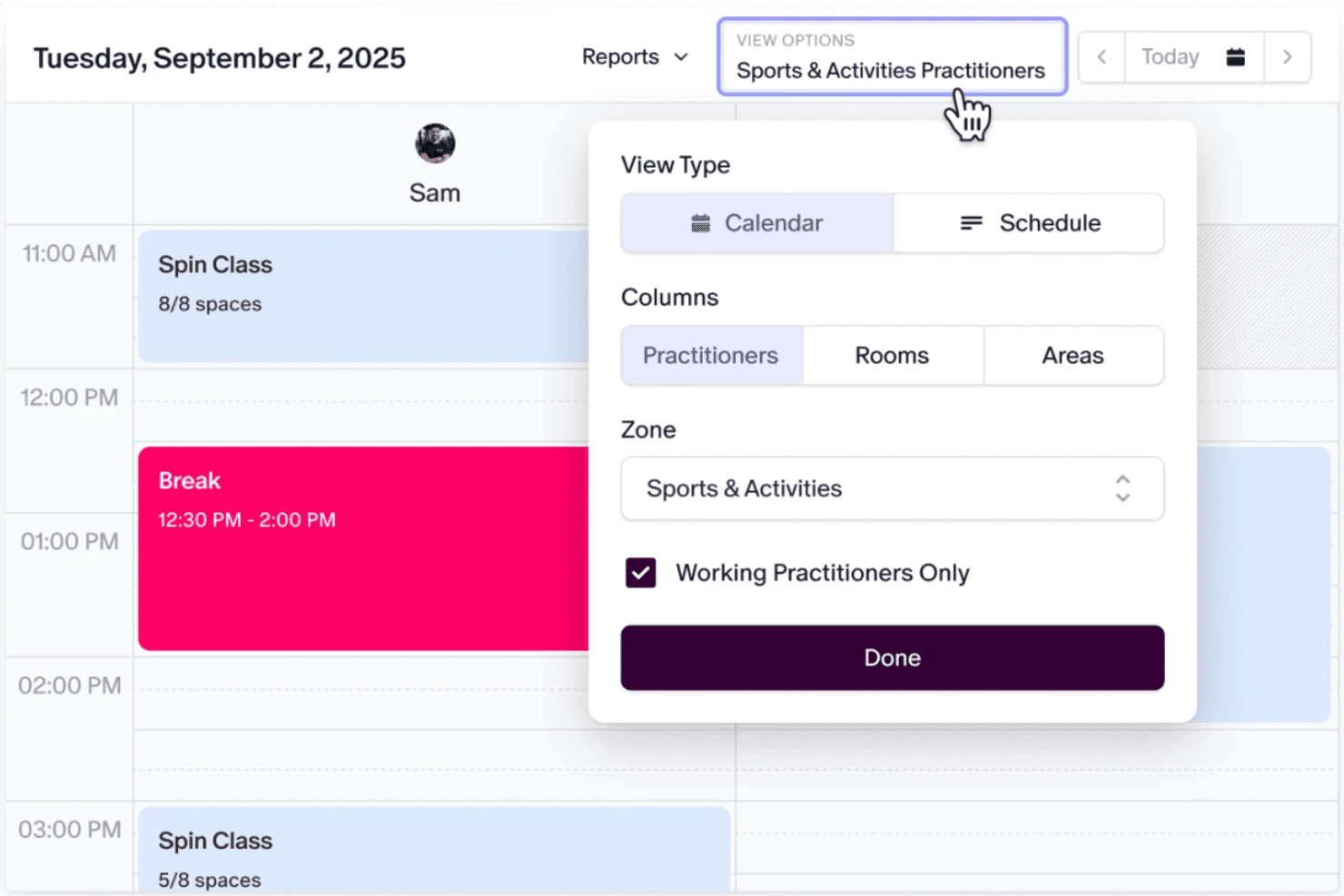
Trybe lets users customize calendar views by zone, columns, and practitioner filters. Trybe is a hotel spa management platform built around appointment scheduling, package booking, staff and resource management, PMS-connected payments, membership programs, retail inventory, and multi-property reporting.
Who Is Trybe Best For?
Trybe is a strong fit for hotel groups and multi-property spa operators that need deep PMS connectivity across brands like Marriott, IHG, and Dorchester Collection.
Why I Picked Trybe
I've included Trybe in my top picks because it handles multi-PMS connectivity better than anything else I've seen in this category, with native integrations across Oracle OPERA Cloud, Mews, Guestline, and a dozen more. I like how Trybe Overnights pulls hotel stays, dining reservations, and spa bookings into a single flow, posting revenue to the correct PMS accounting codes automatically. Group-level reporting across properties, with logos from Marriott, IHG, and Dorchester Collection, confirms this is built for hotel spa operations at scale.
Trybe Key Features
- Build-your-own package booking: Guests can assemble their own spa day by combining treatments, dining, and facility access, with each component checking its own live availability.
- Digital intake forms: Customizable templates send automatically with booking confirmations and require permission plus a secondary password to view.
- Membership management: Supports individual, couple, family, and corporate plans with recurring credits, a self-service member portal, and automatic payment handling for failed or expiring billing.
- Role-based reporting: Revenue, occupancy, therapist utilization, gift card activity, and inventory reports are available at both individual property and group level, with scheduled CSV exports.
Trybe Integrations
Trybe offers documented integrations with Oracle OPERA Cloud, Mews, Guestline, Cloudbeds, SevenRooms, Revinate, Cendyn, Gantner, Adyen, and Profitroom. An open API supports custom integrations.
Pros and Cons
Pros:
- Guest self-booking handles mobile after-hours demand
- Round-the-clock support includes full staff training
- Build-your-own packages support complex spa days
Cons:
- Group settings require hotel-by-hotel changes
- Some reports need deeper operational detail
Learn more about Trybe: Best for hotel PMS-connected spa operations
- Free demo available
- Pricing upon request
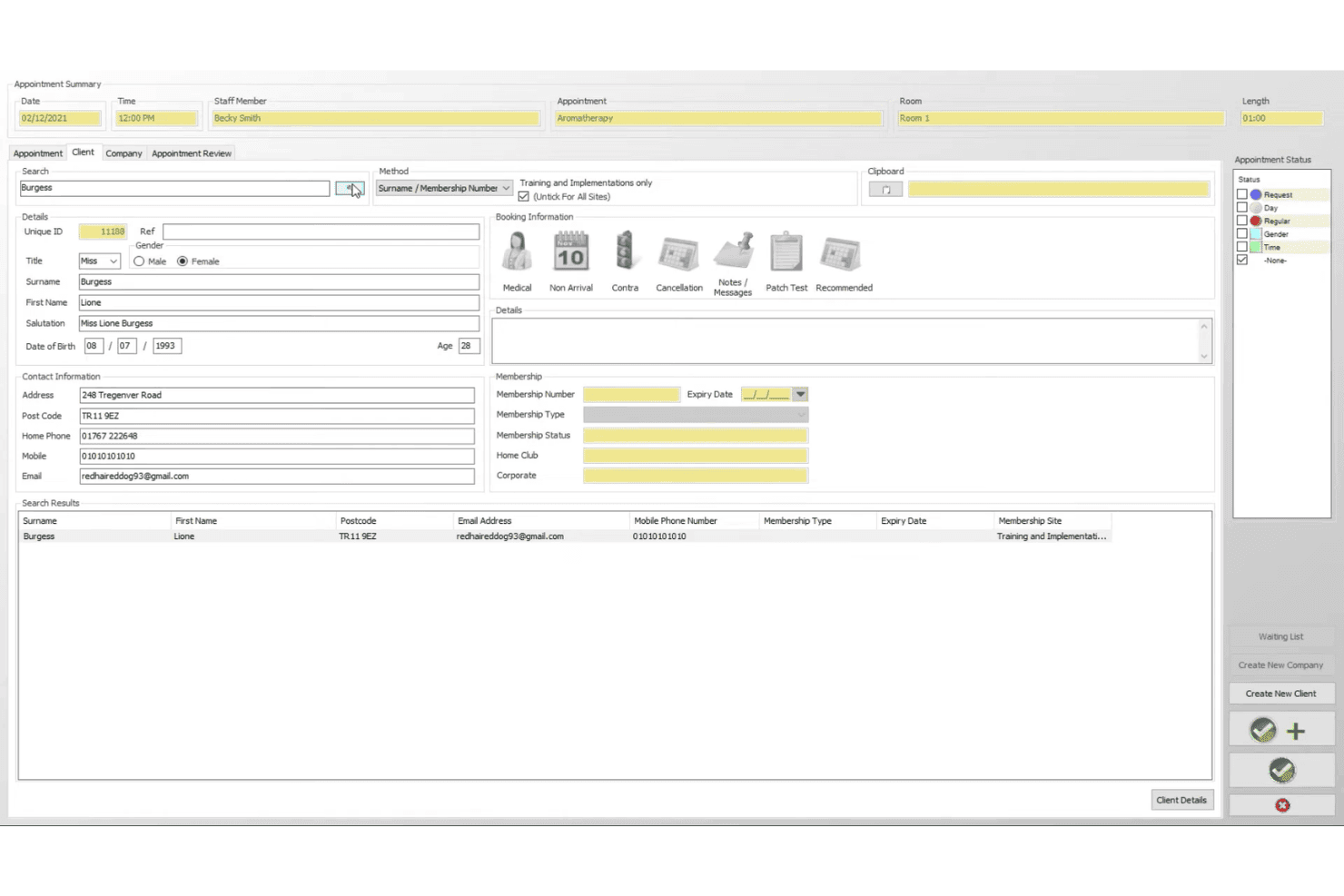
Core by Premier Software manages client bookings and appointment details. Core by Premier Software is a hotel spa management platform covering appointment scheduling, staff rotas, guest profiles with medical and contraindication tracking, POS, retail inventory, memberships, and two-way PMS integration with systems like OPERA Cloud.
Who Is Core by Premier Software Best For?
Core is a strong fit for hotel spa directors managing multi-therapist operations who need tight PMS connectivity, particularly with OPERA Cloud.
Why I Picked Core by Premier Software
I picked Core by Premier Software because its two-way PMS sync with OPERA Cloud is the most complete I've seen for hotel spas, covering guest profiles, reservations, and live charge posting to room folios. When a guest books a massage and wants it billed to their room, Core handles the entire exchange without manual entry on either side. I also love that contraindication forms are linked directly to the booking diary, so therapists see medical flags before a guest even arrives.
Core by Premier Software Key Features
- RSI indicator: Flags back-to-back strenuous treatment assignments to protect therapists from repetitive strain injury.
- Multi-site management: Run spa, leisure, and golf operations across multiple properties from a single database with per-venue user restrictions.
- Membership and direct debit handling: Configure tiered memberships with peak/off-peak pricing, points schemes, and collect fees via UK direct debit or SEPA recurring payments.
- Scheduled reporting: Choose from 400+ reports covering occupancy, revenue, staff KPIs, and stock valuation, and set them to arrive in your inbox automatically.
Core by Premier Software Integrations
Core by Premier Software integrates with OPERA Cloud, OPERA on-premise, Rezlynx, Mews, Hop Software, Hotsoft, Protel, Guestline, and Tevalis. Its open API supports custom connections for profiles, medical data, bookings, retail, vouchers, bills, and golf.
Pros and Cons
Pros:
- Back-bar usage tracks product consumption
- Four-hands bookings prevent therapist conflicts
- Contraindication alerts connect to treatment bookings
Cons:
- Some capabilities require separately purchased extras
- Product roadmap remains unclear after acquisition
Learn more about Core by Premier Software:
Other Hotel Spa Management Software
Here are a few additional options that didn’t make my top list, but are still worth checking out:
- 11Paired PlusBest for all-in PMS folio posting and spa ops
- 12Milano SoftwareBest for multi-PMS folio sync at hotel spas
- 13MangomintBest for spa scheduling without a hotel PMS
- 14PhorestBest for spa guest marketing and retention
- 15FreshaBest for spa bookings without PMS dependency
- 16BoulevardBest for scheduling-first spa ops with OPERA billing
- 17Insight Salon & Spa SoftwareBest for spa ops at standalone or day spa scale
- 18SpaguruBest for affordable spa ops with built-in PMS billing
- 19Concept Spa & LeisureBest for resort spas running multi-property ops
- 20JourneyBest for UK spa ops built on 30 years of expertise
How I Evaluate Hotel Spa Management Software
I split my evaluation into three parts, giving core functionality the most weight: book treatments, assign therapists and rooms, and post charges to guest folios. Next, I look for standout features such as guest self-booking and multi-property management. Finally, I consider support, onboarding, and pricing value beyond features.
Core Functionality (Table Stakes For This List)
When I'm selecting tools for my list, I score each one on a scale from 0 (does not offer the functionality) to 5 (excels in this area) for each core functionality listed below. I then convert the total into a percentage to help assess each tool's overall fit, with extra weight on any functionalities I’ve deemed essential.
- Appointment Scheduling (Essential): I assess multi-therapist, multi-room booking, conflict detection, rescheduling, waitlists, and guest self-booking.
- Staff & Resources (Essential): I look for therapist availability, skills, shifts, room assignments, equipment scheduling, and commission tracking.
- Guest Profiles: I check whether staff can access preferences, allergies, treatment notes, and visit history during booking and check-in.
- Payments & POS: I evaluate service and retail payments, packages, gift cards, memberships, promotions, and folio-ready checkout.
- Inventory & Retail: I look for retail stock counts, treatment supply usage, reorder alerts, and links between inventory and services.
- PMS/Folio Integration: I check whether guest details, reservations, and spa charges sync accurately with the hotel PMS and room folios.
Once I have a list of tools that meet the criteria, I consider what sets each platform apart.
Differentiating Factors (What Sets Vendors Apart)
Here's how I compare and contrast different vendors:
Standout Features
Online guest self-booking is a must. I check whether guests can browse treatments and reserve appointments from their phone before arrival or mid-stay, since pre-arrival booking drives higher spa revenue per guest. Multi-property management matters for hotel groups; I evaluate whether a single dashboard covers centralized reporting and scheduling across locations. I also look at mobile staff apps—therapists need real-time schedule access and client notes on the spa floor without walking back to the front desk.
Beyond Features
I check how each vendor handles onboarding, since spa teams often include part-time therapists who need hands-on training rather than self-serve docs. Vendors like Book4Time and SpaSoft assign dedicated onboarding specialists, which matters when you're migrating years of guest profiles and treatment history. Cloud deployment is another factor I evaluate—resort groups with seasonal staff fluctuations need centralized access without on-site servers. I also look at PMS integration depth beyond basic folio posting, checking whether the platform syncs guest profiles, loyalty tiers, and reservation data with systems like Oracle OPERA or Infor HMS.
How to Choose Hotel Spa Management Software.
Choose hotel spa management software by testing how well it handles the handoffs that affect guest charges, treatment availability, and daily staffing.
| If your priority is | Look for |
|---|---|
| If your priority isAccurate guest folios | Look forA documented PMS posting workflow and correction process |
| If your priority isFewer booking conflicts | Look forA trial task covering two therapists, rooms, and overlapping appointments |
| If your priority isBetter staff coordination | Look forWritten rules for availability, shift changes, room assignments, and commissions |
| If your priority isConsistent multi-property control | Look forA sample reporting pack covering at least three locations |
How to Vet Your Shortlist
- Test folio posting: During a seven-day trial, send a room charge, split payment, cancellation, and corrected charge, then compare each result with the PMS record.
- Request an integration document: Ask for a current PMS integration guide that identifies synchronized guest, reservation, and folio data.
- Run a scheduling scenario: Give the vendor a written trial task involving two therapists, one shared room, a waitlist, a reschedule, and a late cancellation.
- File a support ticket: Submit one spa-specific ticket before purchase and record the response time, requested details, escalation path, and final resolution.
- Choose your operating tradeoff: Decide whether you value deeper hotel-system coordination over broader standalone spa tools, or broader spa tools over tighter PMS control.
What Is Hotel Spa Management Software?
Hotel spa management software is a platform for managing spa bookings, treatments, staff schedules, guest profiles, payments, and hotel folio charges. It helps spa and front-desk teams coordinate reservations, therapist availability, room assignments, and guest records. Many platforms connect with property management systems to transfer guest details and post charges to room accounts.
Features
Here are the main features I look for in any great hotel spa management software:
- Appointment scheduling: Lets staff book treatments, assign therapists and rooms, detect conflicts, manage waitlists, and reschedule appointments. Guest self-booking tools can display treatment availability before arrival or during a stay.
- Staff and resource management: Tracks therapist availability, shifts, skills, room assignments, equipment, and commissions. Managers can match qualified staff with treatments while preventing double bookings.
- Guest profiles: Stores preferences, allergies, treatment notes, visit history, packages, memberships, and hotel stay details. Spa staff can review relevant information during booking, check-in, and treatment delivery.
- Payments and point of sale: Processes treatment, retail, package, membership, gift card, and promotional payments. It should also support split payments, refunds, and posting spa charges to guest room accounts.
- Property management system integration: Connects the spa platform with the hotel PMS to sync guest details and reservations. Staff can post charges to folios and reduce duplicate data entry between the spa and front desk.
- Inventory management: Tracks retail products, treatment supplies, stock levels, usage, and reorder needs. Linking inventory to services helps teams monitor the products used during treatments and sales.
- Online booking and notifications: Gives guests access to treatment menus, availability, booking forms, confirmations, reminders, and cancellation notices. Configurable messages help staff communicate appointment details before each visit.
- Reporting and analytics: Provides reports on bookings, revenue, therapist utilization, cancellations, retail sales, inventory, and guest activity. Managers can compare performance across treatments, departments, or properties.
Common Hotel Spa Management Software AI Features
Beyond the standard hotel spa management software features listed above, many newer solutions are incorporating AI with features like:
- Demand forecasting: AI analyzes booking history, seasonal patterns, hotel occupancy, and local events to predict future treatment demand. Managers can use these forecasts to plan staffing levels, room availability, and treatment capacity for busy periods.
- No-show prediction: AI identifies appointment patterns associated with missed bookings, such as short lead times or repeated cancellations. The system can flag higher-risk appointments so teams can apply deposits or send targeted reminders.
- Personalized treatment recommendations: AI reviews a guest’s stated preferences, previous purchases, treatment history, and stay details to suggest relevant services. Staff can use these recommendations when helping guests choose treatments or packages.
- Sentiment analysis: AI examines guest reviews, survey comments, and post-treatment feedback to identify sentiment and recurring themes. Managers can track concerns about specific treatments, therapists, facilities, or service stages without reading every comment manually.
- Revenue forecasting: AI combines treatment sales, retail purchases, cancellations, occupancy data, and historical performance to estimate future spa revenue. Finance and spa leaders can compare expected results with targets and investigate gaps earlier.
- Automated business insights: AI detects unusual changes in metrics such as therapist utilization, retail sales, cancellation rates, or treatment demand. It presents the likely areas requiring attention, giving managers a focused starting point for operational reviews.
Benefits
Here are a few common benefits you can expect from using hotel spa management software:
- Fewer booking conflicts: Multi-therapist and multi-room scheduling, availability rules, conflict detection, waitlists, and rescheduling tools help coordinate appointments.
- More accurate guest folios: PMS integrations transfer guest and reservation details while allowing staff to post spa charges to room accounts.
- Better staff coordination: Therapist skills, shifts, room assignments, equipment schedules, and commissions give managers clearer resource information.
- More personalized guest service: Guest profiles store preferences, allergies, treatment notes, visit history, packages, and memberships for staff reference.
- More flexible payment handling: POS tools support treatment and retail sales, packages, gift cards, memberships, promotions, split payments, and refunds.
- Tighter inventory control: Stock counts, treatment supply usage, service-linked inventory, and reorder alerts help teams monitor products and supplies.
- Clearer operational decisions: Reports covering bookings, revenue, cancellations, therapist utilization, retail sales, and guest activity help managers compare performance.
Costs and Pricing
Costs vary based on features, team size, add-ons, and more. Here are the pricing ranges you can typically expect from hotel spa management software:
Plan Comparison Table For Hotel Spa Management Software
| Plan Type | Average Price | Common Features |
|---|---|---|
| Plan TypeFree Plan | Average Price$0/month | Common FeaturesBasic appointment scheduling, guest profiles, payment processing, and limited reporting. |
| Plan TypePersonal Plan | Average Price$30–$75/user/month | Common FeaturesAppointment scheduling, staff calendars, guest profiles, payment processing, and booking notifications. |
| Plan TypeBusiness Plan | Average Price$75–$150/user/month | Common FeaturesMulti-room scheduling, resource management, inventory tracking, PMS integration, and operational reporting. |
| Plan TypeEnterprise Plan | Average Price$150–$300/user/month | Common FeaturesMulti-property management, advanced PMS integration, centralized reporting, custom permissions, and dedicated onboarding. |
FAQs
Some answers to common questions about hotel spa management software:
How long does it take to implement hotel spa management software?
Implementation often takes several weeks, depending on your property’s requirements. The timeline usually includes configuration, data migration, PMS connection, testing, and staff training. Start by documenting treatments, rooms, therapist schedules, pricing, cancellation rules, and folio procedures. Ask your vendor for a detailed project plan with owners and deadlines. Run test bookings before launch. Include room charges, split payments, refunds, and cancellations in your testing. A phased rollout can reduce disruption for busy spas.
Can hotel spa management software connect with my property management system?
Yes, many platforms connect with hotel property management systems, but integration depth varies. Confirm which guest, reservation, and folio data synchronizes between systems. Ask whether the connection supports room-charge posting, guest profile updates, reservation changes, and corrections. Request current integration documentation from the vendor. Test the connection with real booking scenarios before launch. Your team should know how to handle failed postings, duplicate records, and reversed charges.
How should I migrate existing guest and treatment data?
Begin by deciding which historical records your team genuinely needs. Common migration fields include guest contact details, preferences, allergies, treatment notes, visit history, memberships, and packages. Ask the vendor which formats and data fields they support. Clean duplicate, outdated, and incomplete records before transferring them. Restrict access to sensitive information during the migration. Keep an export of the original data. After migration, compare sample records against your previous system before staff begin using them.
What should spa staff learn before the system goes live?
Staff should practice the tasks they complete during a normal shift. That includes creating bookings, changing appointments, assigning rooms, checking guest notes, processing payments, and posting folio charges. Managers should also learn availability rules, commission settings, reporting, and correction workflows. Use role-based training for therapists, receptionists, and front-desk staff. Schedule practice sessions during quieter periods. Keep written procedures for failed payments, late cancellations, double bookings, and PMS connection errors. Review these procedures after launch.
How can I test whether the software fits a hotel spa?
Run a practical trial with your actual operating rules and appointment types. Create overlapping bookings for two therapists and one shared room. Add a waitlist, reschedule an appointment, and process a late cancellation. Then post a room charge, split a payment, and correct the charge. Check whether guest details and reservation changes appear in the PMS. Ask staff to complete these tasks without vendor assistance. Record every workaround, missing field, and unclear permission before choosing the platform.