

The 10 Best Event Scheduling Software for 2026

10 Best Event Scheduling Software Shortlist


Managing hotel events means keeping function spaces, guest room blocks, catering details, staff, and equipment aligned without creating scheduling conflicts. The right event scheduling software can bring those moving parts into one place and give your team better visibility across every booking.
I’ve reviewed the leading options for hotels and hospitality venues, focusing on tools that support event scheduling, function space management, BEOs, group bookings, resource coordination, and hospitality integrations.
In this guide, I’ll walk you through the best event scheduling software for hotel teams, including the features, strengths, and use cases that set each option apart so you can choose the right fit for your property.
Why Trust Our Software Recommendations
Our team has been testing and reviewing software since 2012. As hospitality leaders ourselves, we know how difficult—and important—it is to choose the right software.
For this guide, we evaluated tools using hands-on testing and independent research, scoring tools using our selection criteria.
Our reviews reflect our human editorial judgment, not a sales pitch.
Best Event Scheduling Software Summary
This comparison chart summarizes pricing details for my best event scheduling software selections to help you find the best one for your budget and practice needs.
| Tool | Best For | Trial Info | Price | ||
|---|---|---|---|---|---|
| 1 | Best with automated BEO and proposal generation | 14-day free trial | From $199/month (billed annually) | Website | |
| 2 | Best with interactive 3D event space diagramming | Free demo available | Pricing upon request | Website | |
| 3 | Best for venue-wide shared scheduling dashboards | Free demo available | Pricing upon request | Website | |
| 4 | Best with AI-powered event management tools | Free demo available | From $99/month (billed annually) | Website | |
| 5 | Best with unlimited user access for event teams | Free demo available | Pricing upon request | Website | |
| 6 | Best with multi-property chain management | Free trial + free demo available | From $249/month (billed annually) | Website | |
| 7 | Best with Salesforce-powered group sales | Free demo available | Pricing upon request | Website | |
| 8 | Best with AI inquiry and booking automation | Free demo available | Pricing upon request | Website | |
| 9 | Best with instant live event space availability | Free demo available | Pricing upon request | Website | |
| 10 | Best with integrated proposals and payments | Free demo available | From $199/month | Website |
Best Event Scheduling Software Reviews
Below are my detailed summaries of the best event scheduling softwares that made it onto my shortlist. My reviews offer a detailed look at the features, best use cases, and capabilities of each platform to help you find the best one for you.
Best with automated BEO and proposal generation
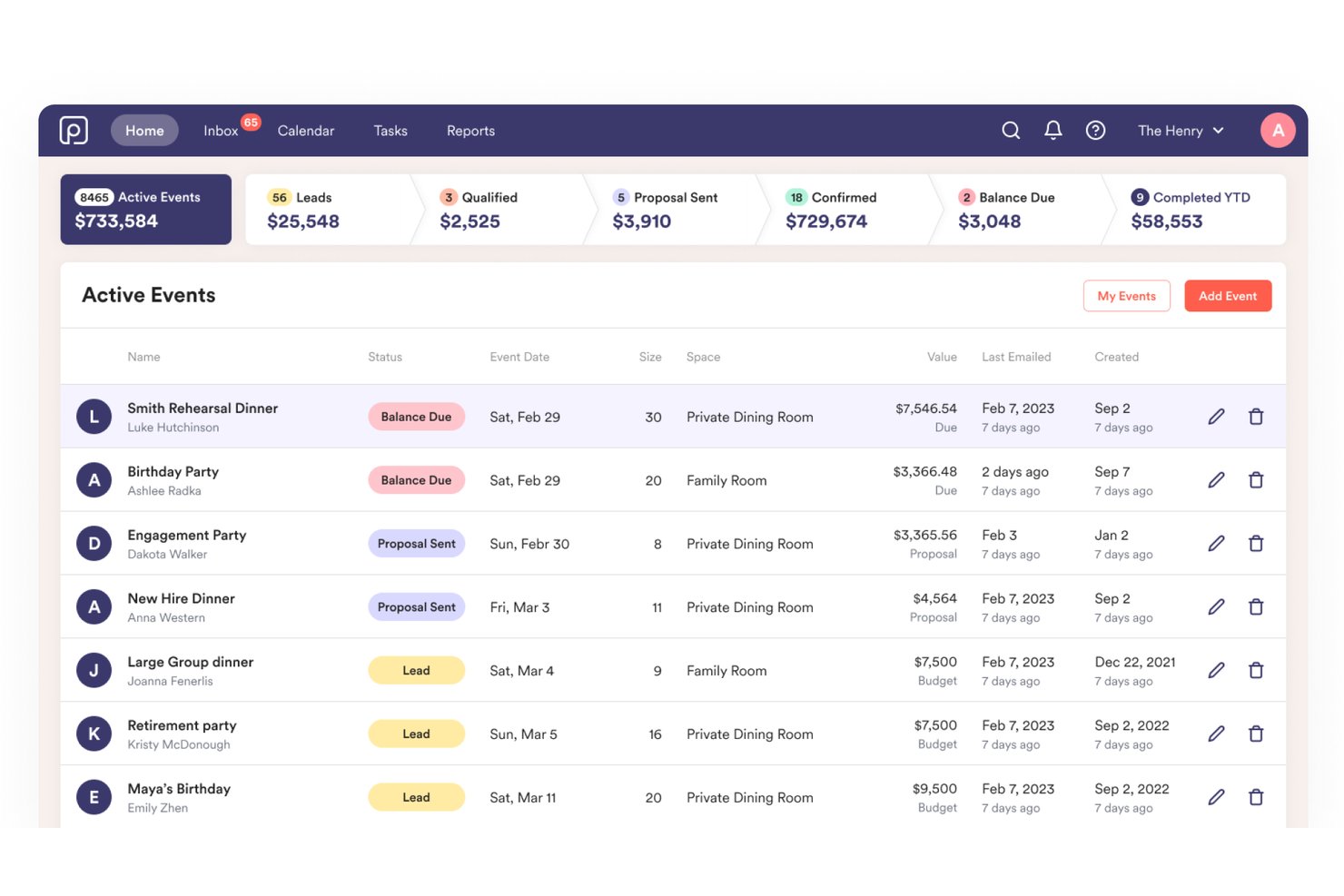
Perfect Venue is a private event management platform built for restaurants and event venues, combining a central booking calendar, automated BEO generation, proposal tools, payment processing, and guest communication in one system.
Who Is Perfect Venue Best For?
Perfect Venue is a strong fit for independent restaurants, breweries, and standalone event venues managing private dining and hosted events.
Why I Picked Perfect Venue
Perfect Venue earns its spot on my shortlist because of how it handles document generation. When a booking comes in, it auto-builds the BEO, including menus, timing, and staffing, and sends a branded proposal to the guest without me touching a template. The Staff BEO feature then distributes event details directly to kitchen and floor teams. I also like that clients can review, sign, and pay via the Guest Portal without any back-and-forth.
Perfect Venue Key Features
- Centralized event calendar: View all event bookings, inquiries, and availability across multiple venues in one calendar.
- Express Book guest booking flow: Let guests view availability, select menu items, and pay deposits directly online.
- Mobile event management app: Manage bookings, update event details, and access guest information on iOS devices.
- Team task assignment: Assign, track, and notify staff of event-related tasks and deadlines in real time.
Perfect Venue Integrations
Perfect Venue offers native integrations with Stripe, Square, HubSpot, Mailchimp, 7shifts, and Tock, and connects with Zapier. An API is available for custom integrations.
Pros and Cons
Pros:
- Staff BEO distribution keeps kitchen teams aligned
- Guest Portal enables self-service deposits and signatures
- Automated BEO generation saves significant admin time
Cons:
- No built-in floorplan or room diagramming
- Limited functionality for large hotel properties

Cvent
Best with interactive 3D event space diagramming
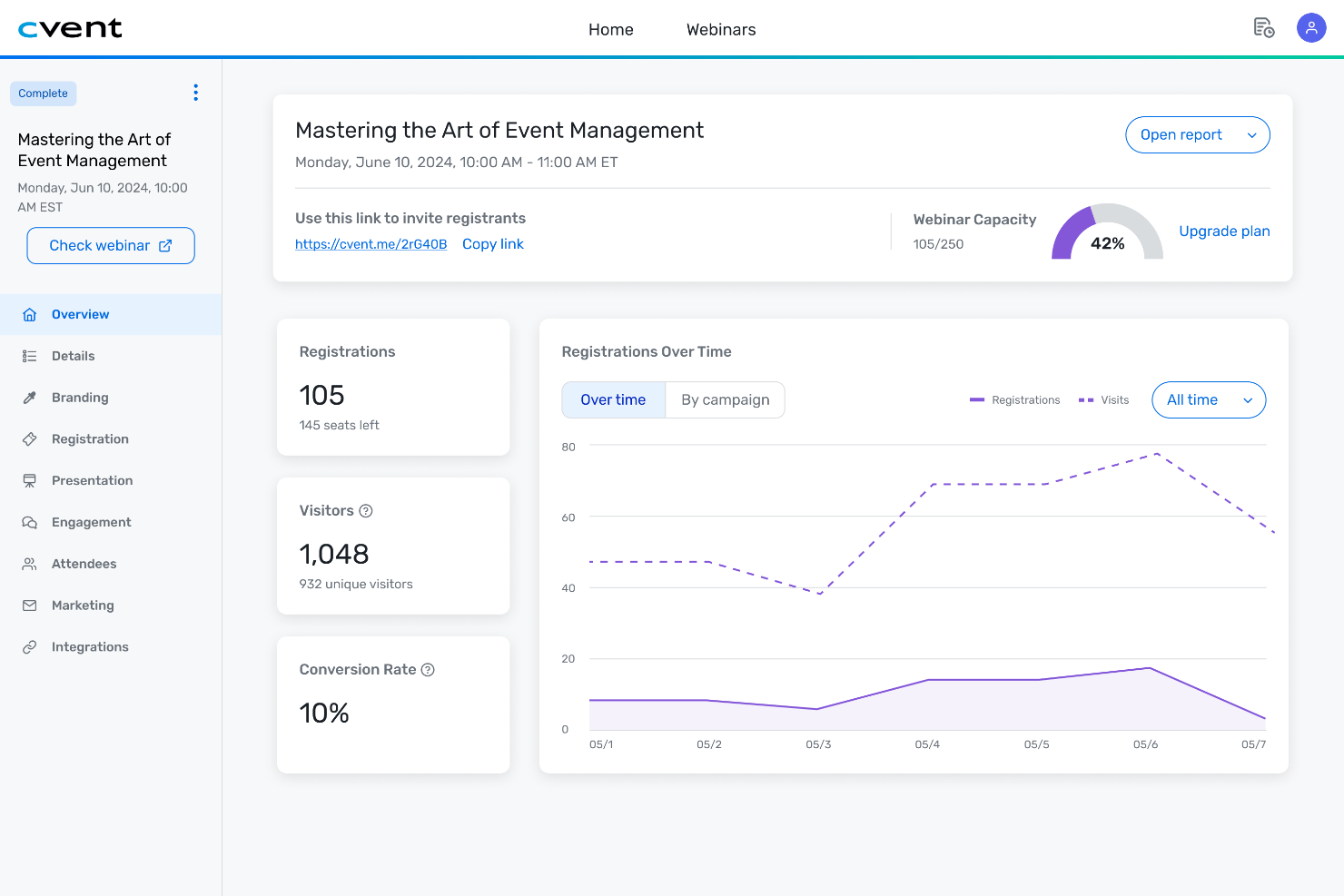
Cvent is an end-to-end event management platform covering registration, venue sourcing, group room blocks, space diagramming, attendee engagement, and post-event reporting for in-person, virtual, and hybrid events.
Who Is Cvent Best For?
Cvent suits enterprise hotels, conference centers, and large corporate event teams managing high volumes of complex, multi-space events.
Why I Picked Cvent
Cvent earns its spot on my shortlist because no other event scheduling platform comes close on 3D space visualization. I love that you can drag a BEO directly into Cvent Event Diagramming and CventIQ AI instantly extracts all the setup details, skipping manual data entry entirely. From there, the photo-realistic 3D walkthrough lets me share a link with clients so they can see the exact room configuration before a single chair moves.
Cvent Key Features
- BEO extraction with CventIQ AI: Drag and drop BEOs directly into the platform to have event details automatically extracted.
- Resource assignment and inventory tracking: Assign staff, AV, and equipment to each event with real-time inventory management.
- PMS and CRM integrations: Connects with leading hotel PMS and sales platforms to sync events, bookings, and attendee records.
- Multi-user collaboration and commenting: Enable simultaneous edits, real-time notifications, and internal or external team communication on any event workspace.
Cvent Integrations
Cvent offers native integrations with Salesforce, HubSpot, Marketo, Oracle Hospitality OPERA, Amadeus Delphi, and Oracle Sales Cloud. An API is available for custom integrations.
Pros and Cons
Pros:
- Client portals support real-time proposal approvals
- AI extracts BEO details automatically
- Industry-leading 3D floorplan diagramming tools
Cons:
- Reporting customization requires additional configuration
- Implementation takes significantly longer than competitors

Best for venue-wide shared scheduling dashboards
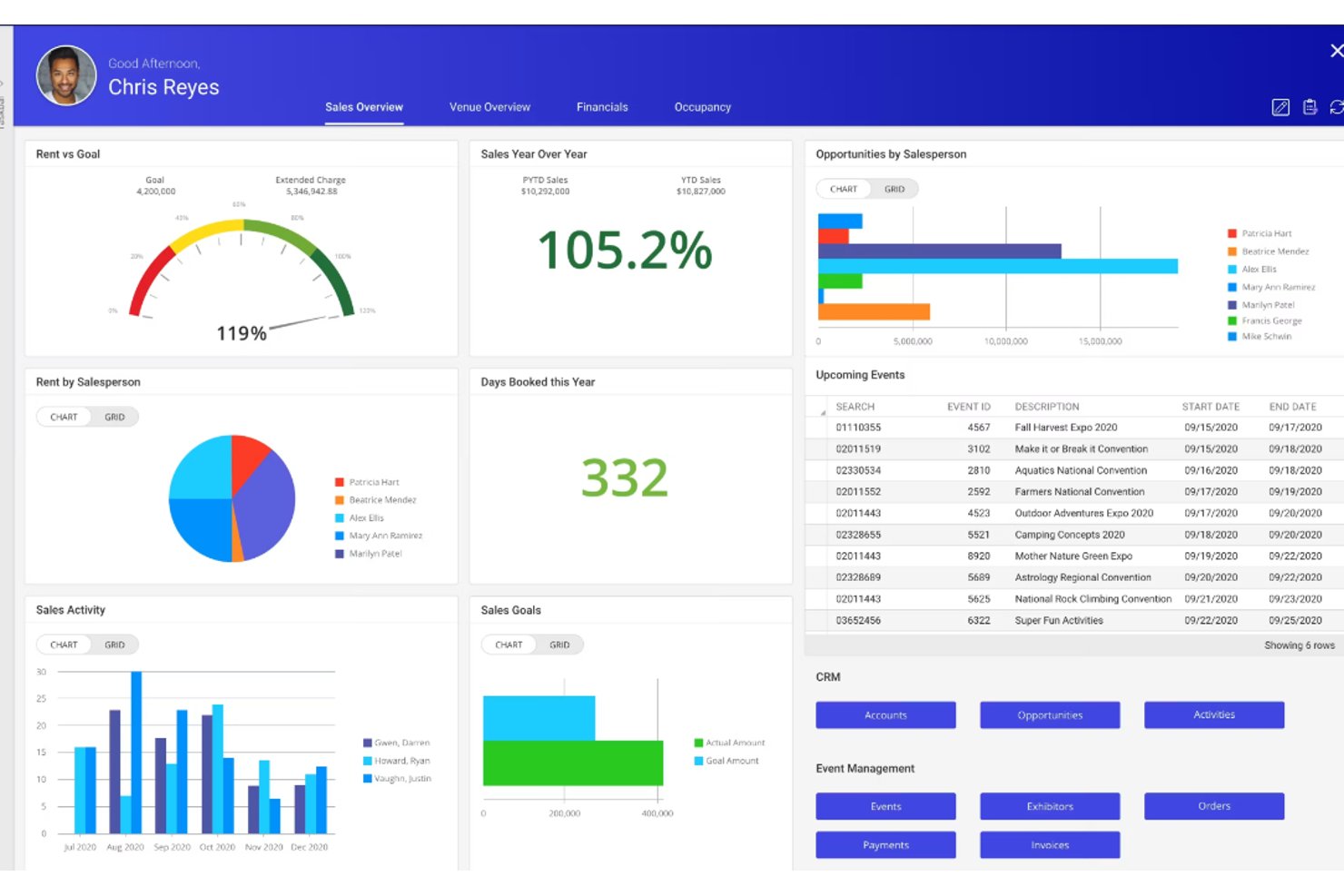
Momentus Technologies is a venue and event management platform that combines space booking, CRM, catering management, event order generation, operations scheduling, and multi-space calendar management for complex venue environments.
Who Is Momentus Technologies Best For?
It's a strong fit for conference services directors and catering sales teams managing high-volume events across convention centers, arenas, stadiums, or university campuses.
Why I Picked Momentus Technologies
Momentus Technologies earns its spot on my shortlist because no other platform gives multi-department venue teams a shared calendar view quite like this. I particularly like the Avails Calendar, which shows real-time space availability across every bookable area at once, and the custom Operations View, which keeps catering, AV, and floor crews on the same event timeline. With unlimited users on one live dashboard, I've found it eliminates the version-control chaos that typically breaks down between sales and operations teams.
Momentus Technologies Key Features
- 2D and 3D room diagramming: Design detailed floorplans and seating layouts for every event space.
- End-to-end group booking management: Handle proposals, contracts, deposits, and revenue forecasting within a single platform.
- Event order creation and editing: Generate, customize, and distribute comprehensive event orders detailing catering and setup needs.
- Open API for system integrations: Connect with other workplace tools or build custom integrations for complex hotel operations.
Momentus Technologies Integrations
Momentus Technologies offers native integrations with DocuSign, Tessitura, EventDraw, Microsoft Outlook, Mailchimp, and WeTrack. An open API is available for custom integrations. Native PMS or POS integrations are not documented.
Pros and Cons
Pros:
- Built-in 3D floorplan and room diagramming
- Detailed event orders distributed to multiple departments
- Real-time availability across all venue spaces
Cons:
- Steeper implementation curve for smaller properties
- No documented native PMS integration

Best with AI-powered event management tools
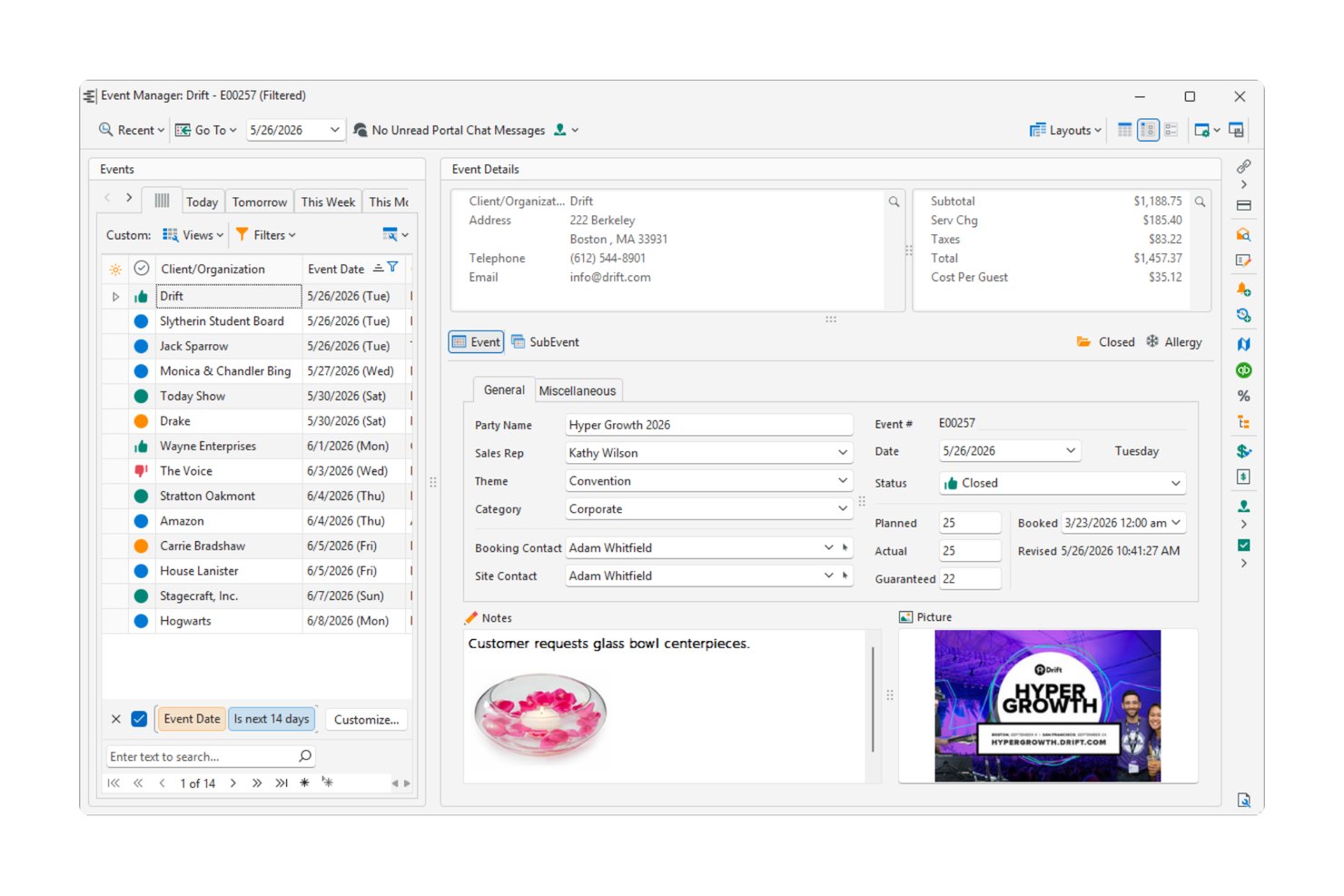
Caterease is a catering and event management platform built around wizard-driven booking, BEO generation, menu management, staffing, and AI-powered reporting through its Horizon Hub.
Who Is Caterease Best For?
Caterease is a strong fit for catering teams and hotel F&B operations managing high volumes of events with complex menu, staffing, and billing requirements.
Why I Picked Caterease
I picked Caterease as one of the best because its Horizon Hub genuinely changes how event data is accessed day-to-day. The Cai Assistant lets me pull event details, client records, and reports using plain-language queries instead of navigating nested menus. Smart Reports generates on-demand analytics without manual setup, and Industry Trends benchmarks my operation against anonymized data from across the Caterease customer base, which is context I can't easily get elsewhere.
Caterease Key Features
- Dynamic event booking wizard: Guides users through capturing all required event, client, and venue details with conditional fields for each event type.
- Customizable BEO and proposal templates: Lets you design and generate tailored Banquet Event Orders, contracts, and proposals for each client or function.
- Integrated kitchen display system: Provides a live, color-coded view of menu items and prep changes to the back-of-house team for each event.
- Multi-space calendar with grouping: Displays bookings and status across multiple function spaces, allowing quick visual review and scheduling.
Caterease Integrations
Caterease offers native integrations with QuickBooks, Outlook, Google Calendar, Mailchimp, Constant Contact, Salesforce, and DocuSign. An API is available for custom integrations.
Pros and Cons
Pros:
- Highly detailed BEO generation and customization
- Wizard-driven booking captures all event details quickly
- AI assistant queries events using plain language
Cons:
- Mobile experience lags behind desktop functionality
- Interface feels dated compared to newer platforms

Priava
Best with unlimited user access for event teams
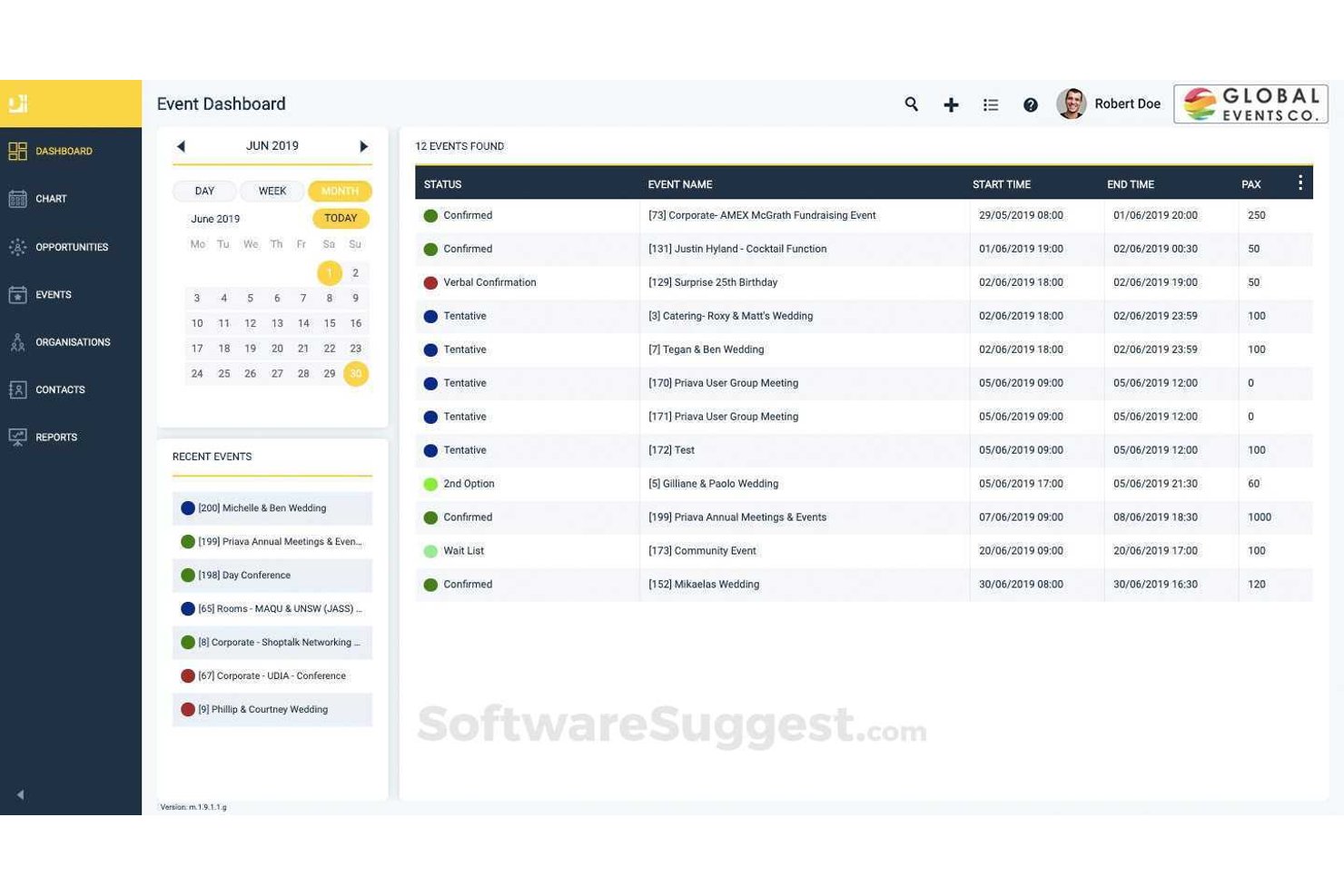
Priava is a cloud-based venue booking and event management platform covering space scheduling, catering coordination, resource assignment, CRM, and conflict detection across multiple venue types.
Who Is Priava Best For?
Priava fits mid-to-large venues—conference centres, performing arts spaces, universities, and arenas—managing high event volumes across multiple spaces simultaneously.
Why I Picked Priava
I've included Priava in my top picks because its unlimited user model means every coordinator, catering manager, and operations lead works in the same system without escalating licence costs. I particularly like how the platform handles simultaneous multi-venue scheduling with built-in conflict checks, so two team members can't accidentally double-book the same space. Shared task management and service order tracking keep every department aligned on a single event record.
Priava Key Features
- Customizable event document templates: Generate proposals, contracts, and client-facing materials tailored to each event and venue.
- Native CRM for lead and inquiry management: Track and manage event inquiries, client interactions, and sales opportunities from within the platform.
- Resource availability and services tracking: Assign AV, catering, and logistical resources to bookings while monitoring inventory and support needs.
- Detailed multi-venue reporting: Produce operational and financial reports across multiple spaces or properties for forecasting and performance tracking.
Priava Integrations
Priava offers native integrations with Salesforce, NetSuite, HubSpot, MailChimp, SAP, and Microsoft Outlook. An API is available for custom integrations.
Pros and Cons
Pros:
- Manages catering, resources, and spaces together
- Real-time conflict detection across multiple venues
- Unlimited users across the whole event team
Cons:
- Setup requires time for complex configurations
- Mobile access is limited for floor staff

Best with multi-property chain management
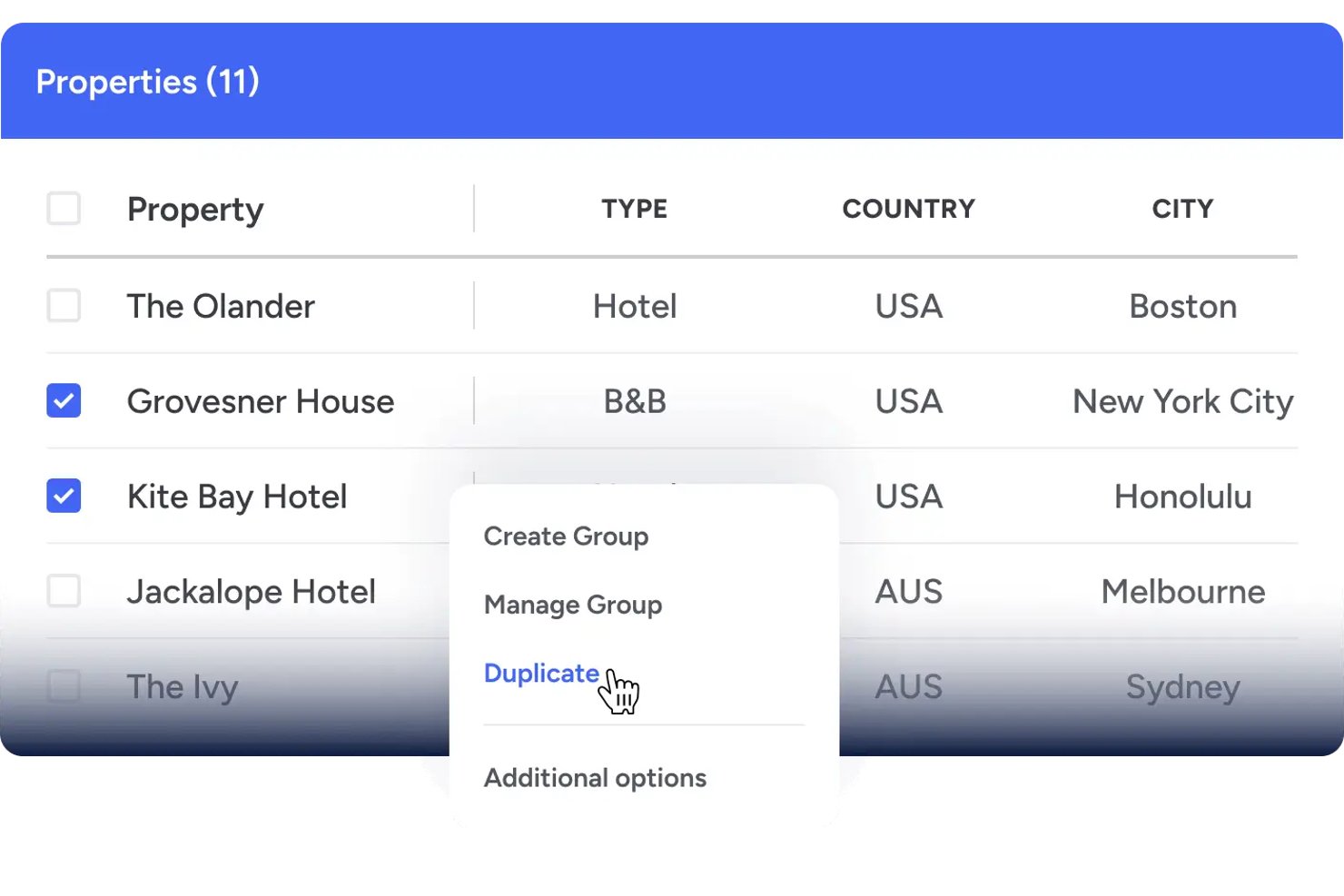
Event Temple is a hospitality-focused event scheduling and sales CRM platform that manages group bookings, catering contracts, BEOs, e-proposals, and function space calendars for hotels and venues.
Who Is Event Temple Best For?
It's a strong fit for catering and events teams at hotel chains and multi-property groups that need centralized visibility across locations.
Why I Picked Event Temple
Event Temple earns its spot on my shortlist because its Chain Management module solves something most event scheduling tools ignore: coordinating group sales and bookings across multiple properties from one place. I especially like the chain dashboard, which lets national sales teams toggle between properties and access a shared view of accounts and contacts to spot cross-selling opportunities. The multi-property roll-up reports make portfolio-level performance tracking genuinely practical.
Event Temple Key Features
- Customizable BEO templates: Lets teams create, edit, and distribute Banquet Event Orders tailored for each event.
- Integrated proposal and e-signature workflows: Generates digital proposals and contracts that clients can review and sign online.
- Visual function space calendar: Offers a drag-and-drop calendar for booking and managing multiple event spaces simultaneously.
- Opera Cloud PMS integration: Enables real-time syncing of event bookings and guest room blocks with leading property management systems.
Event Temple Integrations
Event Temple offers native integrations with Opera Cloud PMS, Salesforce, Mailchimp, Tripleseat, Duetto, For-Sight CRM, GuestRevu, and Zapier. An API is also available for custom integrations.
Pros and Cons
Pros:
- BEO generation with automated distribution workflows
- Dedicated hospitality CRM built for hotels
- Strong multi-property chain management dashboard
Cons:
- Reporting customization options are somewhat restricted
- Limited floorplan diagramming compared to competitors

Best with Salesforce-powered group sales
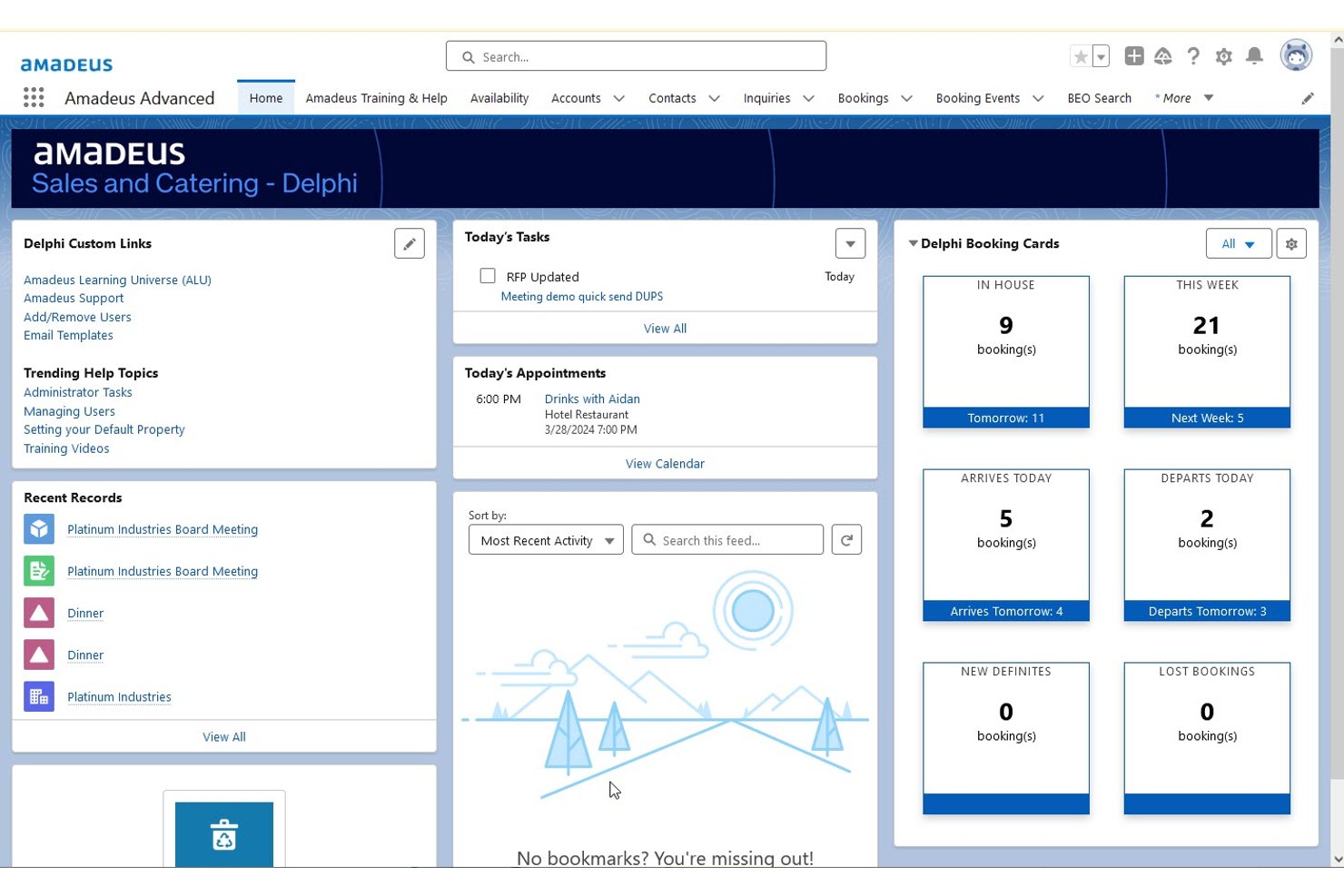
Amadeus Delphi is a hotel sales and catering management platform built on Salesforce that handles group bookings, BEO generation, function space scheduling, and catering contracts across single and multi-property portfolios.
Who Is Amadeus Delphi Best For?
Delphi is a strong fit for full-service and multi-property hotels with dedicated catering sales teams managing high volumes of group and event business.
Why I Picked Amadeus Delphi
Amadeus Delphi earns its spot on my shortlist because it's the only hotel event scheduling platform built natively on Salesforce, which means group sales pipelines, contract tracking, and client follow-ups all live in one CRM. I particularly like the 3-click proposal and contract generation, which keeps sales teams moving fast on inbound group leads. The automated BEO workflow also ties catering, setup, and staffing details directly to each booking, so nothing slips between departments.
Amadeus Delphi Key Features
- 3D floorplan diagramming: Design and visualize event space layouts to scale with interactive floorplans.
- Mobile BEO access: Give banquet, kitchen, and operations staff real-time BEO and changes access on mobile devices.
- Lead and inquiry routing: Automatically distribute meeting and group leads from major sales channels to assigned managers.
- Multi-property portfolio management: Manage shared inventory, templates, and reporting across multiple properties from one system.
Amadeus Delphi Integrations
Amadeus Delphi offers native integrations with StayNTouch PMS, IDeaS G3 RMS, Cvent, Sertifi, Canary, and MeetingPackage, and provides an API for custom integrations.
Pros and Cons
Pros:
- Supports multi-property portfolio management in one system
- Automated BEOs distributed directly to each department
- Native Salesforce CRM powers group sales pipeline
Cons:
- Interface feels dated vs. newer competitors
- Implementation takes months for large properties

Best with AI inquiry and booking automation
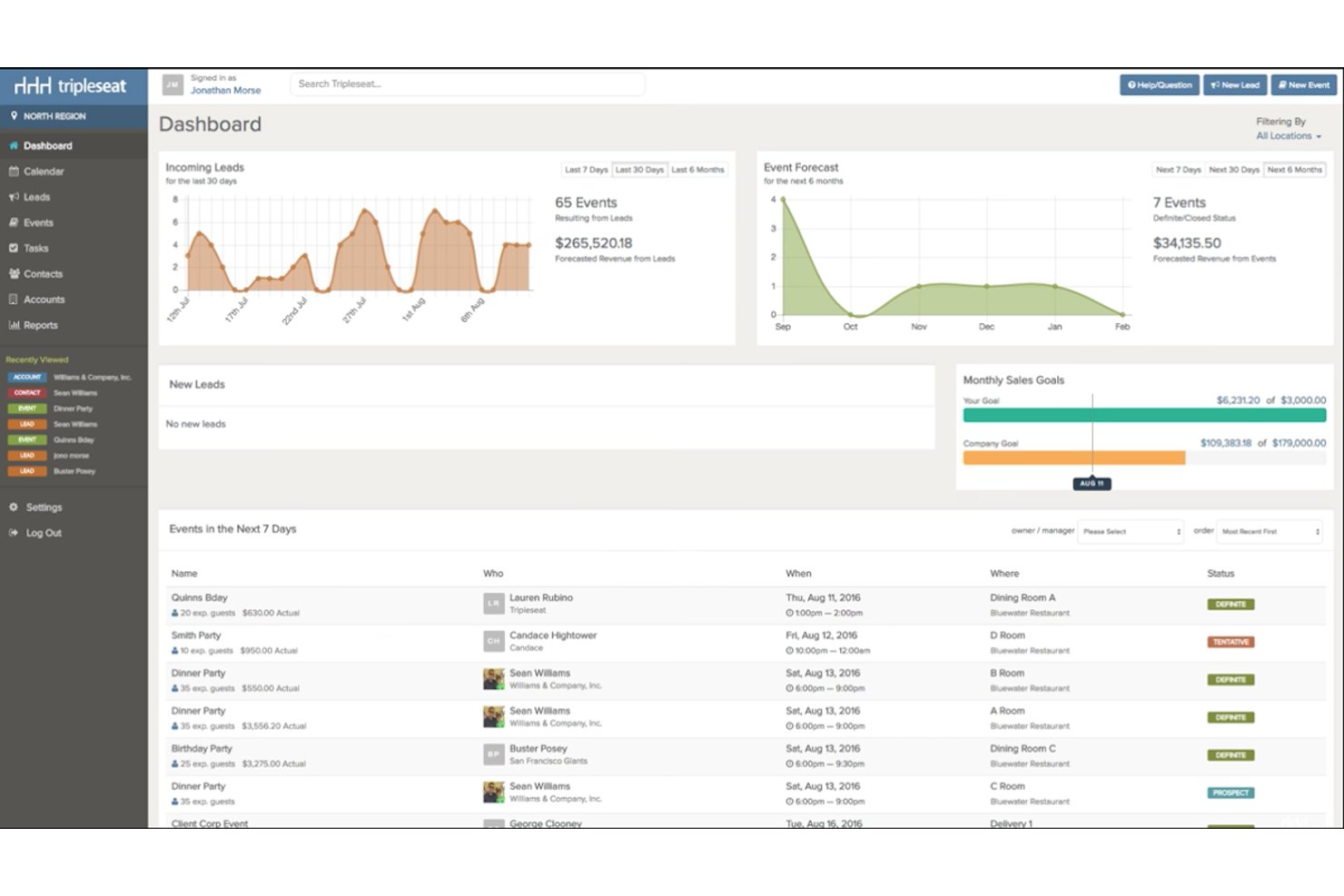
Tripleseat is a hospitality-focused event sales and management platform that handles function space booking, BEO generation, catering proposals, group contracts, and multi-venue calendar coordination for hotels, restaurants, and unique venues.
Who Is Tripleseat Best For?
Tripleseat is a strong fit for hotel event teams, catering managers, and multi-venue operators who need a purpose-built platform to manage the full event sales cycle.
Why I Picked Tripleseat
I've included Tripleseat in my top picks because Tripleseat Intelligence handles the inquiry lifecycle without manual intervention: instant auto-responses acknowledge new leads, AI drafts contracts from event details, and automated nudges trigger when a proposal sits unsigned too long. I also like Direct Book, which lets guests confirm space reservations 24/7 without a phone call. In practice, my team is converting inquiries that would otherwise stall mid-pipeline.
Tripleseat Key Features
- 2D and 3D floorplan diagramming: Design detailed event layouts with drag-and-drop tools for room setup and seating.
- Banquet event order (BEO) generation: Create, customize, and distribute BEOs outlining menus, timing, and staffing for each event.
- Native PMS and POS integrations: Connect event details with leading hotel property management and point-of-sale systems for seamless operations.
- Multi-space visual calendar: Book, block, and manage availability across multiple venues and function spaces in a centralized dashboard.
Tripleseat Integrations
Tripleseat offers native integrations with GoTab POS, OpenTable, SevenRooms, CardConnect, DoorDash for Merchants, Outlook, Google Calendar, and Prismm. An API is available for custom integrations.
Pros and Cons
Pros:
- Strong BEO creation and distribution tools
- AI automates inquiry responses and follow-ups
- Dedicated event sales pipeline built in
Cons:
- Steep setup time for multi-property configurations
- Reporting customization options are limited
iVvy
Best with instant live event space availability
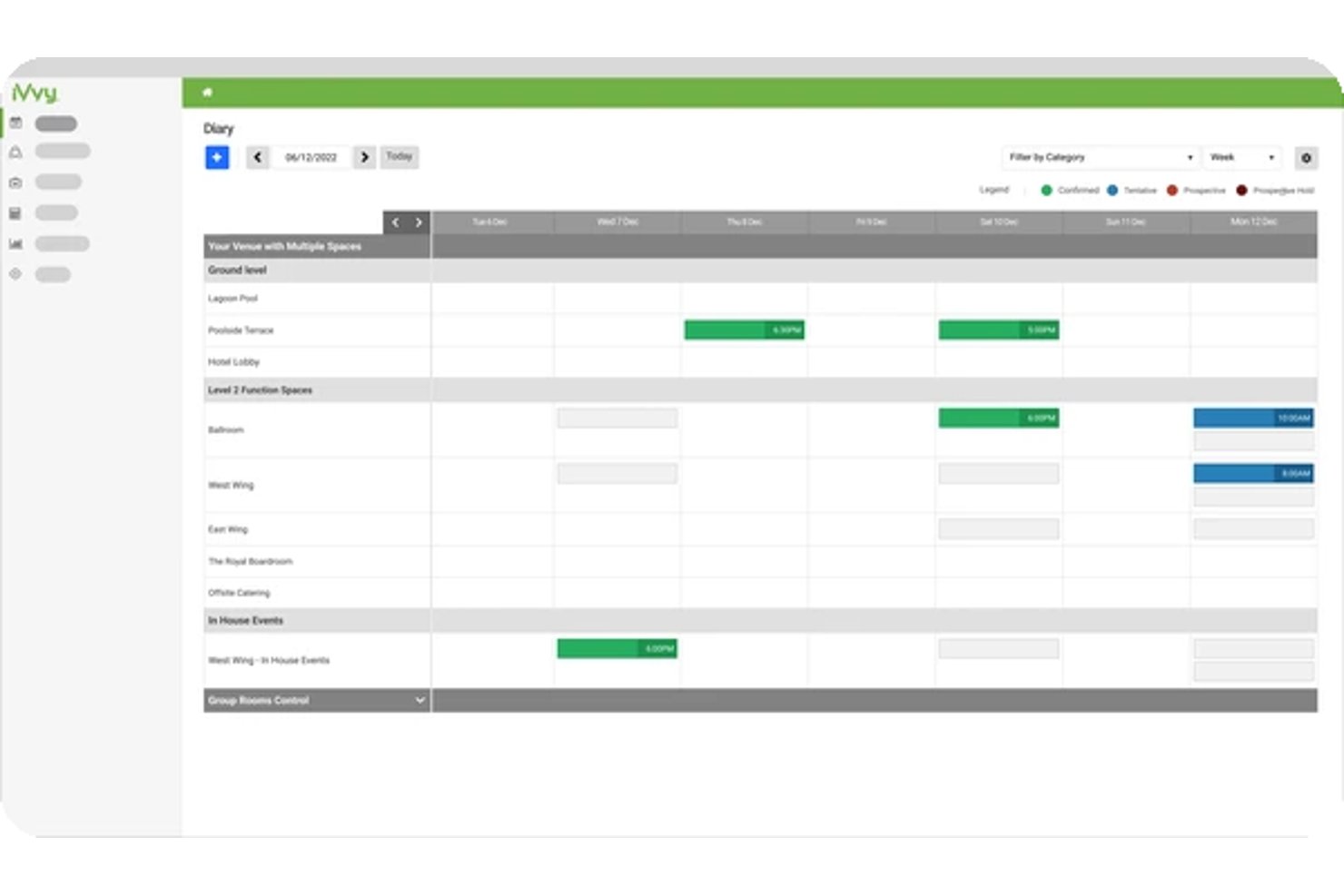
iVvy is a hotel sales and catering platform that combines function space management, BEO generation, group booking coordination, CRM, and catering contracts in one system built for hotels and event venues.
Who Is iVvy Best For?
iVvy fits catering sales and events teams at hotels, function centers, and multi-property hospitality groups managing high volumes of group and conference bookings.
Why I Picked iVvy
iVvy earns its spot on my shortlist because of how it handles live event space availability across a hotel's entire function diary. I love that the Function Diary shows quoted, tentative, and confirmed bookings for both meeting rooms and guest room blocks in a single view, making double-booking a non-issue. The Booking Engine then exposes that real-time availability directly on a hotel's website, so enquiries arrive pre-qualified against what's actually open.
iVvy Key Features
- Banquet event order (BEO) generation: Create, edit, and send detailed BEOs with menus, timelines, and staffing needs for each event.
- Revenue reporting and analytics: Access dashboards, pacing reports, and customizable templates for tracking event revenue and forecasting sales.
- CRM and lead management: Capture all enquiries, manage customer data, and track activities and communication in one system.
- Digital proposals and e-signatures: Generate branded proposals and contracts quickly, then send for client e-signature with version tracking.
iVvy Integrations
iVvy offers native integrations with Opera Cloud, Mews, StayNTouch, RMS, Agilysys, Protel Air, Jonas Chorum, Xero, MYOB, NetSuite, Infor, Salesforce, Cvent, IdeaS, and SevenRooms. An API is available for custom integrations.
Pros and Cons
Pros:
- Built specifically for hotel events and catering
- Live availability displays directly on hotel websites
- Real-time function diary prevents double-bookings
Cons:
- Reporting dashboards offer limited customization options
- Initial setup requires significant configuration time

Planning Pod
Best with integrated proposals and payments
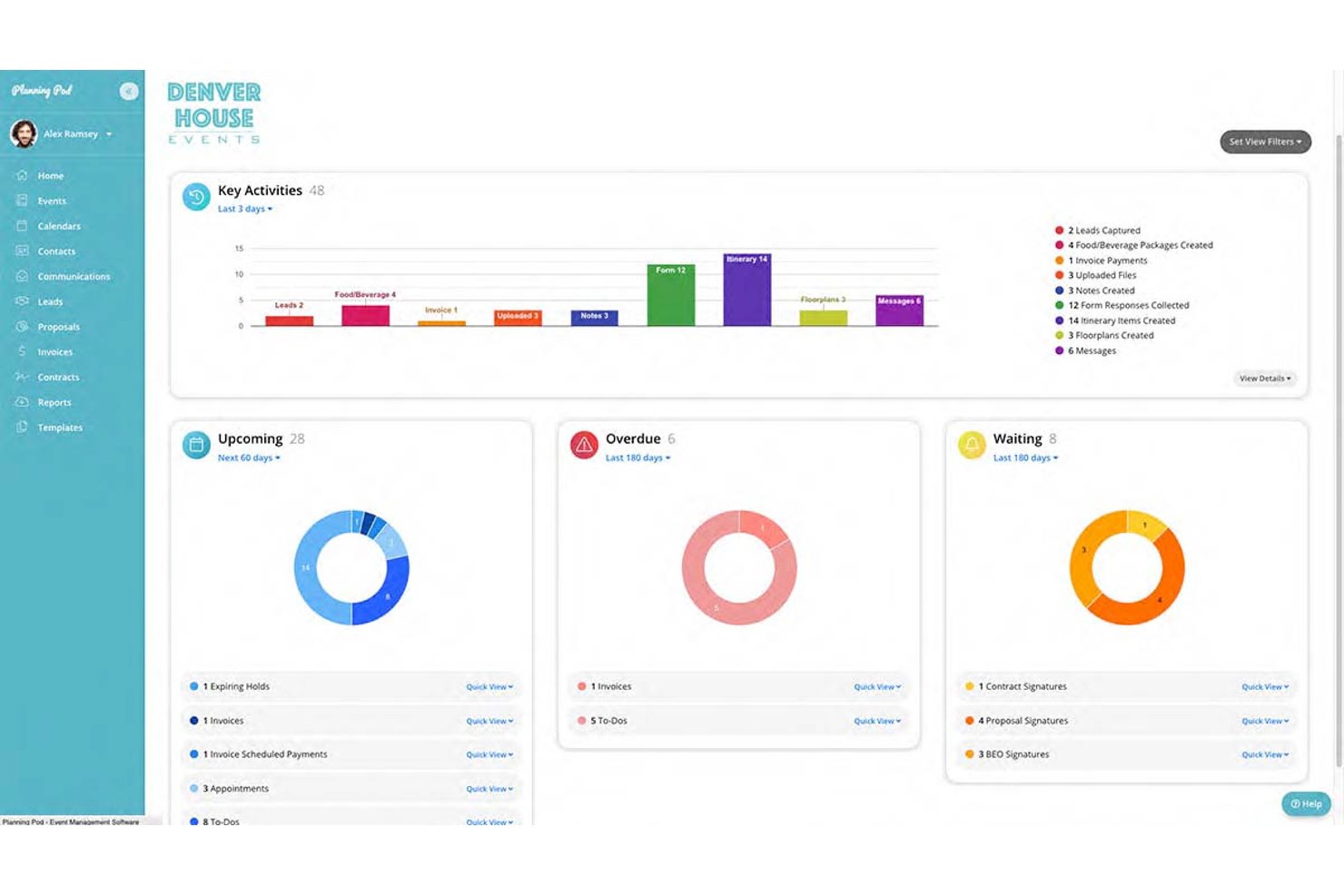
Planning Pod is a venue and event management platform built for hotels, banquet halls, and event centers, combining function space booking, BEO generation, F&B management, catering proposals, and client communication tools in one system.
Who Is Planning Pod Best For?
Planning Pod suits independent hotels, boutique venues, and standalone event centers that manage their own events, catering, and client billing without a full PMS ecosystem.
Why I Picked Planning Pod
Planning Pod earns its spot on my shortlist because of how tightly it connects proposals, contracts, and payments to a single booking record. I like that once a client signs a proposal via eSignature, the platform carries those details straight into an invoice with installment schedules already built in. My team can then collect deposits through branded client portals, with credit card and ACH processed natively through Adyen, without switching tools.
Planning Pod Key Features
- Floor plan diagramming: Build and edit scaled layouts for event spaces, including tables, chairs, and staging.
- BEO generation and distribution: Create customizable banquet event orders for FOH, kitchen, and delivery teams.
- Task manager with staff assignment: Assign and track tasks by team member across event workflows.
- Lead capture webforms: Collect event inquiries from your venue website directly into the sales pipeline.
Planning Pod Integrations
Planning Pod offers native integrations with QuickBooks Online, WeddingWire, The Knot, Google Calendar, Apple Calendar, and Microsoft Outlook Calendar. It also connects with Zapier and provides an API for custom integrations.
Pros and Cons
Pros:
- Clients can self-serve via branded portal
- Built-in floor plan diagramming for events
- Proposals, contracts, and payments flow automatically
Cons:
- Not built for large multi-property portfolios
- Reporting lacks deep revenue and yield analytics
Other Event Scheduling Software
- Swoogo
For flexible event registration workflows
- Eventbrite
For maximizing public event discoverability
- HoneyBook
For client portal collaboration and payments
- Skedda
For advanced booking rules and automation
- Accelevents
With agenda and speaker management at scale


How I Evaluate Event Scheduling Software
I evaluate event scheduling software in two layers: the baseline—event scheduling, venue and resource management, booking workflows, and conflict prevention—and the differentiators that set the strongest hospitality and venue-focused options apart.
Core Functionality (Table Stakes For This List)
When I'm selecting tools for my list, I rank each one on a scale from 0 (does not offer the functionality) to 5 (excels in this area) for each core functionality listed below. Then, I calculate the tool's total score into a percentage. Each tool needs to achieve a minimum total score of 65% to be considered for inclusion.
- Event & Function Space Scheduling: I look for a centralized calendar, function diary, or booking grid that lets teams schedule meeting rooms, ballrooms, event spaces, and other bookable areas while checking availability at a glance.
- Booking & Sales Management: I evaluate how well the platform handles the process from an initial inquiry or RFP through proposals, contracts, confirmations, and payments.
- Conflict Detection: The software should help prevent overlapping bookings by showing space and resource availability and flagging potential scheduling conflicts before an event is confirmed.
- Event Resource Management: I check whether teams can assign equipment, catering requirements, room setups, staff, and other resources to individual events and keep those requirements connected to the booking.
- Event Documents & Communication: I look for tools that help teams create and share proposals, contracts, event summaries, BEOs, run sheets, or other operational documents while keeping clients and internal teams updated.
- Integrations: The platform should connect with relevant hospitality or business systems, such as PMS, POS, CRM, accounting, payment, calendar, or marketing tools, so teams can reduce duplicate data entry.
Once I have a list of tools that meet this criteria, I consider what sets each platform apart.
Differentiating Factors (What Sets Vendors Apart)
Here's how I compare and contrast different vendors:
Standout Features
I look closely at hospitality-specific capabilities such as BEO generation, group room block management, catering workflows, and function space diagramming. Tools that provide 2D or 3D floor plans can help sales teams create accurate room layouts and share them with clients before an event is finalized. Client-facing portals are another differentiator because organizers can review proposals, sign contracts, make payments, and communicate changes without relying on long email threads. Mobile access also matters for operational teams that need to check schedules, BEOs, room setups, or last-minute event changes while working around the property.
Beyond Features
Integration depth is especially important for hotels and hospitality venues. I check whether the platform connects with property management systems such as Oracle OPERA, Mews, Cloudbeds, or Stayntouch, as well as POS, CRM, accounting, and payment platforms where relevant. For hotel-focused tools, reliable PMS connectivity can help keep group room blocks, event details, and property operations aligned.
Property type and operational scale also influence my evaluation. A full-service resort managing multiple ballrooms, catering teams, and group room blocks has different requirements than a restaurant handling private dining events or a boutique hotel with one meeting space. I also consider implementation requirements, ease of use, available integrations, and pricing structure, particularly whether pricing is based on users, properties, modules, or overall event volume.
How to Choose Event Scheduling Software
It’s easy to get bogged down in long feature lists and complex pricing structures. To help you stay focused as you work through your unique software selection process, here’s a checklist of factors to keep in mind:
| Factor | What to Consider |
| Scalability | Will the software support more events, function spaces, properties, and users as your operation grows? Consider whether it can handle everything from a single meeting room to multi-property event operations. |
| Integrations | Does it connect with the systems you already use? Look for integrations with your PMS, POS, CRM, accounting software, payment tools, and calendars to reduce manual data entry. |
| Customizability | Can you tailor proposals, BEOs, contracts, event templates, booking workflows, and reports to match how your property operates? |
| Ease of use | Is it straightforward for sales, catering, banquet, and operations teams to use? Look for intuitive calendars, clear navigation, and simple event updates to reduce training time. |
| Implementation and onboarding | How quickly can your team get started? Consider data migration, PMS setup, workflow configuration, training resources, and vendor-led onboarding support. |
| Cost | Does the pricing model fit your property? Compare per-user, per-property, and module-based pricing, and account for implementation costs, integrations, and optional add-ons. |
| Security safeguards | How does the platform protect guest, payment, and event data? Look for access controls, encryption, secure payment handling, and relevant compliance measures. |
| Support availability | Can you get help when an event issue occurs? Consider support hours, response times, onboarding assistance, and available channels such as phone, email, and chat. |
What Is Event Scheduling Software?
Event scheduling software helps hotels, venues, and hospitality teams manage event bookings, function spaces, group business, catering requirements, and event resources from one system. Hotel managers, sales teams, catering managers, and event coordinators use these platforms to organize availability, prevent double bookings, create event documents, and coordinate departments.
Many hospitality-focused platforms go beyond basic calendar scheduling by supporting BEOs, proposals, contracts, room blocks, deposits, floor plans, and integrations with property management and point-of-sale systems. This gives sales and operations teams a more centralized way to manage events from the initial inquiry through execution.
Features of Event Scheduling Software
When selecting event scheduling software, keep an eye out for the following key features:
- Function space management: Lets you view and schedule ballrooms, meeting rooms, private dining spaces, and other event areas from a centralized calendar.
- BEO generation: Helps catering and banquet teams create and distribute Banquet Event Orders containing menus, setup requirements, timelines, and operational instructions.
- Group booking management: Supports group inquiries, proposals, contracts, room blocks, deposits, and other steps in the event sales process.
- Conflict detection: Identifies overlapping space, equipment, or resource bookings before they create operational problems.
- Proposals and contracts: Lets sales teams create branded proposals, agreements, and contracts and collect electronic signatures.
- Resource scheduling: Helps assign staff, AV equipment, furniture, catering requirements, and other resources to specific events.
- Floor plan and diagramming tools: Allows teams to create room layouts and seating plans for meetings, weddings, conferences, and banquets.
- PMS and POS integrations: Connects event information with property management and point-of-sale systems to reduce duplicate data entry.
- Client portals: Gives event organizers a place to review documents, make payments, submit information, and communicate with the venue.
- Analytics and reporting: Tracks event revenue, conversion rates, space utilization, group business, and other performance metrics.
Benefits of Event Scheduling Software
Implementing event scheduling software provides several benefits for your team and your business. Here are a few you can look forward to:
- Reduced booking conflicts: Real-time function space availability makes it easier to avoid double bookings and overlapping resource assignments.
- Better departmental coordination: Centralized event details give sales, catering, banquet, kitchen, and front-office teams access to the same information.
- Faster event sales: Digital proposals, contracts, payment collection, and automated workflows can shorten the time between inquiry and confirmed booking.
- More accurate event execution: BEOs, floor plans, timelines, and resource schedules help teams understand exactly what each event requires.
- Less manual data entry: PMS, POS, CRM, accounting, and payment integrations reduce the need to re-enter event and guest information across systems.
- Improved guest experience: Faster communication, client portals, and organized event details make it easier to respond to planners and accommodate changes.
- Better revenue visibility: Reporting tools help you understand event revenue, conversion rates, function space utilization, and group business performance.
Costs & Pricing of Event Scheduling Software
Selecting event scheduling software requires an understanding of the various pricing models and plans available. Costs vary based on property size, number of users, function spaces, integrations, modules, and implementation requirements. Many hospitality-focused vendors use custom pricing rather than publishing fixed monthly rates.
The table below summarizes common pricing approaches and the features typically included in event scheduling software solutions:
Plan Comparison Table for Event Scheduling Software
| Plan Type | Typical Pricing | Common Features |
| Entry-Level Plan | Around $50-$150/month | Event calendar, basic bookings, contact management, proposals, and simple reporting |
| Professional Plan | Around $150-$500/month | BEOs, contracts, payments, resource scheduling, automation, and advanced reporting |
| Property-Based Plan | Custom pricing | Function space management, group sales, catering workflows, PMS integrations, and multi-user access |
| Enterprise Plan | Custom pricing | Multi-property management, advanced integrations, centralized reporting, APIs, dedicated support, and custom workflows |
Most Common Questions Regarding Event Scheduling Software (FAQ's)
How do I integrate event scheduling software with my existing hotel systems?
Most event scheduling platforms connect with systems such as property management software, point-of-sale systems, CRMs, accounting tools, payment platforms, and calendars. Before choosing a tool, check whether it offers native integrations with your existing PMS or POS. If a direct integration is unavailable, some platforms also support APIs or third-party connectors.
Can event scheduling software handle recurring events?
Yes, many event scheduling tools support recurring bookings for meetings, conferences, training sessions, and other repeat events. Depending on the platform, you may be able to set the recurrence frequency, reserve the same function space, assign resources, and copy event details from one booking to the next.
How customizable is event scheduling software?
Customizability varies by platform. Some tools let you tailor proposals, contracts, BEOs, booking forms, event templates, user permissions, workflows, and reports. Hotel and venue teams should look for software that can reflect their existing sales, catering, and event operations rather than forcing them into a rigid workflow.
Is there support available for onboarding new users?
Many providers offer onboarding assistance through training sessions, tutorials, knowledge bases, webinars, and customer support. More advanced hospitality platforms may also provide implementation specialists who help configure function spaces, integrations, templates, user permissions, and workflows before launch.
How do I assess the cost-effectiveness of event scheduling software?
Start by comparing the software’s total cost with the operational value it provides. Consider subscription fees, implementation costs, integrations, add-ons, and whether pricing is based on users, properties, or modules. Then look at whether the platform can reduce double bookings, manual data entry, administrative work, and event coordination time while helping your team manage more group and event business.